Wayground logo

Free Printable Worksheets

Font size

S
M
L
XL
Worksheets

Weather: Air Masses and Fronts

Total questions: 56

Worksheet time: 34mins

Name
Class
Date
1.
The boundary  between two air masses is known as:
a)
front
b)
storm
c)
climate
d)
flood
2.
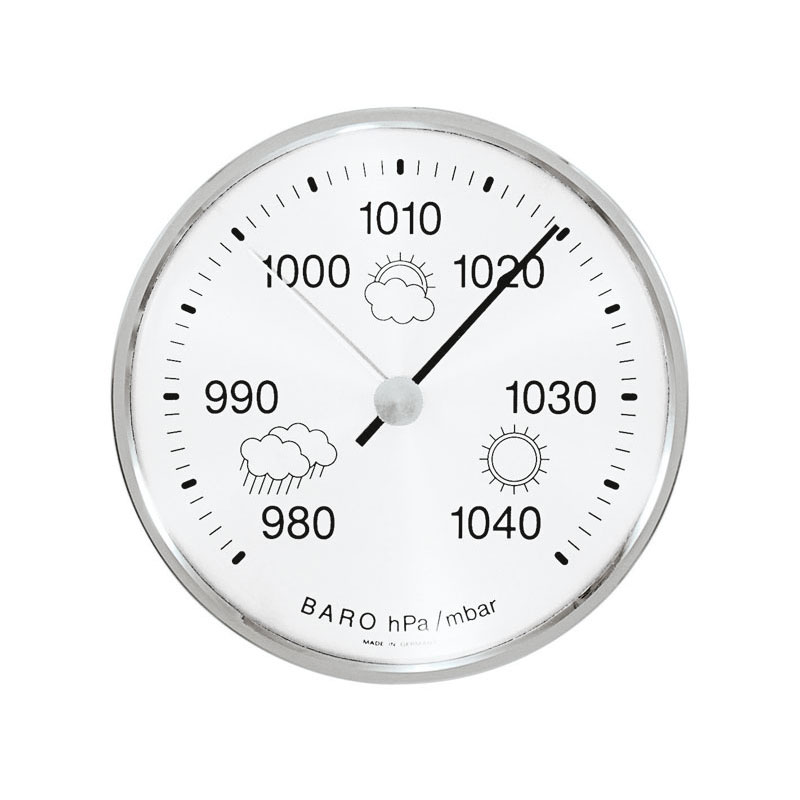
Which type of pressure system is pictured?
a)
high
b)
low
c)
medium
d)
none
3.
What type of weather would you expect with the pressure system pictured?
a)
clear
b)
cloudy
c)
severe storms
d)
hot
4.
Which type of pressure system is pictured?
a)
high
b)
low
c)
medium
d)
none
5.
What type of weather would you expect from the pressure system pictured?
a)
clear
b)
cloudy
c)
hot
d)
stormy
6.
Cold air traveling south from Canada is:
a)
continental tropical
b)
continental polar
c)
maritime tropical
d)
maritime polar
7.
Warm air moving upwards from the Gulf of Mexico is:
a)
continental tropical
b)
continental polar
c)
maritime tropical
d)
maritime polar
8.

Which is a warm air mass with low humidity?

a)
continental tropical
b)
continental polar
c)
maritime tropical
d)
maritime polar
9.
Cold air mass that is carrying water is:
a)
continental tropical
b)
continental polar
c)
maritime tropical
d)
maritime polar
10.
In _________ pressure systems, air sinks:
a)
high
b)
low
c)
medium
d)
none
11.
In _______ pressure systems, air rises
a)
high
b)
low
c)
medium
d)
none
12.
This type of front can bring strong storms
a)
cold
b)
warm
c)
stationary
d)
occluded
13.
This type of front results in the same weather for several days
a)
warm
b)
cold
c)
stationary
d)
occluded
14.
These two conditions describe an air mass.
a)
temperature and precipitation
b)
wind speed and heavy rain
c)
temperature and humidity
d)
direction and air pressure
15.
Where are colder air masses usually formed?
a)
over oceans
b)
over the North or South poles
c)
over the equator
d)
out in space
16.
This climate zone is located directly north and directly south of the equator.
a)
polar climate 
b)
temperate climate
c)
tropical climate
d)
thermosphere
17.
What is the edge of a cold air mass moving into a mass of warmer air called?
a)
cold front
b)
warm front
c)
thunderstorm
d)
cloud
18.
Based on the weather map, which city will most likely experience increasing temperatures during the next 24 hours? 
a)
Denver, because it is raining there
b)
Minneapolis, because a cold front is approaching
c)
Atlanta, because a warm front is approaching
d)
Houston, because it is in a high pressure area
19.
If a cold front is currently passing through the city of Denver, what type of weather conditions is Denver most likely experiencing?
a)
warm, foggy weather
b)
cooler, dry weather
c)
hot, dry weather
d)
thunderstorms 
20.
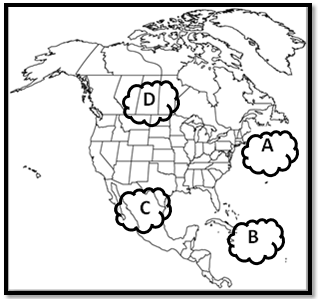
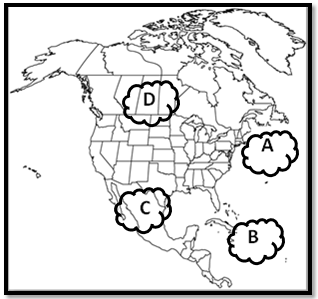
Which location is most likely experiencing the greatest wind speeds? 
a)
Location A
b)
Location B
c)
Location C
d)
Location D
21.
Which of the following best describes the weather conditions of location B? 
a)
cloudy
b)
windy
c)
clear skies
d)
hurricane
22.
When isobars are closer together, what does that signify? 
a)
stronger winds
b)
an area of no wind
c)
clear skies
d)
clouds
23.
Based on the information provided in the weather map, which city shown most recently saw a drop in temperature? 
a)
Boise
b)
Denver
c)
Louisville
d)
Shreveport
24.
A front is moving across Oklahoma and Texas bringing cold air behind it. Which of the following labels could be used to label the air behind the front? 
a)
III only
b)
I and II
c)
II and IV
d)
I and III
25.
A front is moving across Oklahoma and Texas bringing warm humid air behind it. Which of the following labels should be used to mark this front on a map? 
a)
IV only
b)
II and III
c)
II only
d)
I and III
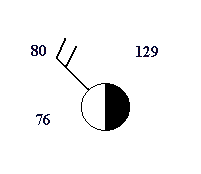
26.

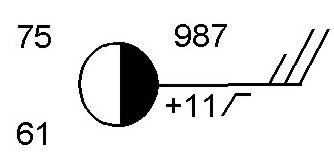
What is the temperature for the following station model?

a)

4 ºF

b)

76 ºF

c)

80 ºF

d)

129 ºF

27.

What is the dewpoint for the following station model?

a)

10 ºF

b)

23 ºF

c)

65 ºF

d)

75 ºF

28.

What is the wind direction for the following station model?

a)

north

b)

east

c)

northwest

d)

northeast

29.

What is the wind speed for the following station model?

a)

10 knots

b)

15 knots

c)

20 knots

d)

25 knots

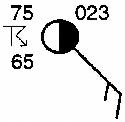
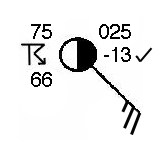
30.

What is the station model code for a barometric pressure of 1019.5 mb?

a)

101

b)

195

c)

019

d)

119

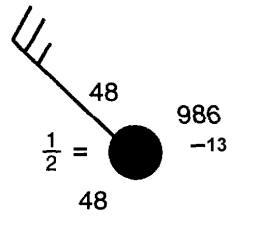
31.

What is the barometric pressure for the following station model?

a)

987 mb

b)

998.7 mb

c)

1098.7 mb

d)

1098 mb

32.

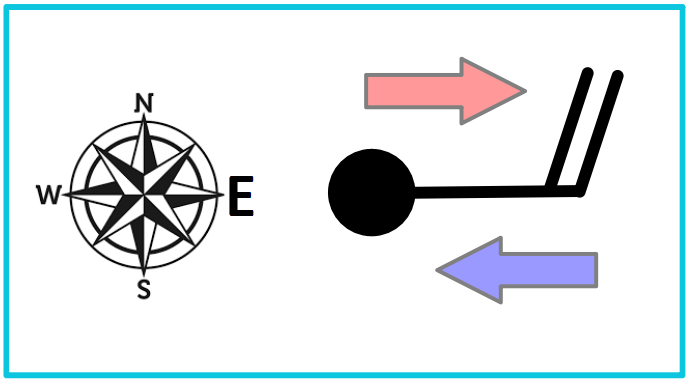
Based on the picture, what direction is the wind blowing?

a)

To the east

b)

From the east

c)

To the South

d)

To the North

33.

Which way is the wind blowing in this scenario?

a)

from the north

b)

toward the north

c)

from the west

d)

toward the west

34.

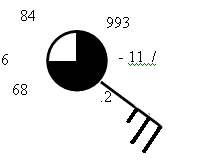
What is the amount of cloud cover for the following station model?

a)

25%

b)

50%

c)

75%

d)

100%

35.

An air mass is

a)

a large body of air with about the same temperature and humidity throughout

b)

the amount of moisture in the air

c)

a place where two different air masses meet

d)

a cold air mass that bumps against a warm air mass

36.

When air is cold and sinks what kind of pressure system is it?

a)

low pressure system

b)

high pressure system

37.

In which kind of pressure system does warmer air rise bringing wet, cloudy weather?

a)

High pressure system

b)

Low pressure system

38.
How do we name air masses?
a)
Water and temperature
b)
Air pressure
c)
Humidity and temperature
d)
Cold and warm
39.
How do we characterize an air mass that forms over the ocean?
a)
Dry
b)
Wet
c)
Cold
d)
Warm
40.
How do we characterize an air mass that forms over land?
a)
Dry
b)
Wet
c)
Cold
d)
Warm
41.
How do we characterize an air mass that forms over near the equator?
a)
Dry
b)
Wet
c)
Cold
d)
Warm
42.
How do we characterize an air mass that forms near the poles?
a)
Dry
b)
Wet
c)
Warm
d)
Cold
43.
What types of air masses form over oceans?
a)
Maritime
b)
Continental
c)
Polar
d)
Tropical
44.
What types of air masses form over land?
a)
Maritime
b)
Continental
c)
Polar
d)
Tropical
45.
What types of air masses would be colder?
a)
Maritime
b)
Continental
c)
Polar
d)
Tropical
46.
What types of air masses would be warmer?
a)
Maritime
b)
Continental
c)
Polar
d)
Tropical
47.

What's the humidity and temperature of a continental tropical (cT) air mass?

a)

Wet and cold

b)

Dry and warm

c)

Wet and warm

d)

Dry and cold

48.

What's the humidity and temperature of a maritime tropical (mT) air mass?

a)

Wet and cold

b)

Dry and warm

c)

Wet and warm

d)

Dry and cold

49.

Which type of air would you find at air mass D?

a)

mT

b)

mP

c)

cP

d)

cT

50.

Which type of air would you find at air mass C?

a)

mT

b)

mP

c)

cT

d)

cP

51.

If enough heat is removed from a liquid, it will become a ____________.

a)

solid

b)

gas

c)

tree

d)

cloud

52.

The process of a liquid turning into a solid is called ________.

a)

boiling

b)

condensation

c)

melting

d)

freezing

53.

_____________ is when a gas turns into a liquid.

a)

freezing

b)

condensation

c)

melting

d)

evaporation

54.
Can result from adding or removing thermal energy
a)
explosion
b)
change of conservation
c)
change of state of matter
d)
Change of Newton's law
55.
Gas becomes solid without first becoming liquid
a)
sublimation
b)
deposition
c)
vaporization
d)
evaporation
56.
Solid becomes gas without first changing to liquid
a)
deposition
b)
sublimation
c)
evaporation
d)
condensation