
 Worksheets
Dunes/ Glaciers Review
Total questions: 61
Worksheet time: 38mins
Name
Class
Date
1.
What is necessary for sand dunes to form?
a)
a loose sand and strong wind
b)
pressure in the Earth
c)
ice glaciers
d)
Gravity
2.
If students used a fan to blow sand and the sand piled up, what natural process is being modeled?
a)
the formation of sand dunes
b)
Glaciers
c)
Moriane
d)
Sandstone
3.
What is the steep side of a dune called?
a)
leaward
b)
slip
c)
slope
d)
saltation
4.
Which way do sand dunes move?
a)
up & down
b)
to the west
c)
toward the sea
d)
in the direction of the wind
5.
What is it called when sand moves by jumps and bounces?
a)
sediment
b)
erosion
c)
saltation
d)
slip face
6.
When wind creates a sand dune, the sheltered side of the dune
a)
has no incline
b)
has the same incline as the windward side
c)
is steeper than the windward side
d)
has a more gently sloping angle than the windward side
7.
Longitudinal dunes the longest kind of dunes
a)
true
b)
false
8.

What type of dune is this?
a)
Barchan dune
b)
Longitudinal dune
c)
Parabolic dune
d)
Transverse dune
9.

What type of dune is this?
a)
Barchan dune
b)
Longitudinal dune
c)
Parabolic dune
d)
Transverse dune
10.

What type of dune is this?
a)
Barchan dune
b)
Longitudinal dune
c)
Parabolic dune
d)
Transverse dune
11.

What type of dune is this?
a)
Barchan dune
b)
Longitudinal dune
c)
Parabolic dune
d)
Transverse dune
12.
An __________ dune is constantly exposed to wind without vegetation and is in constant motion.
a)
Active Dune
b)
Inactive Dune
c)
Parabolic Dune
d)
Transverse dune
13.
An _____________ dune is protected from wind by dense vegetation.
a)
Active Dune
b)
Inactive Dune
c)
Transverse Dune
d)
Buchan Dune
14.
An inactive dune can become an active dune by _____________.
a)
Stronger winds
b)
Change in climate
c)
Loss of vegetation
d)
Heavy rain
15.
Threats to dunes include ______________.
a)
Natural events like fire and animal paths
b)
Unnatural events like overuse, off-road vehicles, pedestrians.
c)
Loss of vegetation
d)
All of these answers are correct
16.
The main minerals that make up Michigan's sand are ________.
a)
Calcite, Feldspar, Halite, Garnet
b)
Feldspar, Garnet, Magnetite, Quartz
c)
Gypsum, Fluorite
d)
Calcite, Feldspar, Garnet
17.
A ____________ dune occurs on the top of a cliff or bluff.
a)
Barchan Dune
b)
Parabolic Dune
c)
Transverse dune
d)
Longitudinal Dune
18.
A ____________ dune is a long, crescent-shaped dune, whose base forms a parabola, with tapering arms that face windward.
a)
Barchan Dune
b)
Parabolic Dune
c)
Transverse dune
d)
Longitudinal Dune
19.
A ____________ dune have parallel sand ridges that are very long and straight.
a)
Barchan Dune
b)
Parabolic Dune
c)
Transverse dune
d)
Longitudinal Dune
20.
A ____________ dune are large asymmetrical dunes that form right angles facing toward the wind.
a)
Barchan Dune
b)
Parabolic Dune
c)
Transverse dune
d)
Longitudinal Dune
21.
Grass limit wind erosion by __________.
a)
Creating a natural barrier that decreases the impact of wind erosion
b)
Entraps sand allowing sand to accumlate vertically to create high coastal dunes
c)
Both answers are correct
22.
A _____________ is a cross-section taken perpendicular to a given beach contour.
a)
Dunes
b)
Parabolic dune
c)
Beach Profile
d)
Beach diagram
23.
The four main components of a beach profile in order from the closest to the beach inland are ___________.
a)
Mature dune, foredune, beach berm, back dunes
b)
foredunes, beach berm, mature dune, back dunes
c)
beach berm, foredunes, back dunes, mature dune
d)
beach berm, foredunes, mature dunes, back dunes
24.
Decreased lake levels affects sand dunes by __________.
a)
Increased erosion of the shoreline
b)
Decrease in sand supply
c)
greater amounts of vegation because of higher groundwater levels
d)
Greater supply of sand and less vegetation to stabilize a dune
25.
Increased lake levels affects sand dunes by __________.
a)
Increased erosion of the shoreline
b)
Decrease in sand supply
c)
greater amounts of vegation because of higher groundwater levels
d)
All of the answers are correct
26.
What is Sand?
a)
dust particles left from the last ice age
b)
Any rock particle having a diameter of 2 mm to 1/16 mm
c)
A mixture of medium to small rock particles
d)
Stuff you find on the beach
27.
What feature forms when a glacier reaches the ocean and a portion breaks off through a process called calving?
a)
an iceberg
b)
a marine glacier
c)
an alpine glacier
d)
an ice sheet
28.
a sharp, pyramid shaped peak formed by glacial erosion
a)
horn
b)
arete
c)
moraine
d)
kettle
29.
Continental glaciers...
a)
cover millions of square miles
b)
do not cover an entire land mass
c)
carve out cirques and arretes
d)
are responsible for U-shaped valleys
30.
What is a bowl-shaped depression formed by glacial erosion?
a)
cirque
b)
arrete
c)
ice pack
d)
kettle
31.
What is an enormous mass of ice moving over land?
a)
glacier
b)
iceberg
c)
ice wedging
d)
dune
32.
Poorly graded (unsorted) rock material deposited directly by a glacier.
a)
glacial drift
b)
stratified drift
c)
till
d)
glacier
33.
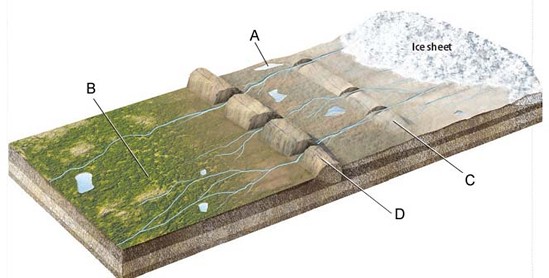
What glacial features are indicated by the labels C and D on the figure?
a)
moraines
b)
outwash plains
c)
kettle lakes
d)
ice sheets
34.
This force causes the movement of glaciers
a)
pressure
b)
ice age
c)
gravity
d)
firn
35.

When a glacier retreats and large, partially buried, ice chunks are left behind to melt, these are formed:
a)
Moraine
b)
Prairie pothole
c)
Kettle Lake
d)
Fjord
36.
glacial erosion causes ______ as it moves across the land?
a)
plucking and striations
b)
beaches and sand bars
c)
sea caves and headlands
d)
sand dunes and losses
37.
a large rock or boulder transported from a distant source by a glacier
a)
erratic
b)
till
c)
moraine
d)
drumlin
38.
a ridge of unsorted sediment formed by glacial deposition
a)
moraine
b)
kettle
c)
erratic
d)
horn
39.
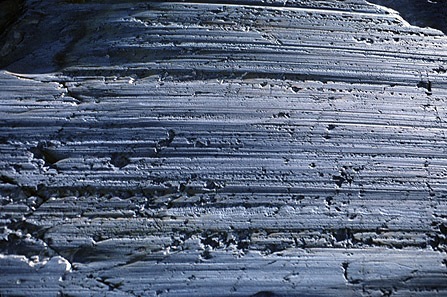
_____ are parallel scratch marks on bedrock
a)
Plucking
b)
Abrasion
c)
Straitions
d)
Till
40.

_____ is one of the two types of glaciers.
a)
Valley
b)
Mountain
c)
Plain
d)
Ocean
41.
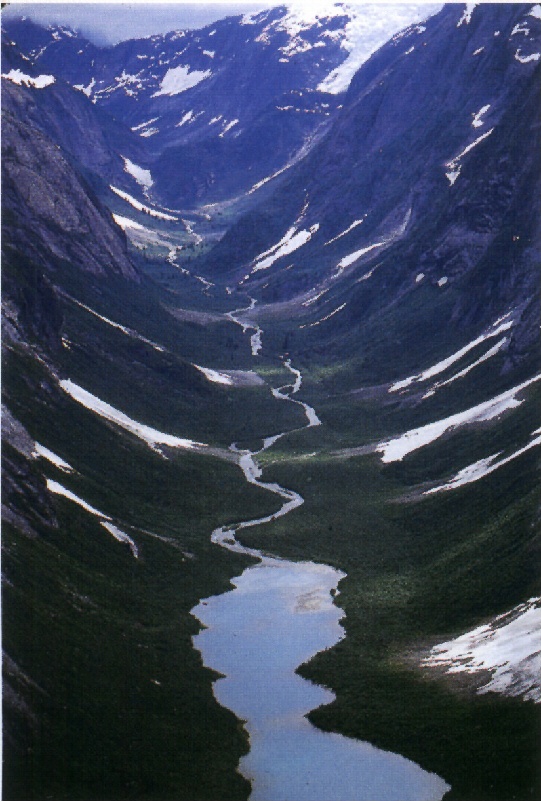
A _____ glacier carves a V-shaped valley into a U-shaped valley.
a)
Valley
b)
Continental
c)
Mountain
d)
Plain
42.
A _____ is a meandering narrow ridge formed when water, flowing in a tunnel underneath a melting glacier, deposited sediment
a)
erratic
b)
moraine
c)
esker
d)
fjords
43.
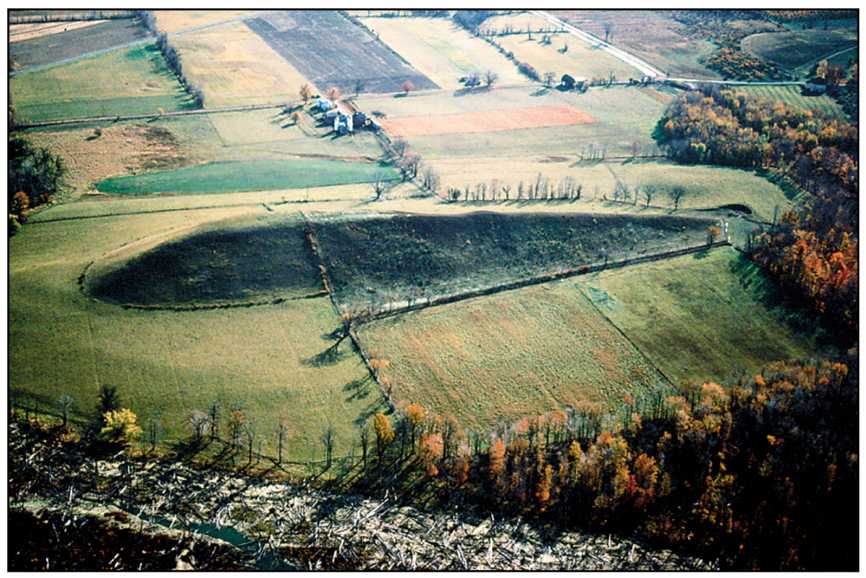
A _____ is a tear-drop-shaped hill created by ice flow over and around till deposit.
a)
drumlin
b)
esker
c)
moraine
d)
erratic
44.
What is a bowl-shaped (hint: circular) depression formed by glacial erosion?
a)
cirque
b)
arrete
c)
ice pack
d)
kettle
45.
A glacier is __________
a)
series of frozen lakes that line up parallel to one another
b)
series of frozen seas that rest in the interior of continents
c)
o large body of ice that does not move across the earth's surface
d)
large body of ice and snow that shows evidence of movement
46.
When a glacier is experiencing more melting than snow accumulation it is said to be in a period of _____.
a)
glacial drift
b)
glacial retreat
c)
glacial advance
d)
o glacial outburst
47.
All of the following were formed by glaciers EXCEPT _____.
a)
Lake Superior
b)
Lake Michigan
c)
Niagra Falls
d)
Grand Canyon
48.
Which is not true on continental glacier
a)
also called an ice sheet
b)
flows in a one direction.
c)
occurs only at high latitudes
d)
only two at present
49.
unsorted rock material deposited directly by ice as it melts
a)
glacial drift
b)
stratified drift
c)
till
d)
glacier
50.
This kind of glacier once covered Mighigan
a)
continental ice sheet
b)
valley glacier
c)
Very Big Wisconsin
d)
Super large Minnesota
51.
A period of time when ice covered large areas of the earth's surface
a)
ice age
b)
Cooler time
c)
firn
d)
interglacial period
52.
Inside glaciers, you will find __________ water.
a)
fresh
b)
sea
53.
When glaciers melt, the can fill valleys with water and become gorgeous _________.
a)
streams
b)
gardens
c)
lakes
d)
oceans
54.
Scientists today can use glacial ice to learn more about....
a)
dinosaurs
b)
climate change
c)
valleys
d)
reservoirs
55.
Where is the largest glacier in the world?
a)
Pakistan
b)
Antarctica
c)
Arctic
d)
Greenland
56.
Small depressions that form when a chunk of ice is left in a glacial till.
a)
till
b)
kettle
c)
erratic
d)
abrasion
57.
A long winding ridge of stratified sand and gravel.
a)
eskers
b)
till
c)
glacier
d)
kettle
58.
Sand and gravel deposited by running water from the melting ice of a glacier.
a)
till
b)
eskers
c)
moraine
d)
outwash
59.
What percent of the Earth is covered by glaciers?
a)
5%
b)
10%
c)
15%
d)
20%
60.
If the glaciers melt at their current rate how much will the sea level rise (prediction)?
a)
1.5 - 3 inches
b)
1.5 - 3 feet
c)
1 - 2 feet
d)
4 - 5 feet
61.
What will be a predicted future result of glaciers melting and climate change?
a)
150 million people displaced due to sea level rise & increased hurricans
b)
Nothing, climate change isn't happening
c)
Glaciers are actually growing
d)
We will have more available freshwater
100 %

