
 Worksheets
Weathering and Erosion Exam Review
Total questions: 66
Worksheet time: 58mins
Name
Class
Date
1.
When rocks are broken down into smaller pieces
a)
erosion
b)
weathering
c)
sediment
2.
When water, ice and wind move particles of rock and soil from one place to another
a)
sediment
b)
weathering
c)
erosion
3.
A mass of ice that covers a large area and moves slowly
a)
gravity
b)
glacier
c)
sediment
4.
Erosion occurs when water, ice wind and gravity move __________________ of rock and soil from one place to another
a)
water
b)
waves
c)
particles
5.
Water ________ heavier sediment first
a)
particles
b)
waves
c)
depositis
6.
Roots break apart a side walk
a)
Chemical weathering
b)
Physical weathering
7.
Carbon dioxide in rainwater dissolves limestone
a)
Chemical weathering
b)
Mechanical weathering
8.
The iron in the stones of the Grand Canyon turn the color of red
a)
Mechanical Weathering
b)
Chemical Weathering
9.

What type of erosion causes landslides
a)
wind
b)
waves
c)
water
d)
gravity
10.
Which of the following is not a form of erosion?
a)
Frost Wedging
b)
Wind
c)
Glacial
d)
Water
11.
Which of these substances plays the most important part in chemical weathering?
a)
Wind
b)
Water
c)
Ice
d)
Frost
12.
Is the growth of vegetation a form of physical or chemical weathering?
a)
Physical
b)
Chemical
13.

Deltas are built up by -
a)
deposition
b)
leaching
c)
abrasion
d)
erosion
14.

A rock containing iron becomes soft and crumbly and reddish-brown in color. It probably has been chemically weathered by -
a)
abrasion
b)
carbon dioxide
c)
oxygen
d)
acid rain
15.
wind erosion forms what type of landform?
a)
meander
b)
drumlin
c)
sand dune
d)
sand bar
16.
A marble statue is left exposed to the weather. Within a few years, the details on the statue have begun to weather away. This weathering probably is caused by...
a)
oxygen in the air
b)
carbonic acid in rainwater
c)
lichens
d)
abrasion
17.

The diagrams shows a natural process that weathers rock.
Which statement best explains why this process results in weathering?
Which statement best explains why this process results in weathering?
a)
frozen water acts as a solute
b)
water expands when it freezes
c)
the mass of water increases when it freezes
d)
frozen water dissolves most types of rock
18.

What is mechanical weathering?
a)
Process through which rocks are physically broken into smaller pieces.
b)
Rocks are broken down through chemical changes.
c)
Rocks are worn away from acid in plant roots.
d)
Rocks broken down by machinery.
19.
As the current in a stream becomes stronger, what will happen to its erosional power?
a)
it will increase
b)
it will decrease
c)
it will stay the same
d)
it will increase then decrease
20.
As the velocity of a stream decreases, what happens to the size particles that it is able to carry?
a)
It's only able to carry larger particles
b)
It's only able to carry smaller particles
c)
It can carry any size particles
21.
Valleys created by downcutting streams are ___- shaped
a)
W
b)
U
c)
V
d)
Y
22.
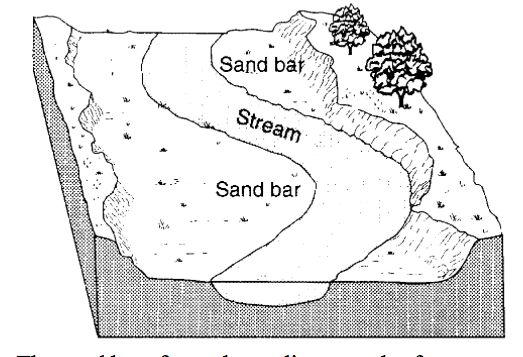
The diagram below shows a portion of a stream. The sand bar formed as a direct result of
a)
erosion due to a decrease in stream velocity
b)
erosion due to an increase in stream velocity
c)
deposition due to a decrease in stream velocity
d)
deposition due to an increase in stream velocity
23.
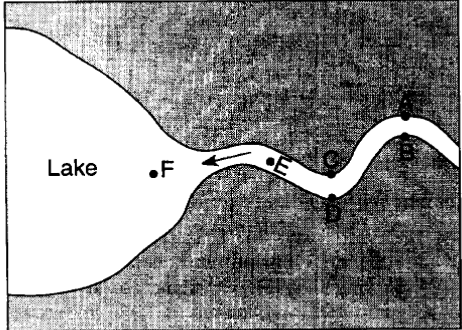
The map below represents a river as it enters a lake.
At which locations is the amount of deposition greater than the amount of erosion?
At which locations is the amount of deposition greater than the amount of erosion?
a)
A,C and E
b)
B, D and F
c)
B, C, and F
d)
A, D and E
24.
Sediments are deposited in a river delta because the
a)
velocity of the river decreased
b)
force of gravity decreased
c)
volume of the river increases
d)
gradient of the river increases
25.
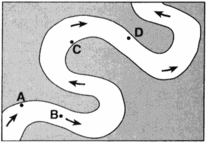
At which location is the greatest amount of sediment most likely being deposited?
a)
A
b)
B
c)
C
d)
D
26.
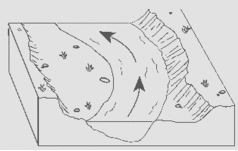
The diagram below shows a section of a meander in a stream. The arrow shows the direction of stream flow. The stream bank on the outside of this meander is steeper than than the stream bank on the inside of this meander because the water on the outside of the meander is moving
a)
Slower, causing deposition
b)
Faster, causing deposition
c)
Slower, causing erosion
d)
Faster, causing erosion
27.
A stream’s velocity decreases from 100 cm/s to 5cm/s. Which size sediment particles will still be transported by the stream?
a)
pebbles, sand, silt and clay
b)
sand, silt and clay only
c)
silt and clay only
d)
clay only
28.

At which two locations in this stream is deposition normally dominant over erosion?
a)
A and D
b)
B and E
c)
C and E
d)
D and C
29.

The type of formation shown is at the southern end of the Mississippi river. What is it called?
a)
coastal erosion
b)
a delta
c)
a loess
d)
sand dunes
30.
Waves dropping sand on the beach
a)
Weathering
b)
Erosion
c)
Deposition
31.
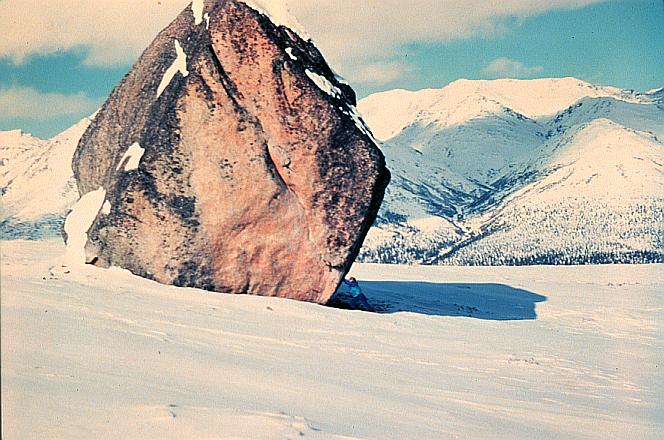
_____ are enormous boulders transported and deposited by glaciers, often far from their source region.
a)
Till
b)
Erratics
c)
Moraines
d)
Fjords
32.
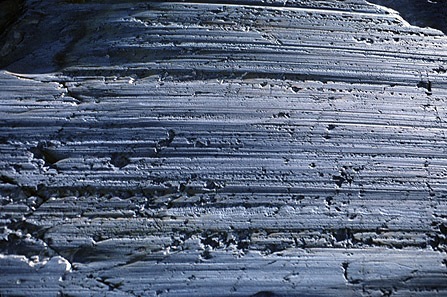
_____ are parallel scratch marks on bedrock
a)
Plucking
b)
Abrasion
c)
Straitions
d)
Till
33.

_____ is the unsorted material that is deposited directly by ice.
a)
Outwash
b)
Till
c)
Erratic
d)
Esker
34.
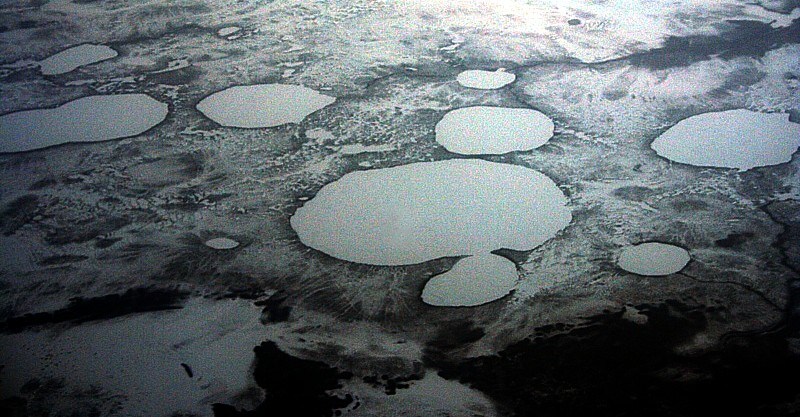
A _____ are depressions formed as stranded ice blocks melt in outwash.
a)
erratics
b)
eskers
c)
kettles
d)
drumlin
35.
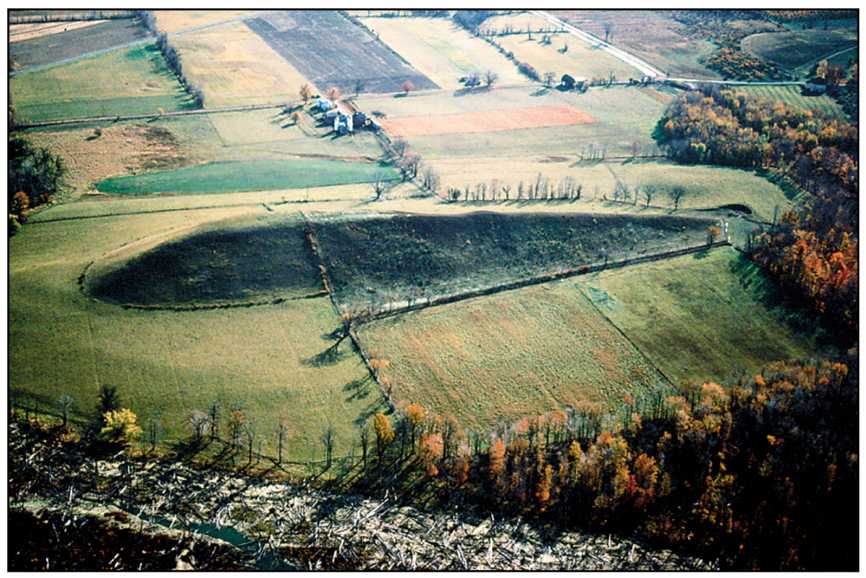
A _____ is a tear-drop-shaped hill created by ice flow over and around till deposit.
a)
drumlin
b)
esker
c)
moraine
d)
erratic
36.
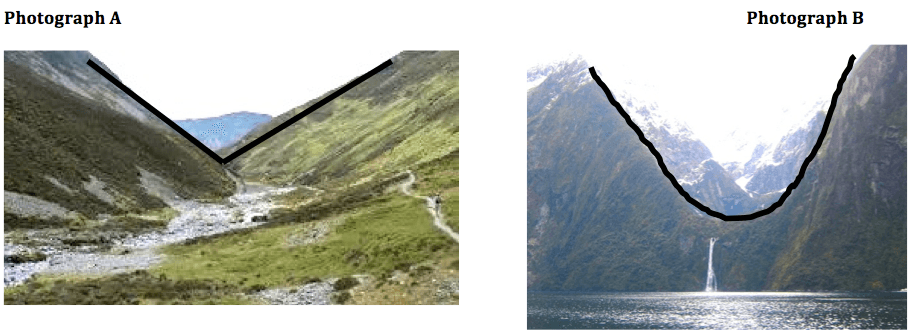
Which list best identifies the agent of erosion that primarily determined the shape of each valley?
a)
photograph A—glacier; photograph B—river
b)
photograph A—river; photograph B—glacier
c)
Both A and B—river
d)
Both A and B—glacier
37.
Till deposited in the front of a glacier
a)
ground moraine
b)
lateral moraine
c)
terminal moraine
d)
medial moraine
38.
The deposit at the furthest point the glacier ever gets.
a)
moraine
b)
ground moraine
c)
recessional moraine
d)
terminal moraine
39.
This force causes the movement of glaciers
a)
pressure
b)
ice age
c)
gravity
d)
firn
40.
Continental glaciers...
a)
cover millions of square miles
b)
do not cover an entire land mass
c)
carve out cirques and arretes
d)
are responsible for U-shaped valleys
41.
An area of a glacier where more snow is added than lost.
a)
Zone of Accumulation
b)
Zone of Ablation
c)
Equilibrium Line
d)
Hanging Valley
42.
This zone is most often found with retreating glaciers.
a)
Zone of Accumulation
b)
Zone of Ablation
c)
Zone of Equilibrium
d)
End Zone
43.
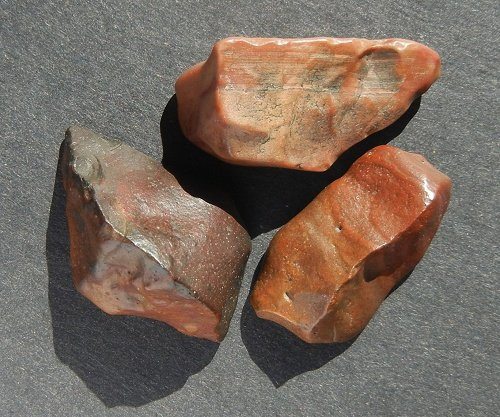
These rocks were made smooth by wind blowing smaller rock particles across their surface. This is an example of:
a)
ice wedging
b)
chemical weathering
c)
acid rain
d)
abrasion
44.
The formation of stalactites and stalagmites in a cave as water mixed with carbon dioxide creates carbonic acid, which dissolves away the limestone, is an example of:
a)
mechanical weathering
b)
chemical weathering
45.
The formation of large cracks in the face of a mountain from ice wedging is an example of:
a)
mechanical weathering
b)
chemical weathering
46.
Acid rain wearing away the face of a marble gravestone or statue is an example of?
a)
mechanical weathering
b)
chemical weathering
47.
Lichens (small green plants) growing on a large boulder release enzymes and other acids that slowly break the rock apart. This is an example of:
a)
mechanical weathering
b)
chemical weathering
48.
A metal statue slowly turning green after years of being outside is an example of:
a)
mechanical weathering
b)
chemical weathering
49.
Potholes forming in the road after a cold winter is an example of:
a)
mechanical weathering
b)
chemical weathering
50.
A stream flowing at 0.3 cm/s can erode what type of sediment?
a)
Pebbles, sand, silt, and clay
b)
Sand, silt, and clay
c)
Silt and clay
d)
Clay Only
51.
What is the largest sediment size that a stream flowing at 10 cm/s can carry?
a)
1.0 cm
b)
0.2 cm
c)
0.1 cm
d)
0.01 cm
52.
For a stream to carry a sediment the size of 20 cm, how fast must it's velocity be?
a)
200 cm/s
b)
100 cm/s
c)
50 cm/s
d)
500 cm/s
53.
Which sediment requires the least amount of velocity to be eroded?
a)
Cobbles
b)
Pebbles
c)
Silt
d)
Clay
54.
If a stream were flowing 100 cm/s and slowed to 10 cm/s, what type of sediment would it no longer carry?
a)
Clay
b)
Silt
c)
Sand
d)
Pebbles
55.
What variables does this stream graph not account for? (Hint: Read the fine print!)
a)
Density and Shape
b)
Mass and Size
c)
Gravity and Slope
d)
Discharge and Volume
56.
What determines a river's ability to erode sediment?
a)
Discharge
b)
Velocity
c)
Gradient (Slope)
d)
All the Above
57.
What is the largest type of sediment that can be carried by a river flowing at 3 cm/s?
a)
Silt
b)
Sand
c)
Pebbles
d)
Clay
58.
The movement of water and sediment down a beach caused by waves
a)
sand bar
b)
barrier island
c)
beach
d)
longshore drift
e)
spit
59.
Increasing the surface area of a sediment will cause the weathering rate to...
a)
Increase
b)
Decrease
c)
Remain the Same
60.

The maps below labeled A, B, and C show three different stream drainage patterns. Which factor is primarily responsible for causing these three different drainage patterns?
a)
amount of precipitation
b)
bedrock structure
c)
stream discharge
d)
prevailing winds
61.

According to the ESRT,
the Catskills
are part of which type of landscape region?
the Catskills
are part of which type of landscape region?
a)
plateau
b)
coastal lowland
c)
mountain
d)
plain
62.
In which landscape region are New York State's Finger Lakes primarily located?
a)
Adirondack Mountains
b)
Allegheny Plateau
c)
Atlantic Coastal Plain
d)
Erie-Ontario Lowlands
63.
Which New York State landscape region is mostly composed of horizontal sedimentary bedrock at high elevations?
a)
Hudson Highlands
b)
Allegheny Plateau
c)
Taconic Mountains
d)
Atlantic Coastal Plain
64.

Which map shows the stream drainage pattern that will most likely develop as the bedrock is weathered and eroded from this igneous dome?
a)
b)
c)
d)
65.

Which location is experiencing the most deposition?
a)
A
b)
B
c)
C
d)
D
66.

What would the cross section for W to X look like?
a)
b)
c)
d)
100 %

