
 Worksheets
Force and Motion Test Review
Total questions: 48
Worksheet time: 55mins
Name
Class
Date
1.
One object rubbing against another object produces a force that works against motion is known as friction
a)
True
b)
False
2.
An object's speed in a particular direction is
a)
force
b)
inerita
c)
velocity
d)
speed
3.
What increases as a ball falls to the ground?
a)
the density of the ball
b)
the momentum of the ball
c)
the inerita of the ball
d)
the pull of gravity on the ball
4.
An object is moving at a constant speed. If a balanced force is applied in the opposite direction the object is moving, what will most likely happen?
a)
The object will slow down and eventually stop moving
b)
The object will continue moving at a constant speed
c)
the object will change direction
d)
the object will speed up
5.
How is gravity affected by mass?
a)
the larger the mass of the object, the greater the gravity
b)
small objects have no gravity
c)
gravity is not affected by mass of objects, whether large or small
6.
which force produces a change in motion?
a)
unbalanced force
b)
balanced force
c)
gravitational force
d)
frictional force
7.
What is the difference between mass and weight?
a)
mass is how much matter is in an object, and weight is the gravitational pull on that object
b)
mass and weight are the same
c)
weight affects how much mass is in an object
d)
weight is determined by how many atoms make up an object
8.

If these boys are pulling with the same amount of force. What will happen?
a)
The boy in blue will win.
b)
They will not move at all.
c)
The boy in red will win.
d)
Both will fall down.
9.
A bowling ball and a soccer ball are rolling at the same speed on the same surface. Why will the bowling ball be harder to stop?
a)
it has greater velocity
b)
it has greater momentum
c)
it has greater friction
d)
it has greater acceleration
10.
A picture is hanging on a wall and does not move.
a)
Newton's 1st Law
b)
Newton's 2nd Law
c)
Newton's 3rd Law
d)
None of them
11.
__________ is the change in speed or direction of an object's motion.
a)
velocity
b)
acceleration
c)
force
d)
position
12.
What are two examples of forces?
a)
Art and Music
b)
A push or pull
c)
A stand or ground
d)
The dark side and the light side
13.
What pulls a ball back to earth?
a)
Gas
b)
Gravity
c)
Friction
d)
Molecules
14.

Pushing a child on a swing is easier than pushing an adult on the same swing.
a)
1st Law
b)
2nd Law
15.

A soccer player kicks a ball with their foot and their toes are left stinging.
a)
2nd Law
b)
3rd Law
16.

What is this graph showing?
a)
Constant Speed
b)
Acceleration (speeding up)
c)
Deceleration (slowing down)
d)
No motion
17.

What is this graph showing?
a)
Constant Speed
b)
Acceleration (speeding up)
c)
Deceleration (slowing down)
d)
No motion
18.

What is happening in this graph from point A to B?
a)
The object is accelerating.
b)
The object is not moving.
c)
The object is decelerating.
d)
The object is moving at a constant speed.
19.

How many times does this object STOP moving?
a)
None
b)
Once
c)
Twice
d)
Three times
20.

At 60 seconds, how far had this object traveled?
a)
0 m
b)
10 m
c)
20 m
d)
40 m
21.

The distance-time graphs shown represent the motion of a car. Which of the following graphs represents the car at constant speed?
a)
graph A
b)
graph B
c)
graph C
d)
graph D
22.
A lion runs 8 meters in one second. By the end of the next second, the lion has traveled an additional 6 meters. Which best describes the motion of the lion during the two seconds?
a)
The lion slows down
b)
The lion comes to a stop
c)
The lion changes in mass
d)
The lion changes in direction
23.
Momentum is the measure of how hard it is to slow down or stop and object in motion.
a)
False
b)
True
24.

What is inertia?
a)
the tendency of an object to resist change in motion
b)
how fact an object is going in a given direction
c)
a measure of the lack of motion of an object
d)
change in speed or direction of an object
25.

For every action there is an equal and opposite reaction.
a)
Newton's 1st Law
b)
Newton's 2nd Law
c)
Newton's 3rd Law
d)
None of them
26.

Acceleration is produced when a force acts on a mass. The greater the mass (of the object being accelerated) the greater the amount of force needed (to accelerate the object).
a)
Newton's 1st Law
b)
Newton's 2nd Law
c)
Newton's 3rd Law
d)
None of them
27.

What is frame of reference?
a)
How fast an object's position changes over time.
b)
A group of objects from which you can measure the position or motion.
c)
A change in position over time.
d)
The location of an object.
28.

Any push or pull from one object to another.
a)
Force
b)
Friction
c)
Speed
d)
gravity
29.

During which interval is the object not moving?
a)
B to C
b)
C to D
c)
D to E
d)
only at point A
30.
A car driving at 50 miles per hour drives for 2 hours. What distance did it cover?
a)
50 miles
b)
25 miles
c)
100 miles
d)
75 miles
31.

What does this graph represent?
a)
Constant Speed
b)
Acceleration
c)
Not moving
32.

What does this graph represent?
a)
Constant speed
b)
Acceleration
c)
Not moving
33.

What does this graph represent?
a)
Constant speed
b)
Acceleration
c)
Not moving
34.
Acceleration is
a)
increasing speed
b)
decreasing speed
c)
changing direction
d)
all of the above
35.
A student jogging at 2 m/s picks up the pace until she is jogging at 4 m/s. This is an example of acceleration. True or False?
a)
True
b)
False
36.
What happens when one force PULLS an object toward another?
a)
Friction
b)
Motion
c)
Gravity
d)
Magnetism
37.
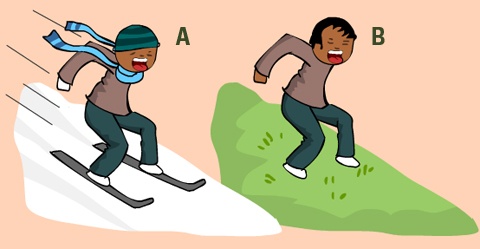
Why is it harder for the boy in Image B to get down the hill?
a)
Motion
b)
Friction
c)
Work
d)
Displacement
38.

In the image, which of the person and their bikes will get down a hill faster?
a)
The boy because he is younger
b)
The woman because she is stronger
c)
The boy because he has a greater mass which applies a greater force
d)
The woman because she has more mass and applies a greater force
39.
Which force produces a change in motion?
a)
unbalanced force
b)
balanced force
c)
gravitational force
d)
frictional force
40.
Which will be different on the moon?
a)
Mass of an object
b)
Weight of an object
41.
Mike slides his glass of milk across the table, but he knows that the glass will slow down and stop before it falls off the edge. What is the most likely reason why the glass doesn't just keep going?
a)
The glass is moving in a straight line.
b)
The bottom of the glass is not perfectly round.
c)
The force of friction acts on the glass.
d)
Glass cannot travel far compared to other materials.
42.
Energy due to motion is ____________ energy.
a)
Potential
b)
Energy
c)
Kinetic
d)
Friction
43.
The faster an object moves, the ________ kinetic energy it has.
a)
more
b)
less
c)
none of the above
d)
all of the above
44.
__________ is stored energy.
a)
Potential
b)
Kinetic
c)
None of the above
d)
All of the above
45.

What kind of energy is in a rock at the edge of a cliff?
a)
Potential
b)
Kinetic
46.
Energy can not be created or destroyed, only converted from one form to another.
a)
true
b)
false
47.
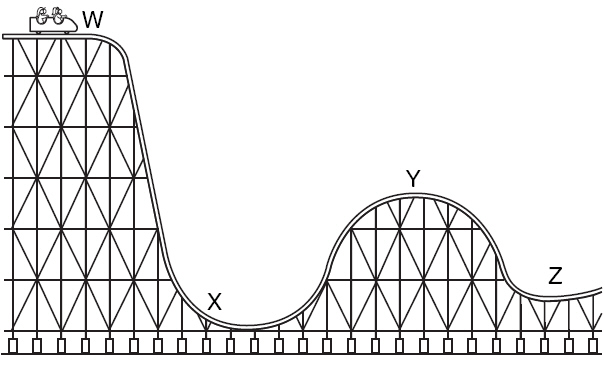
At which point is potential energy greatest?
a)
W
b)
X
c)
Y
d)
Z
48.
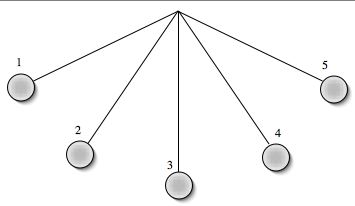
When a pendulum swings, at which point is kinetic energy highest?
a)
1
b)
2
c)
3
d)
4
100 %

