
 Worksheets
Heat & Light
Total questions: 41
Worksheet time: 52mins

White light is composed of all the colors of the visible light spectrum


A beaker of water at 5 degrees Celsius is placed inside a beaker containing water at 100 degrees Celsius. Each beakers have an equal volume of water. What will the final temperature of the water be inside both beakers after leaving them over night?
approximately 100 degrees Celsius
approximately 50 degrees Celsius
approximately 0 degrees Celsius
A snowman melting in the sun. What type of heat transfer is this?
Conduction
Convection
Radiation
A heater circulating warm air to heat up a room. What type of heat transfer is this?
Conduction
Convection
Radiation
Hands warming up from holding a hot cup of coffee. What type of heat energy transfer is this?
Conduction
Convection
Radiation

A sweater keeps you warm in cold weather. This is an example of a(n) _________________.
Conductor
Insulator
A metal pan easily lets heat pass through it so it can cook your egg. This is an example of a(n) ________________.
Conductor
Insulator
____________ is the transfer of heat energy through empty space by invisible electromagnetic rays.
Conduction
Convection
Radiation
Why does your hand feel colder after holding an ice cube?
The cold has entered your hand.
The heat energy has left your hand.
What will happen to a hot tea kettle if it is left on the counter overnight?
The tea kettle will remain the same temperature.
The air around the tea kettle will get colder.
Heat will flow out of the tea kettle until the kettle and the air around it reach the same temperature.
When you stand outside in cold weather and feel colder, it is because you are losing heat energy to the air around you.
True
False
A measurement of the average amount of kinetic energy of the particles in a sample of matter.
Temperature
Energy
Potential energy
Heat
The transfer of thermal energy between objects
Kinetic energy
Temperature
Heat
Potential energy

Everything has thermal energy
False
True
How does thermal energy play a role in particle motion and changes of state?
Thermal energy is a term that refers to temperature
Increasing an object's thermal energy increases particle motion and can cause a change of state.
Decreasing an object's thermal energy increases particle motion and can cause a change of state.
Thermal energy is the energy added from a heat source.
What happens to particles during changes of state between solid and liquid.
Particles move so fast they break from their fixed position.
Particles melt and become a liquid.
Particles find a circular orbit around an atom's nucleus.
Particles stop vibrating and change into their liquid form.
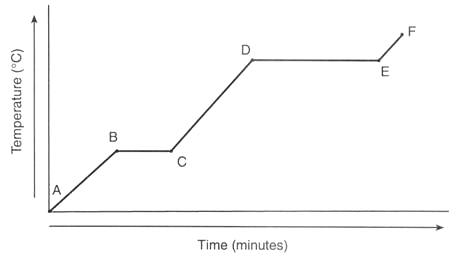
Are the particles moving faster or slower as time goes on?
Faster
Slower
What is happening to the particles in the substance between points A and B?
Melting
Freezing
Speeding Up
Slowing Down
What is happening to the particles in the substance between points D and E?
Melting
Freezing
Vaporizing
Sublimating
What is happening to the particles in the substance between points D and E?
Melting
Freezing
Vaporizing
Sublimating
Which object has the most thermal energy?


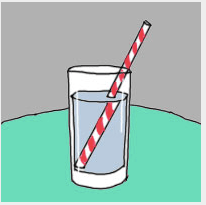
Why does the straw appear to be bent?
light is reflected
light is absorbed
light is turned
light is refracted

What is the best explanation for Mickey seeing himself in the mirror?
refraction
absorbed
reflection
flipped
What do we call a material that light can travel through?
air
water
medium
pathway


