
 Worksheets
more joints, circulatory systemFinal review part three
Total questions: 60
Worksheet time: 55mins
Name
Class
Date
1.
allow movement primarily in one direction or plane; knees and elbows are examples
a)
ball and socket
b)
hinge
2.
type of joint that allows a wide range of movement in many directions; hips and shoulders are examples
a)
Diarthrodial
b)
Amphiarthrodial
c)
Synarthrodial
3.
Joints are also called
a)
annotations
b)
articulations
c)
affectations
d)
affiliations
4.
Classifying joints as synarthrotic, amphiarthrotic, or diarthrotic represents
a)
location in the body
b)
the composition of the joint
c)
the number of bones that joint affects
d)
degree of movement possible at the joint
5.
Classifying joints as fibrous, cartilaginous, or synovial represents
a)
location in the body
b)
the composition of the joint
c)
the number of bones that joint affects
d)
degree of movement possible at the joint
6.
Cartilagenous joints are connected by
a)
synovial fluid
b)
fibrous connective tissue.
c)
hyaline cartilage or fibrocartilage
d)
a joint capsule
7.
Bones of a synovial joint are held together by
a)
a synovial membrane
b)
a joint capsule
c)
a meniscus
d)
articular cartilage
8.
Fluid-filled sacs containing synovial fluid are called
a)
bursae
b)
menisci
c)
ligaments
d)
tendons
9.
Bone regions united by fibrous connective tissue
a)
fibrous/suture
b)
cartilaginous/amphiarthrotic
c)
fibrous/symphysis
10.
Joints between skull bones
a)
diarthrotic/synovial
b)
fibrous/suture
c)
amphiarthrotic/epiphyseal disk
11.
All are reinforced by ligaments
a)
fibrous
b)
cartilaginous
c)
synovial
12.
Often contains a fluid-filled cushion
a)
fibrous
b)
cartilaginous
c)
synovial
13.
Child's long bone growth plate made of hyaline cartilage
a)
fibrous/epiphyseal
b)
cartilaginous/epiphyseal
c)
synovial/epiphyseal
14.

Connects bone to bone
a)
Ligament
b)
Tendon
c)
Cartilidge
15.

The cushion between bones.
a)
Tendon
b)
Cartilidge
c)
Ligament
16.
What type of tissue is bone?
a)
Nerve
b)
Muscle
c)
Epithelium
d)
Connective
17.
An enlongated bursa that wraps around the tendon
a)
bursa sac
b)
meniscus
c)
tendon sheath
18.
A syndesmoses is what type of articulation?
a)
Fibrous
b)
Cartilagenous
c)
Synovial
19.
Hip and shoulder have examples of this type of joint
a)
ball and socket
b)
condyloid
c)
hinge
d)
gliding
20.
Carpals and tarsals (flat bones) are examples of this type of joint
a)
condyloid
b)
gliding
c)
hinge
d)
saddle
21.
This type of joint allows the your first two vertebrate to rotate as in shaking your head no
a)
condyloid
b)
gliding
c)
pivot
d)
saddle
22.

Which of the following best describes extension?
a)
The straightening of a joint where the angle of movement increases
b)
The bending of a joint where bones get closer together
c)
The rotation of a joint or spinning of one bone on another
d)
The lateral movement away from the midline
23.

The lateral motion TOWARDS the midline is called ______.
a)
adduction
b)
abduction
c)
internal rotation
d)
external rotation
24.

Movement away from the mid-line is called _____________.
a)
abduction
b)
adduction
c)
internal rotation
d)
external rotation
25.

Rotation of the forearm until the palm faces posteriorly is called __________.
a)
supination
b)
pronation
c)
flexion
d)
dorsiflexion
26.

Rotation of the forearm until the palm faces anterioriorly is called _________.
a)
Supination
b)
external rotation
c)
plantar flexion
d)
pronation
27.
Slightly movable joint
a)
synarthrotic
b)
amphiarthrotic
c)
diarthrotic
28.

Name this joint.
a)
Saddle
b)
Ball and Socket
c)
Ellipsoid
d)
Hinge
29.
Straightening beyond the anatomical position
a)
extension
b)
hyperextension
c)
flexion
d)
hyperflexion
30.
Pointing your toe
a)
dorsiflexion
b)
plantar flexion
c)
flexion
d)
extension
31.
Circular motions about a joint
a)
circumduction
b)
rotation
c)
opposition
d)
retraction
32.
Flexing your foot; toes towards the ceiling
a)
dorsiflexion
b)
plantar flexion
c)
opposition
d)
elevation
33.
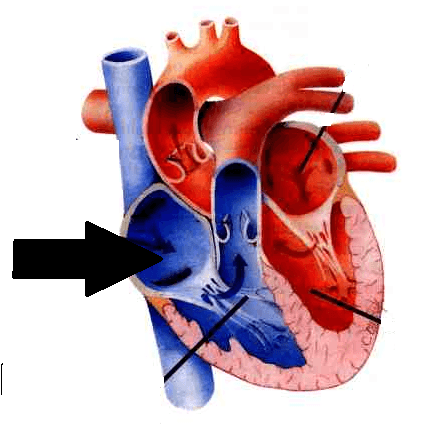
Identify
a)
Left atrium
b)
Right atrium
c)
Left ventricle
d)
Right ventricle
34.
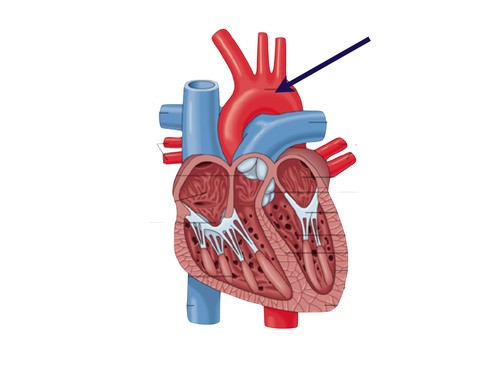
Identify
a)
Pulmonary veins
b)
Pulmonary artery
c)
Aorta
d)
Vena cava
35.
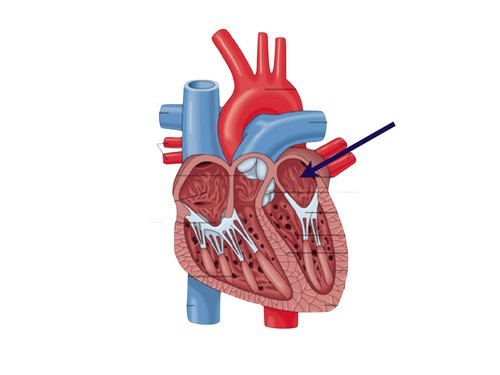
Identify
a)
Left atrium
b)
Right atrium
c)
Left ventricle
d)
Right ventricle
36.
This chamber of the heart RECEIVES blood returning from the body
a)
Right Atrium
b)
Right Ventricle
c)
Left Atrium
d)
Left Ventricle
37.
The aorta is the largest artery in the body. The blood leaving the aorta is full of?
a)
Oxygen
b)
Carbon Dioxide
c)
White blood Cells
d)
Potassium
38.
Thin-walled vessels that allow for the exchange of O2 , CO2, nutrients and wastes between blood cells or air sacs in the lungs
a)
Arteries
b)
Veins
c)
Capillaries
39.
Blood circulation from the heart to the rest of the body is called
a)
Full body
b)
Systemic
c)
pulmonary
d)
heart to lung
40.
Which one of the following represents the correct path for the transmission of an impulse in the intrinsic conduction system of the heart?
a)
AV node, Bundle of His, SA node, Purkinje fibers, bundle branches
b)
SA node, AV node, Bundle of His, bundle branches, Purkinje fibers
c)
SA node, Bundle of His, AV node, Purkinje fibers, bundle branches
d)
SA node, Bundle of His, bundle branches, Purkinje fibers, AV node
41.
The heart sounds "lub" and "dup" result from ________.
a)
opening of the heart valves
b)
firing of the nodes of the intrinsic conduction system
c)
blood rushing through the chambers
d)
closure of heart valves
42.
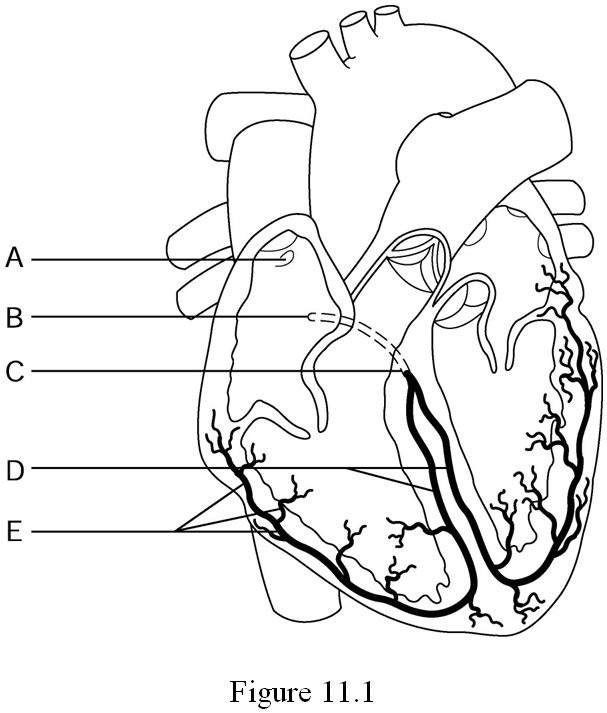
Which label is representing the Purkinje fibers?
a)
A
b)
C
c)
D
d)
E
43.
One complete heartbeat
a)
ECG
b)
systole
c)
diastole
d)
cardiac cycle
44.
SA node. regulates to pace of the heart
a)
AV node
b)
Purkinje fibers
c)
SV node
d)
pacemaker
45.
The ____ side of the heart pumps oxygen-rich blood to the body.
a)
right
b)
left
46.
What is the sequence of events in the transmission of an impulse through the heart muscle?
a: AV node
b: AV bundle
c: SA node
d: Through the atria
e: Through the ventricles
f: Bundle branches
g: Purkinje fibers
a: AV node
b: AV bundle
c: SA node
d: Through the atria
e: Through the ventricles
f: Bundle branches
g: Purkinje fibers
a)
d, b, a, c, f, g, e
b)
c, d, a, b, f, g, e
c)
b, a, d, c, f, g, e
d)
f, g, d, c, b, a, e
47.
Order the phases an action potential travels in the conduction system
a)
SA node--> AV bundle branches--> AV node--> Purkinje fibers
b)
SA node--> AV node--> AV bundle branches--> Purkinje fibers
c)
Av bundle branches--> AV node--> SA node--> Purkinje fibers
d)
Purkinje fibers--> SA node--> AV node--> AV bundle branches
48.

The t-wave correlates with which event?
a)
atrium contraction /signals moving from SA node to AV node
b)
ventricle contraction
c)
ventricle repolarization
d)
both atrial and ventricle contraction
49.

The p-wave correlates with which event?
a)
atrium contraction /signals moving from SA node to AV node
b)
ventricle contraction
c)
ventricle repolarization
d)
both atrial and ventricle contraction
50.
What carries the oxygenated blood from the lungs to the left atrium of the heart?
a)
vena cava
b)
aorta
c)
pulmonary vein
d)
pulmonaryartery
51.
What are the two large veins that drain blood from the upper body and from the lower body and empty it into the right atrium of the heart?
a)
vena cava
b)
aorta
c)
pulmonary artery
d)
pulmonary vein
52.
Which of the following lists the valves in the order through which the blood flows from the vena cava through the heart?
a)
tricuspid, pulmonary, bicuspid, aortic
b)
mitral, pulmonary, bicuspid, aortic
c)
bicuspid, aortic, tricuspid, pulmonary
d)
aortic semilunar, pulmonary, tricuspid, bicuspid
53.
Which valve separates the left atrium from the left ventricle?
a)
tricuspid
b)
mitral
c)
pulmonary
d)
aortic
54.
Place the following in the correct order:
1.atria contract
2. AV node
3. Bundle of His
4.Purkinje fibers
5. SA node
6. ventricles contract
1.atria contract
2. AV node
3. Bundle of His
4.Purkinje fibers
5. SA node
6. ventricles contract
a)
5, 1, 2, 3, 4, 6
b)
2, 1, 5, 3, 4, 6
c)
5, 6, 2, 3, 4, 1
d)
2, 6, 5, 3, 4, 1
55.
Into which chamber of the heart do the pulmonary veins deliver blood?
a)
left ventricle
b)
right atrium
c)
left atrium
d)
right ventricle
56.
What part of blood is responsible for carrying oxygen and carbon dioxide to body cells?
a)
Red Blood Cells
b)
White Blood Cells
c)
Platelets
d)
Plasma
57.
What part of blood is responsible for carrying wastes, nutrients, and minerals?
a)
Red Blood Cells
b)
White Blood Cells
c)
Platelets
d)
Plasma
58.
Which formed element is the most abundant in blood?
a)
erythrocyte
b)
eosinophil
c)
platelet
d)
basophil
59.
What type of blood can receive any type of blood?
a)
A
b)
B
c)
AB
d)
0
60.
Choose the answer that will fill in the missing words in the correct order:vena cava, _________________, tricuspid valve, right ventricle, pulmonary valve, __________________, lungs, ___________________, left atrium, ____________________, left ventricle, aorta
a)
right atrium, pulmonary artery, pulmonary veins, bicuspid valve
b)
atrial valve, right atrium, right ventricle, body
c)
left ventricle, pulmonary artery, pulmonary veins, tricuspid valve
d)
right atrium, pulmonary veins, pulmonary artery, bicuspid valve
100 %

