
 Worksheets
4 - Enzyme
Total questions: 17
Worksheet time: 11mins
Name
Class
Date
1.
Enzymes will make a reaction go _______ and use ______ energy.
a)
faster, less
b)
faster, more
c)
slower, less
d)
slower, more
2.
Which of the following tasks listed below is most associated with enzymes?
a)
catalyze chemical reactions
b)
store genetic information
c)
store chemical energy in the cell
d)
dissolve nutrients and minerals
3.
Enzymes are capable of increasing the rate of a chemical reaction within a living cell. Enzymes accomplish this through which of the following means?
a)
reducing the number of products
b)
reducing the activation energy
c)
increasing the temperature of the cell
d)
increasing the concentration of reactants
4.
Cells can produce over one thousand different enzymes at a time. Enzymes are critical to the metabolism of these cells, but why are so many different enzymes needed?
a)
Cells are completely unable to control what enzymes
they produce
they produce
b)
The variety of enzymes prevents their actions from being inhibited.
c)
The active site of an enzyme can only bind to a specific substrate.
d)
The products of a reaction are always converted into new enzymes.
5.
Which factors can change the shape of an enzyme and thus denatures a enzyme?
a)
Excessive heat and changes in pH
b)
Nothing can
c)
Exposure to light and sound
d)
Exposure to bacteria and Amoebas
6.
Enzymes are composed of what organic molecule?
a)
Sugars
b)
DNA
c)
Proteins
d)
Fatty Acids
7.
What happens to an enzyme when it is denatured?
a)
Activation energy is lowered.
b)
It becomes stronger.
c)
It loses its shape.
d)
Activation energy is raised.
8.
Every enzyme has a optimal temperature and pH. True or False?
a)
True
b)
False
9.
Enzymes influence chemical reactions in living systems by:
a)
Providing the substrate required for the reaction to occur.
b)
Affecting the rate at which reactions occur.
c)
Absorbing water released when polymers are formed.
d)
Combining with excess hydrogen to from gaseous wastes.
10.
The "lock and key hypothesis" attempts to explain the mechanism of?
a)
Vacuole formation
b)
Pinocytosis
c)
Sharing of electrons
d)
Enzyme are specific to a substrate
11.
Any substance that is acted upon by an enzyme is called a(n)?
a)
Coenzyme
b)
Substrate
c)
Vitamin
d)
Polypeptide
12.
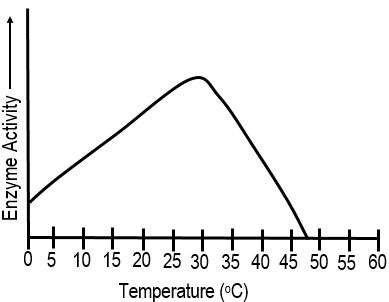
Based on the graph, what temperature does this enzyme work best?
a)
15 C
b)
40 C
c)
30 C
13.
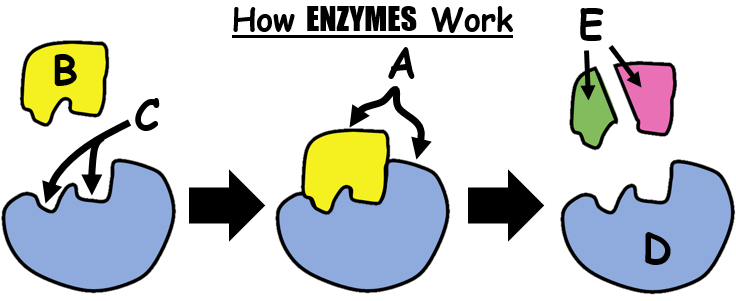
In the diagram, what is letter A?
a)
product
b)
substrate
c)
enzyme-substrate complex
d)
active site
14.
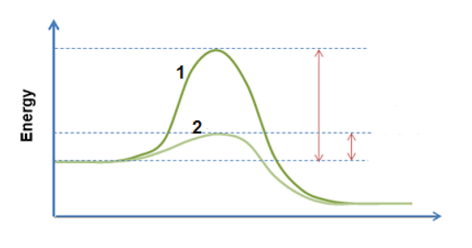
Which line represents an enzyme-catalyzed reaction?
a)
Line 1
b)
Line 2
15.
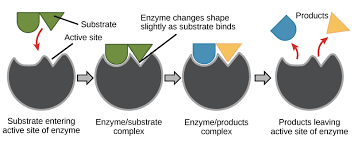
In a chemical reaction, a reactant binds to an enzyme at a region known as the
a)
catalyst.
b)
product.
c)
substrate.
d)
active site.
16.
Significantly changing the pH the enzyme is exposed to will cause the enzyme to _____________.
a)
increase enzymatic action
b)
fit better with the substrate
c)
denature
d)
evaporate
17.
Enzymes need to be manufactured often because they are used up in the chemical reactions they perform. (True / False)
a)
True
b)
False
100 %

