
 Worksheets
Unit Three Review
Total questions: 38
Worksheet time: 58mins
Name
Class
Date
1.
All matter is made of
a)
energy
b)
atoms
c)
air
d)
chemistry
2.
The positive particles of an atom are
a)
electrons
b)
atoms
c)
neutrons
d)
protons
3.
The central region of an atom where its neutrons and protons are is called the
a)
nucleus
b)
electron cloud
c)
core
d)
center
4.
Particles in an atom that are neutral and have no charge are
a)
negatrons
b)
electrons
c)
neutrons
d)
protons
5.
An atom's mass number equals the number of...
a)
protons plus the number of electrons
b)
protons plus the number of neutrons
c)
protons
d)
neutrons
6.
Atoms have no electric charge because they...
a)
have an equal number of charged and non charged particles
b)
have neutrons in their nuclei
c)
have an equal number of electrons and protons
d)
have an equal number of neutrons and protons
7.
How many protons are in the element, Sodium, with an atomic number of 11?
a)
23
b)
11
c)
13
d)
14
8.
True or False? Isotopes are atoms of the same element that differ in mass number and number of neutrons
a)
True
b)
False
9.
What will nitrogen's charge be as an ion?
a)
+3
b)
-3
c)
0
d)
-1
10.
When an atom loses a valence electron, it becomes a_____________ ion.
a)
positive
b)
negative
c)
neutral
d)
polyatomic
11.
Group 17 always has ions with a charge of
a)
+1
b)
+2
c)
-1
d)
-2
12.
Overall, the nucleus of an atom is charged.
a)
positively (+)
b)
negatively (-)
c)
variable
d)
not
13.
An atom has 5 protons and 7 neutrons. What is the atomic mass of the atom?
a)
5
b)
7
c)
2
d)
12
14.

How many protons does this isotope of titanium have?
a)
48
b)
22
c)
26
d)
70
15.

How many neutrons does the isotope of lithium have?
a)
8
b)
3
c)
4
d)
5
16.

What do these isotopes of carbon all have in common?
a)
neutrons & mass number
b)
atomic number and neutrons
c)
atomic number and electrons
d)
protons, atomic number, and mass number
17.

In a correctly written symbol what would be located in the "A" position?
a)
number of neutrons
b)
atomic number
c)
number of electrons
d)
mass number
18.

Calculate the average atomic mass of silver.
a)
106.38649amu
b)
111.91896amu
c)
107.8677amu
d)
121
19.
Copper occurs naturally as Cu-63 and Cu-65. Which isotope is more abundant?
a)
Cu-63
b)
Cu-65
20.
What quantities vary between isotopes of an element?
a)
protons, electrons, and atomic mass
b)
protons, electrons, and atomic number
c)
neutrons and electrons
d)
neutrons and atomic mass
21.
Which of the following would produce an anion?
a)
Ca
b)
Al
c)
K
d)
F
22.
Cations are _______ that form ____________ ions and __________ electrons.
a)
nonmetals, positive, lose
b)
nonmetals, negative, gain
c)
metals, positive, gain
d)
metals, positive, lose
23.
Valence electrons are:
a)
Electrons farthest away from the nucleus
b)
Electrons closest to the nucleus
c)
Electrons that just come and go - they don't stay with the atom
24.
Ions are:
a)
atoms with a positive or negative charge
b)
atoms with no charge
c)
atoms with ONLY a positive charge
d)
atoms with ONLY a negative charge
25.
If an element has 3 valence electrons, what charge will likely form on its ion ?
a)
+3
b)
+5
c)
-3
d)
-5
26.
Magnesium's ion
a)
Mg+
b)
Mg2+
c)
Mg-
d)
Mg2-
27.
The lightest halogen is....
a)
Bromine
b)
Iodine
c)
Florine
d)
Astatine
28.
A halogen will quickly for a bond with a noble gas?
a)
True
b)
False
29.
Which is a highly reactive metal?
a)
Zinc
b)
Titanium
c)
Magnesium
d)
Cesium
30.
Which is a highly reactive nonmetal?
a)
Bromine
b)
Carbon
c)
Helium
d)
Xenon (Xe)
31.
Which is a metalloid?
a)
Boron
b)
Aluminum
c)
Lead
d)
Bismuth (Bi)
32.
How many valence electrons does the halogen family have?
a)
8
b)
3
c)
7
d)
1
33.
Most of the elements on the periodic table are ___________.
a)
Metals
b)
Non-Metals
c)
Gases
d)
Metalloids
34.
Which of these is a property of metals?
a)
It's malleable
b)
It can't conduct electricity
c)
They are used in food
d)
It's very brittle
35.
One metal that is liquid at room temperature is
a)
Magnesium
b)
Manganese
c)
Mercury
d)
Sodium
36.
The second group of metals.
a)
Alkali Metals
b)
Alkaline Earth Metals
c)
Transition Metals
d)
Halogens
37.
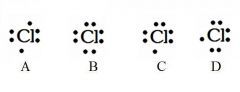
Which of the following is the correct Lewis structure for chlorine?
a)
A
b)
B
c)
C - this is incorrect placement, however I would accept this on a test.
d)
D
38.
How many electrons should Nitrogen have around its Lewis dot model?
a)
1
b)
3
c)
4
d)
5
100 %

