wayground logo

Free Printable Worksheets

NEW

Font size

S
M
L
XL
Worksheets

Scientific Method 1

Total questions: 31

Worksheet time: 3hrs 35mins
Name
Class
Date
1.
Which statement best describes a scientific theory?
a)
A - It is a collection of data designed to provide support for a prediction
b)
B - It is an educated guess that can be tested by experimentation
c)
C - It is a scientific fact that no longer requires any evidence to support it
d)
D - It is a general statement that is supported by many scientific observations.
2.
Researchers performing a well-designed experiment should base their conclusions on
a)
A - the hypothesis of the experiment
b)
B - data from repeated trials of the experiment
c)
C - a small sample size to insure a reliable outcome of the experiment
d)
D - results predicted before performing the experiment
3.
The analysis of data gathered during a particular experiment is necessary in order to
a)
A - formulate a hypothesis for that experiment
b)
B - develop a research plan for that experiment
c)
C - design a control for that experiment
d)
D - draw a valid conclusion for that experiment
4.
A scientist is planning to carry out an experiment on the effect of heat on the function of a certain enzyme. Which would not be an appropriate first step?
a)
A - doing research in a library
b)
B - having discussions with other scientists
c)
C - completing a data table of expected results
d)
D - using what is already known about the enzyme
5.
Why do scientists consider any hypothesis valuable?
a)
A - A hypothesis requires no further investigation.
b)
B - A hypothesis may lead to further investigation even if it is disproved by the experiment
c)
C - A hypothesis requires no further investigation if it is proved by the experiment.
d)
D - A hypothesis can be used to explain a conclusion even if it is disproved by the experiment.
6.
In Texas, researchers gave a cholesterol-reducing drug to 2,335 people and an inactive substitute (placebo) to 2,081. Most of the volunteers were men who had normal cholesterol levels and no history of heart disease. After 5 years, 97 people getting the placebo had suffered heart attacks compared to only 57 people who had received the actual drug. The researchers are recommending that to help prevent heart attacks, all people (even those without high cholesterol) takes these cholesterol-reducing drugs. In addition to the information above, what is another piece of information that the researchers must have before support for the recommendation can be justified?
a)
A - Were eating habits of the two groups similar?
b)
B - How does a heart attack affect cholesterol levels?
c)
C - Did the heart attacks result in deaths?
d)
D - What chemical is in the placebo?
7.
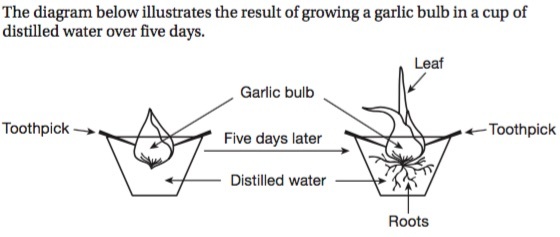
"Garlic grows better as the salt concentration of the solution in which it is grown increases."        Describe the control to be used in the experiment.
a)
Garlic bulb in pure water
b)
Garlic bulb in a solution with high a salt concentration
c)
Garlic bulb in a solution with a low salt concentration
d)
Garlic bulb in a solution with a high glucose concentration
8.
A biologist reported success in breeding a tiger with a lion, producing healthy offspring. Other biologists will accept this report as fact only if
a)
A - research shows that other animals can be crossbred
b)
B - the offspring are given a scientific name
c)
C - the biologist included a control in the experiment
d)
D - other researchers can replicate the experiment
9.
Though scientists study the world from differing perspectives, what must all scientists take into account?
a)
A - universal laws
b)
B - animal behavior
c)
C - temperature differences
d)
D - the importance of biology
10.
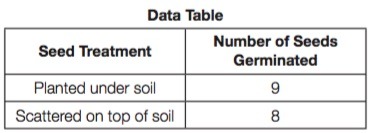
A student hypothesized that lettuce seeds would not sprout (germinate) unless they were exposed to darkness. The student planted 10 lettuce seeds under a layer of soil and scattered 10 lettuce seeds on top of the soil. The data collected are shown in the Data Table #9 above.One way to improve the validity of these results would be to
a)
A - conclude that darkness is necessary for lettuce seed germination
b)
A - conclude that darkness is necessary for lettuce seed germination
c)
C - revise the hypothesis
d)
D - repeat the experiment
11.
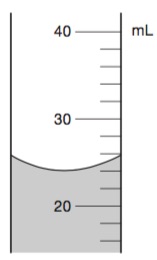
The diagram shows a portion of a graduated cylinder. What is the volume of the liquid in the cylinder?
a)
A - 22 mL
b)
B - 24 mL
c)
C - 25 mL
d)
D - 26 mL
12.
A science researcher is reviewing another scientist's experiment and conclusion. The reviewer would most likely consider the experiment invalid if
a)
A - the sample size produced a great deal of data
b)
B - other individuals are able to duplicate the results
c)
C - it contains conclusions not explained by the evidence given
d)
D - the hypothesis was not supported by the data obtained
13.
Which source would provide the most reliable information for use in a research project investigating the effects of antibiotics on disease-causing bacteria?
a)
A - the local news section of a newspaper from 1993
b)
B - a news program on national television about antigens produced by various plants
c)
C- a current professional science journal article on the control of pathogens
d)
D - an article in a weekly news magazine about reproduction in pathogens
14.
A scientist is investigating a new treatment for a disease that affects thousands of people. Many people with this disease volunteer to be part of the study. Which of the following is an ethical concern that the scientist must address before conducting the study?
a)
A - The scientist must ensure that the treatment will be effective.
b)
B - The scientist must ensure that the study's results will not be shared with other scientists.
c)
C - The scientist must inform the volunteers about the potential dangers of participating in the study.
d)
D - The scientist must demonstrate that the treatment will not cause any side effects.
15.
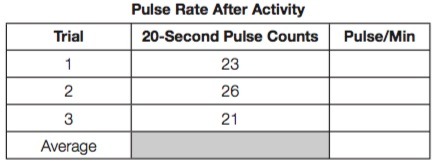
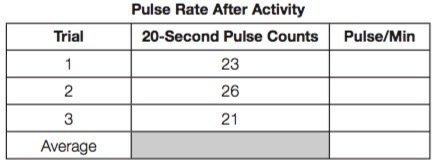
A student squeezes and releases a clothespin as often as possible for 2 minutes and then takes his pulse for 20 seconds. After a 2-minute rest, he repeats the procedure. This pattern is repeated one more time. The student's 20-second pulse counts were 23, 26, and 21.
What is the pulse/minute for trail 1?
a)
60
b)
59
c)
49
d)
69
16.
What additional data should the student have collected in order to determine the effect of squeezing a clothespin on his pulse rate?
a)
The size of the clothespin
b)
The number of people who are apart of the experiment
c)
The resting pulse rate before doing the activity
d)
The type of activity
17.
Which statement best expresses a basic scientific assumption?
a)
A - Interpretation of experimental results has provided explanations for all natural phenomena.
b)
B - If a conclusion is valid, similar investigations by other scientists should result in the same conclusion.
c)
C - For any conclusion to be valid, the design of the experiment requires that only two groups be compared.
d)
D - After a scientist formulates a conclusion based on an experiment, no further investigation is necessary.
18.
Which activity would be an appropriate first step when designing an experiment?
a)
A - reporting a conclusion based on multiple experimental traits
b)
B - researching the problem, using information from a variety of sources
c)
C - creating a data table to organize experimental observations
d)
D - repeating the experiment with a different hypothesis
19.
The development of an experimental research plan should NOT include a
a)
A - list of safety precaution for the experiment
b)
B - list of equipment needed for conducting the experiment
c)
C - procedure for the use of technologies needed for the experiment
d)
D - conclusion based on data expected to be collected in the experiment
20.
A student observes that an organism is green. A valid conclusion that can be drawn from this observation is that
a)
A - the organism must be a plant
b)
B - the organism cannot be a single celled organism
c)
C - the organism must be an animal
d)
D - not enough information is given to determine whether the organism is a plant or an animal.
21.

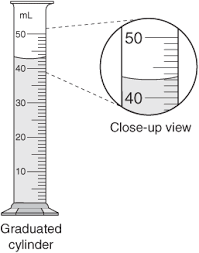
A student measures the liquid in the graduated cylinder and determines that it is 43 ml. What is the student doing?

a)

Make an hypothesis

b)

Making a prediction

c)

Making an observation

d)

Making an inference

22.

What is another term used to describe the independent variable?

a)

Responding variable

b)

Manipulated variable

c)

Control variable

d)

Constant variable

23.

When conducting an experiment, why do we analyze our data?

a)

To form a question to investigate

b)

To draw a valid conclusion for that experiment

c)

To design the experiment

d)

To create a hypothesis

24.

Which of the following is the most accurate representation of the order that an experiment should be conducted?

a)

1.Hypothesis 2.Question 3. Analyze data 4. Formulate conclusion

b)

1.Question 2. Gather materials 3. Test the hypothesis 4. Formulate a conclusion

c)

1.Gather materials 2. Analyze data 3. Hypothesis 4. Question

d)

1.Analyze data 2. Hypothesis 3. Question 4. Gather materials

25.

In experiment that determines the effect of exercise on heart rate , what is the control group?

a)

The group that exercises

b)

The group that drinks water

c)

The group that does not exercise

d)

The group that tracks the time it takes to exercise

26.

Identify the statement below that best describes an observation that supports the fact that the student's heart range was above their normal rate which 115 beats per minute.

a)

The student was tired after exercising

b)

The student was sweating after exercising

c)

The student was sitting down after exercising

d)

The student measured their heart at 125 beats per minute after exercising

27.

Identify the observation below that shows an object is being burnt and that it is going through a chemical change.

a)

The object changes shape

b)

The object melts

c)

The object changes color and turns into something new

d)

The object begins to bubble

28.

In an experiment to find out the effects of sunlight on a plant's growth the experimenter completes the following steps. They allow one plant to get sunlight for 2 hours a day. Another plant receives 4 hours of sunlight, and the last plant receives 8 hours of sunlight. What is the independent variable?

a)

The growth of the plant

b)

The amount of sunlight

c)

The amount of water

d)

The experimenter

29.

In an experiment to find out the effects of sunlight on a plant's growth the experimenter completes the following steps. They allow one plant to get sunlight for 2 hours a day. Another plant receives 4 hours of sunlight, and the last plant receives 8 hours of sunlight. What is the dependent variable?

a)

The growth of the plant

b)

The amount of water

c)

The amount of sunlight

d)

The experimenter

30.

In order to compare the effects that different types of liquid on plant growth the following experiment was conducted. One plant received water, another plant received milk, and the third plant was given orange juice. What would be the control in this investigation?

a)

The plant that gets the orange juice

b)

The plant that receives the water

c)

The plant that receives the milk

d)

The plant that receives the soda

31.

What is the purpose of a graph in a lab report?

a)

To accurately represent the data

b)

To observe the patterns or trends that are seen in the data

c)

To reduce errors in the investigation

d)

To create data not seen in the data table