
 Worksheets
Isotope Review
Total questions: 23
Worksheet time: 14mins
Name
Class
Date
1.
What is the scientific definition of a theory?
a)
A guess.
b)
A well tested set of ideas that explain many observations.
2.
What phenomenon did Einstein explain mathematically, thus showing that atoms must exist?
a)
Einsteinian motion, the observed random motion of a grain of pollen in a solution
b)
Brownian motion, the observed random motion of a grain of pollen in a solution
c)
Planckian motion, the observed random motion of a grain of pollen in a solution
d)
Curian motion, the observed random motion of a grain of pollen in a solution
3.
An Atom:
a)
An ancient idea about the structure of substances that is incorrect.
b)
Has electrons and neutrons in the nucleus.
c)
Makes up protons.
d)
Is the smallest discrete particle of an element than can exist.
4.
All of the following are characteristics of electrons except:
a)
Has the same charge as the proton, but opposite.
b)
Is 1800 times less massive than a proton.
c)
Has the same charge as a neutron.
d)
Is 1800 times less massive than a neutron.
5.
The defining property of an atom is:
a)
The number of neutrons in the atom.
b)
The number of protons in the atom.
c)
The number of electrons in the atom.
d)
The number of positrons in the atom.
6.
What is the neutron's role in the nucleus?
a)
To counteract the repulsive forces between the protons.
b)
To counteract the repulsive force between electrons.
c)
To increase the mass of the atom, allowing it to react properly with other elements.
d)
To determine the type of element the atom is.
7.
Why is the relative atomic mass not a whole number?
a)
Nuclei can contain partial neutrons.
b)
Nuclei can contain varying number of electrons.
c)
Nuclei can contain partial protons.
d)
Nuclei can contain different numbers of neutrons and be the same element.
8.
The atomic number of Uranium is:
a)
110
b)
16
c)
53
d)
92
9.
O is the symbol for what element?
a)
Orduvicium
b)
Oxygen
c)
Osmium
d)
Holonium
10.
The average atomic mass of Cesium is
a)
132.905
b)
55
c)
190.23
d)
Unknown
11.
The chemical symbol for Sulfur is:
a)
Su
b)
S
c)
Fr
d)
Sr
12.

What is the name of the atom pictured here?
a)
Nitrogen
b)
Nitrogen-15
c)
Nitrogen-7
d)
Nitrogen-8
13.
Silicon-30 has an atomic mass of:
a)
14
b)
15
c)
16
d)
30
14.

The number of neutrons in this atom is:
a)
15
b)
5
c)
Not enough information is available
d)
10
15.
The number of neutrons in Beryllium-8 is:
a)
4
b)
7
c)
8
d)
3
16.
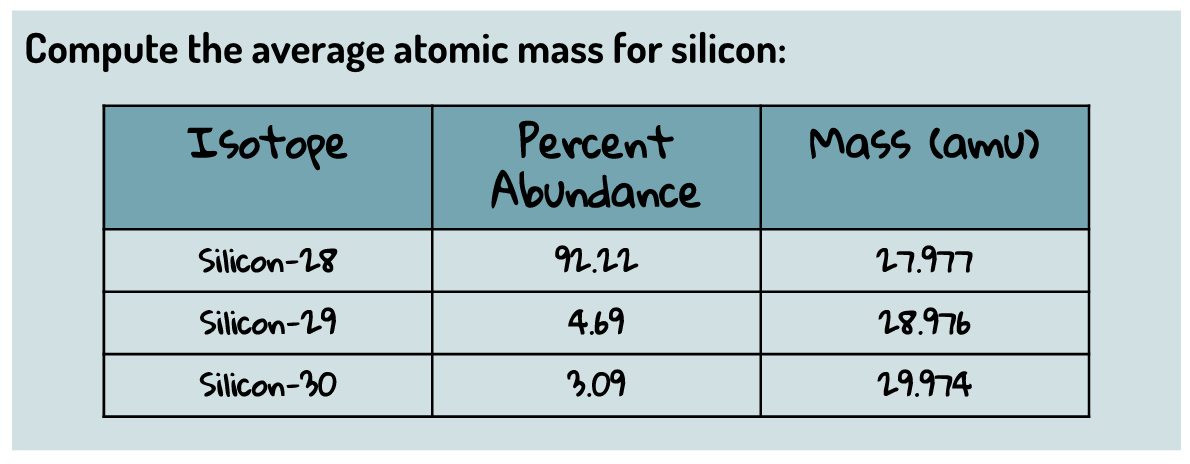
Compute the average atomic mass for silicon:
a)
27.977
b)
28.09
c)
28.976
d)
The average mass cannot be determined from provided information.
17.

The highlighted elements are called:
a)
alkali gases
b)
actinoids
c)
noble gases
d)
metalloids
18.

The following are examples of:
a)
the wavelengths of light emitted or absorbed by atoms of a given element
b)
possible white light spectra
c)
absorption spectra
d)
the color wheel
19.

The highlighted elements are:
a)
metalloid
b)
transitions metals
c)
alkali metals
d)
lanthanoids
20.
Cesium (atomic number: 55) is:
a)
a transition metal
b)
an alkali metal
c)
an alkaline earth metal
d)
a nobel gas
21.
Germanium (atomic number: 32) is:
a)
a metalloid
b)
a halogen
c)
a transition metal
d)
a post-transition metal
22.

This atom has:
a)
Three more electrons than a neutral atom of aluminum.
b)
Three less electrons than a neutral atom of aluminum.
c)
Three more protons than a neutral atom of aluminum.
d)
Is actually another way of writing the symbol for sulfur.
23.

This electron configuration shows the ground state of what element?
a)
Phosphorus
b)
Nitrogen
c)
Aluminum
d)
Oxygen
100 %

