
 Worksheets
US History AP Midterm Review
Total questions: 182
Worksheet time: 3hrs 58mins
Name
Class
Date
1.
Which significant American political document was signed July 4, 1776?
a)
The Virginia Bill of Rights
b)
The Mayflower Compact
c)
The United States Constitution
d)
The Declaration of Independence
2.
Which British Law required certain Colonists to allow British troops to live in their homes?
a)
Townshend Revenue Act
b)
Quartering Act
c)
Declaratory Act
d)
Intolerable Acts
3.
The Townshend Revenue Act allowed British officials to:
a)
Break down doors to seize items
b)
Sell finished products to the Colonists at extra high prices
c)
Crack down on rebellious activity in the colonies
d)
Declare all laws passed in the colonies to have no effect
4.
In the Declaration of Independence "Life, liberty, and the pursuit of happiness" are called "unalienable". What is the definition of unalienable?
a)
Impossible to surrender
b)
Impossible for a peasant to obtain
c)
Impossible to buy
d)
Impossible to earn
5.
What was one immediate effect of the passage of The Stamp Act?
a)
Colonists began to make their own paper
b)
British tax collectors began to live more comfortable lives
c)
Colonists began to boycott British goods
d)
British ships refused to dock in Boston harbor
6.
Why did the Townshend Revenue act focus on items such as paint, glass, paper, and lead?
a)
The British crown needed money to pay for its wars
b)
Colonists no longer could afford these items
c)
The British people preferred Colonial goods over British goods
d)
Colonists could not produce these items on their own
7.
Who was fighting each other in The French and Indian war?
a)
The French & Indians vs. The British
b)
The French vs. The Indians
c)
The Indians vs. The British
d)
The French vs. The British
8.
Which of the following words mean "a complaint"?
a)
Self-Evident
b)
Delegate
c)
Grievance
d)
Unalienable
9.
Why were the colonists so angry about The Tea Act?
a)
The British tea tasted bad
b)
The British tea was taxed heavily
c)
The British tea was ruined because of the Boston Tea Party
d)
They did not like that their choices were limited
10.
Which of the following colonies was punished by The Intolerable Acts?
a)
Virginia
b)
Massachusetts
c)
Georgia
d)
New York
11.
What did the representatives of the colonies do in the 1st Continental Congress?
a)
They wrote a letter to the King to respect their rights
b)
They wrote the Declaration of Independence
c)
They planned The Boston Tea Party
d)
They wrote the U.S. Constitution
12.
The colonists who carried out The Boston Tea Party were disguised as which of the following?
a)
Hessians
b)
British Soldiers
c)
Native Americans
d)
French Soldiers
13.
The 2nd Continental Congress was organized in order to find a solution to which of the following laws?
a)
The Tea Act
b)
The Intolerable Acts
c)
The Stamp Act
d)
The Townshend Revenue Act
14.
Which of the following items would have been taxed according to The Stamp Act?
a)
Playing Cards
b)
A Rifle
c)
Corn
d)
Coffee
15.
How did the British government plan to make money to pay off its debts?
a)
Do a bake sale
b)
Sell tea in Europe
c)
Go to war
d)
Tax the colonists heavily
16.
The Declaratory Act stated:
a)
Parliament had the power to tax the colonists whenever they wanted
b)
British soldiers could live in the houses of the colonists
c)
Printed materials must be taxed
d)
British tea would not be taxed, making it the cheaper option
17.
A person who fought for independence was known as a:
a)
Loyalist
b)
Tory
c)
Patriot
d)
Scallywag
18.
A person who wanted to remain together with Great Britain was known as a:
a)
Loyalist
b)
Tory
c)
Patriot
d)
Scallywag
19.
When Thomas Jefferson copied John Locke's ideas about the social contract, what did he say the people had the right to do to a government who was not protecting the people's rights?
a)
Write a letter
b)
Suggest how it could be better
c)
Wait until they started to respect the people's rights
d)
Abolish it
20.
Which of the following words means to "refuse to buy goods"?
a)
Grievance
b)
Boycott
c)
Delegate
d)
Self-evident
21.
Who was the main author of the Declaration of Independence?
a)
Benjamin Franklin
b)
Samuel Adams
c)
Thomas Jefferson
d)
Paul Revere
22.
Jefferson stated that people have the rights to life, liberty, and the pursuit of happiness.
a)
your born rights
b)
bill of rights
c)
natural rights
d)
1st amendment
23.
According to the Declaration of Independence, where does the government get its power?
a)
From its Constitution
b)
From its military
c)
From the elected representatives
d)
From the Consent of the Governed
24.

What is the importance of the first section, the Introduction.
a)
States that people have rights that cannot be taken away and the purpose of a government
b)
It's the longest section that states the grievances the colonists had.
c)
It's where members of Congress signed & pledged their loyalty to one another & declared independence
d)
States why it is being written, which was to break away from Britain.
25.

The phrase "No Taxation without Representation" was shouted by colonist who felt what?
a)
They needed a tax collector
b)
That they had no voice in Parliment
c)
That they wanted their tax check
d)
That Parliament had heard them
26.
What happened to the patriots on the Battle of Breeds Hill/ Bunker Hill?
a)
They defeated the Red Coats
b)
They ran out of ammunition
c)
They used the first machine gun
d)
They surrendered
27.
What was the purpose of the DoI?
a)
to declare independence from France.
b)
to declare independence from Germany.
c)
to declare independence from Cuba.
d)
to declare independence from England
28.
What are unalienable rights?
a)
Rights of this world
b)
Rights granted by the King
c)
Rights you have just because you were born
d)
Rights given in the Constitution
29.
A leader in government who is cruel to his/her people is called a __________.
a)
tyrant
b)
mayor
c)
depot
d)
nice
30.
According to Jefferson, if a government does not protect our natural rights, what should the people do?
a)
Ignore or support it
b)
Celebrate and petition
c)
Alter it and ignore it
d)
Alter or abolish it
31.
When the colonists said they were going to dissolve their political bands with Britain, they meant that they were going to ________ these bands.
a)
end
b)
strengthen
c)
declare
d)
make sacred
32.
The Grievance section of the DoI is directed toward whom?
a)
The Colonists
b)
Parliment
c)
King George III
d)
King Charles
33.
The Declaration begins with the List of Grievances.
a)
True
b)
False
34.
The Articles of Confederation created a _________________ type of government.
a)
strong
b)
average
c)
weak
d)
federal
35.
One weakness of the Articles of the Confederation was ____________.
a)
The ability of Congress to tax.
b)
The inability of Congress to tax.
c)
The ability of Congress to declare war.
d)
The ability of Congress to create courts.
36.
Under the Articles of Confederation, the government consisted of _______________ branch of government.
a)
3
b)
2
c)
1
d)
4
37.
Under the Articles of Confederation, Congress could regulate trade between the states.
a)
true
b)
false
38.
Under the Articles of Confederation, more government power went to the -
a)
state governments
b)
national government
c)
foreign governments
d)
Native American councils
39.

The main idea of this cartoon is that the Articles of Confederation -
a)
would carry the nation into the future
b)
had many serious problems
c)
gave the government strong powers
d)
created a navy strong enough to protect against a foreign invasion
40.
Which branches were NOT included under the AOC?
a)
Legislative and Judicial
b)
Executive and Judicial
c)
Legislative and Executive
41.
The country under the Articles of Confederation could not defend itself because it could not
a)
collect taxes
b)
amend the Articles
c)
create a national Army
42.

This picture shows which weakness of the Articles?
a)
no common currency
b)
no executive branch
c)
no power to tax
d)
one vote for each state
43.
How did Shays' Rebellion affect people's reactions to the Articles of Confederation?
a)
People hoped for a new revolution.
b)
People worried about having a weak central government.
c)
People wanted more individual rights.
d)
It put more farmers' in debtors jail.
44.
What is one reason people wanted change to the Articles of Confederation?>
a)
They opposed the Land Ordinance of 1785.
b)
They didn't want the government to have only 1 branch.
c)
Central government was weak and ineffective.
d)
State government was weak and ineffective.
45.
Who put down Shays Rebellion?
a)
French troops
b)
British soldiers
c)
local state militia
d)
John Adams
46.
The Articles of Confederation established a national court system for the country.
a)
True
b)
False
47.
Shay's Rebellion started as a protest against
a)
unfair taxes and farmer debt
b)
the death penalty
c)
no judicial system
d)
debtors' prisons
48.
Daniel Shays' rebellion showed that:
a)
the government under the Articles of Confederation could not keep control of its citizens
b)
the government should be able to defend our citizens from Great Britain again
c)
the government needs to protect the citizens from Native American attacks
49.
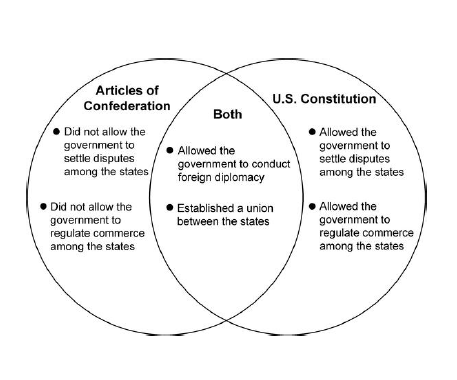
The Venn diagram describes the powers of the Articles of Confederation and the U.S. Constitution.
Which conclusion does the diagram support?
Which conclusion does the diagram support?
a)
The Articles of Confederation were very effective in solving the new nation's various problems.
b)
The Articles of Confederation were effective because they gave more power to the states than to the central government.
c)
The Articles of Confederation were ineffective because they gave more power to the central government than to the states.
d)
The Articles of Confederation were ineffective because they gave too much power to the states and not enough power to the central government.
50.
What is the Declaratory Act?
a)
Allowed Parliament to make laws for the colonists although the British government allowed them no representation in Parliament.
b)
Required colonist to house British army in their private homes.
c)
Taxed all products made of paper.
51.
What phrase was a main cause for the cry for independence?
a)
Give me Liberty or give me death.
b)
It is what it is.
c)
"no taxation without representation
130.
What was the name of the pamphlet that Thomas Paine wrote?
a)
Declaration of Independence
b)
Common Sense
c)
Peter Pan
53.
What was the name of the document that the Continental Congress composed to declare Independence from Britain?
a)
Common Sense
b)
Bill of Rights
c)
Declaration of Independence
54.
Who was the author of the Declaration of Independence?
a)
Thomas Jefferson
b)
George Washinigton
c)
Thomas Paine
131.
When was the Declaration of Independence ratified(official approval)?
a)
January 1, 1778
b)
July 4, 1776
c)
October 31, 1774
132.
Who was known for engraving "The Bloddy Massacre" and for warning that the British were coming?
a)
Thomas Jefferson
b)
James Madison
c)
Paul Revere
57.
In what battle was the "shot heard round the world" fired?
a)
The Battle of Lexington
b)
Ticonderoga
c)
Bunker Hill
58.
Who was the commander of the Continental Army?
a)
Thomas Jefferson
b)
George Washington
c)
Benedict Arnold
59.
In which battle did the Continental Army surprise attack Hessian soldiers on Christmas night?
a)
Bunker Hill
b)
Ticonderoga
c)
Battle of Trenton
60.
What battle was considered the turning point of the war?
a)
Battle of Saratoga
b)
Ticongeroga
c)
Trenton
61.
Where did the Continental Army spend the winter of 1777-1778?
a)
Valley Forge
b)
Bahamas
c)
Yorktown
62.
What style of warfare did Francis Marion use?
a)
duck and cover
b)
horns and run
c)
guerrilla warfare
63.
What country helped the patriots in the battle of Yorktown?
a)
French
b)
Germans
c)
British
64.
What Navy blockaded the bay at Yorktown to prevent the British from recieving support?
a)
German Navy
b)
Japanese Navy
c)
French Navy
65.
What was the name of the treaty (year included) that ended the Revolutionary War?
a)
Treaty of Paris
b)
Treaty of Versallies
c)
Treaty of Paris 1783
66.
Which NC battle weakened the supplies and morale of the British before Yorktown?
a)
Ticonderoga
b)
Guilford Courthouse
c)
Concord
67.
Who was the patriot general of the Battle of Guilford Courthouse?
a)
Benedict Arnold
b)
Nathanael Greene
c)
Thomas Jefferson
68.
To gain support for the Patriot cause what did Patrick Henry say in his speech that was motivational?
a)
"It is what it is...so let us fight!'
b)
"Give me liberty, or give me death"
c)
"taxation without representation is AWESOME!"
69.
Who was elected as the first president fo the United States of America?
a)
John Hancock
b)
George Washington
c)
Nathanael Greene
70.
What were mercinaries?
a)
Hired soilders from other countries (Hessians)
b)
People who loved to show mercy.
c)
very loving understanding people from other countried.
71.
What document was basically America's first Constitution?
a)
Bill of Rights
b)
Declration of Independence
c)
Articles of Confederation
72.
What was the last major battle of the American Revolution?
a)
Yorktown
b)
Jamestown
c)
Ticonderoga
73.
Who were the Redcoats?
a)
French and German Army
b)
American Army
c)
British Army
74.
Where was the Constitutional Convention held?
a)
Annapolis
b)
Philadelphia
c)
Washington D.C.
d)
Boston
75.
In what year was the Constitutional Convention held?
a)
1776
b)
1781
c)
1787
d)
1790
76.
What was the original goal of the Constitutional Convention?
a)
Revise the Articles of Confederation
b)
Create a new consitution
c)
Elect Washington to the presidency
d)
Establish an army
77.
Who introduced the Virginia Plan at the Constitutional Convention?
a)
Thomas Jefferson
b)
John Adams
c)
Edmund Randolph
d)
Roger Sherman
78.
Under the Virginia Plan, who would have supreme power?
a)
Central Government
b)
States
c)
President
d)
Legislature
79.
Under the Virginia Plan, how many houses would the legislature have?
a)
1
b)
2
c)
3
d)
4
80.
How would representatives be decided under the Virginia plan?
a)
every state is equal
b)
based on population
c)
president would choose
d)
courts would decide
81.
What plan was created to oppose the Virginia Plan?
a)
New Jersey Plan
b)
Pennsylvania Plan
c)
New York Plan
d)
Delaware Plan
82.
Who introduced the New Jersey Plan at the Constitutional Convention?
a)
John Adams
b)
Patrick Henry
c)
William Paterson
d)
James Madison
83.
Under the New Jersey Plan, how many houses would the legislature have?
a)
1
b)
2
c)
3
d)
4
84.
Under the New Jersey Plan, how would representatives be decided?
a)
states would be equal
b)
based on population
c)
president would decide
d)
courts would decide
85.
What solution solved the debate between the New Jersey and Virginia plans?
a)
Great Compromise
b)
3/5 Compromise
c)
Washington's Way
d)
Great Awakening
86.
Who introduced the Great Compromise to the Constitutional Convention?
a)
James Madison
b)
James Wilson
c)
George Washington
d)
Roger Sherman
87.
Under the Great Compromise, how many houses would the legislature have?
a)
1
b)
2
c)
3
d)
4
88.
Which house of the legislature has representatives based on population?
a)
House of Representatives
b)
Senate
89.
How many representatives does each state have in the Senate?
a)
1
b)
2
c)
3
d)
4
90.
What solution solved the debate regarding how slaves should be counted?
a)
Great Compromise
b)
Slave Solution
c)
South Carolina Plan
d)
3/5 Compromise
91.
In what system is political power shared between a central government and the states that form a country?
a)
republicanism
b)
federalism
c)
democracy
d)
compromise
92.
What is the name for the idea that the power in a government belongs to the people?
a)
popular sovereignty
b)
democracy
c)
plurality
d)
republicanism
93.
How many branches of government did the Constitution create?
a)
1
b)
2
c)
3
d)
4
94.
Which branch of the government writes the laws?
a)
legislative
b)
executive
c)
judicial
95.
Which branch of government includes the president?
a)
legislative
b)
executive
c)
judicial
96.
Which branch of government is made up of all the national courts?
a)
legislative
b)
executive
c)
judicial
97.
What system prevents any branch of the government from becoming too powerful?
a)
federalism
b)
democracy
c)
socialism
d)
checks and balances
98.
The Southern economy depended on...
a)
Plantations
b)
Manufacturing
c)
Fishing
d)
Logging
99.
Where did the colonists get the idea of representative government from?
a)
The French
b)
The English
c)
The Spanish
d)
Themselves
100.
The Magna Carta and English Bill of Rights took power away from who?
a)
The Lords
b)
The Ladies
c)
The People
d)
The King
101.
Which time period caused greater religious freedom in the colonies?
a)
The Great Awakening
b)
The Enlightenment
c)
The Middle Ages
d)
The Gilded Age
102.
Which item is being sold to a foreign country?
a)
Import
b)
Export
c)
Deport
d)
Ports
103.
Which word means partnership?
a)
Group
b)
Alliance
c)
Enemies
d)
Peers
104.
Which act was passed as a result of the Boston Tea Party?
a)
Stamp Act
b)
Quartering Act
c)
Intolerable Acts
d)
Outrageous Acts
105.
What act taxed printed material in the colonies?
a)
Townshend Act
b)
Intolerable Act
c)
Stamp Act
d)
Print Act
106.
In order to pay off French and Indian War debt, the British Parliament took what action?
a)
Closed the Boston Harbor
b)
Passed new colonial taxes like the Stamp Act
c)
Held a seaside tea party
d)
Allowed the colonists to chose their own governors
107.
Sons of __________ founded by Sam Adams
a)
Anarchy
b)
Liberty
c)
Peace
108.
Soil, minerals, air, water, and coal are all examples of
a)
Fossil fules
b)
Conservation
c)
recycling
d)
natural resources
109.
What three countries had colonies in the New World
a)
Spain, France, and Africa
b)
England, France, and Spain
c)
Africa, England, and Spain
110.
Which European country claimed territory in the New World which included the West Indies and Florida? They farmed this land and searched for gold.
a)
Spain
b)
France
c)
England
111.
Which European country claimed territory in the New World which included parts of Canada, area along the Mississippi, and St. Lawrence Rivers?
a)
Spain
b)
France
c)
England
112.
Which of the following crops was NOT grown in the southern colonies?
a)
Tobacco
b)
Wheat
c)
Rice
d)
Indigo
113.
What three regions did the Triangular Trade Route connect during colonial times?
a)
Asia, England, and the English Colonies
b)
Africa, England, and the English Colonies
c)
Spain, England, and France
d)
Africa, France, and the English Colonies
114.
William wants to migrate to the colonies but he doesn't have enough money. He finds a wealthy colonist and promises to work for him in the New World. William is
a)
an indentured servant
b)
an African Slave
c)
a master craftsman
d)
an apprentice
115.
Within the Triangular Trade Route, enslaved Africans were shipped across the Atlantic Ocean and many died of hunger, disease, harsh treatment. This is known as
a)
Great Migration
b)
Middle Passage
c)
Columbian Exchange
d)
Northwest Passage
116.
Most of the slaves in the 13 English Colonies were imported into the
a)
New England Colonies
b)
Middle Colonies
c)
Southern Colonies
117.
Indentured servants and slaves influenced the colonies in all of the following ways EXCEPT
a)
creating new cooking styles
b)
developing the Gullah language
c)
writing books
d)
developing new farming techniques
118.
Which colonies were nicknamed the "bread basket" colonies because of all the wheat they grew and sold?
a)
New England Colonies
b)
Middle Colonies
c)
Southern Colonies
119.
Select the one characteristic of a slave that made him/her different from an indentured servant.
a)
They were forced to work without pay forever.
b)
They worked for wealthy colonists.
c)
Freedom was granted after a period of time.
d)
Many times they eventually worked for themselves.
120.
The English government had a tradition of legislative representation in _______.
a)
Boston
b)
Parliament
c)
French and Indian War
121.
What was the result of the French and Indian War?
a)
The British won and gained land in the Ohio River Valley area.
b)
The French won and gained land in the Ohio River Valley area.
c)
The Indians won and gained land in the Ohio River Valley area.
122.
________ were times of violence by slaves.
a)
Slave Codes
b)
Faking Illness
c)
Slave Revolts
123.
All of the following were ways that slaves fought back against their owners EXCEPT
a)
Working slowly
b)
Breaking tools
c)
Cooking with vegetables
d)
Running Away
124.
Goods that are brought into a country/colony are called imports. Goods that go out are called exports.
a)
TRUE
b)
FALSE
125.
Quakers settled in the Southern Colonies.
a)
TRUE
b)
FALSE
126.
Florida was an English Colony.
a)
TRUE
b)
FALSE
127.
Indentured servants suffered many hardships during the Middle Passage.
a)
TRUE
b)
FALSE
128.
Puritans had very strict religious beliefs.
a)
TRUE
b)
FALSE
129.
Some slaves in the North could work additional jobs to purchase their freedom.
a)
TRUE
b)
FALSE
130.
What was the name of the pamphlet that Thomas Paine wrote?
a)
Declaration of Independence
b)
Common Sense
c)
Peter Pan
131.
When was the Declaration of Independence ratified(official approval)?
a)
January 1, 1778
b)
July 4, 1776
c)
October 31, 1774
132.
Who was known for engraving "The Bloddy Massacre" and for warning that the British were coming?
a)
Thomas Jefferson
b)
James Madison
c)
Paul Revere
133.
What kind of lives did the Puritans live?
a)
Stictly the words of the bible
b)
The bible was important but not the end-all-be-all
c)
They never followed the words of the bible
d)
They had never been exposed to the bible
134.
The Great Awakening focused on what?
a)
Rivalries
b)
Religion
c)
Riots
d)
Rebellion
135.
Which time period focused on science, reason, and knowledge?
a)
The Great Awakening
b)
The Enlightenment
c)
The Middle Ages
d)
The Gilded Age
136.
Which of the following is a natural right?
a)
Life
b)
Liberty
c)
Property
d)
All of the above
137.
Which act said that colonists could only trade with the English and on English ships?
a)
The Navigation Acts
b)
The Proclamation of 1763
c)
The Declaration of Independence
d)
The Second Act
138.
After the French lost the French and Indian War the two powers left in North America were...
a)
The British and French
b)
The French and Spanish
c)
The British and Spanish
d)
The Spanish and Dutch
139.
The Proclamation of 1763 said that colonists could no longer move ____________ into Native American lands.
a)
North
b)
South
c)
East
d)
West
140.
What do you call permanantly moving from one country to another?
a)
Travel
b)
Vacation
c)
Immigration
d)
Lost
141.
What type of military force is made up of ordinary citizens?
a)
Army
b)
Navy
c)
Air Force
d)
Militia
142.
Which word means partnership?
a)
Group
b)
Alliance
c)
Enemies
d)
Peers
143.
Which word is farming just enough to meet your family's needs?
a)
Plantation
b)
Cash Crops
c)
Subsistence Farming
d)
Organic
144.
What theory says that having colonies will help a country build their wealth?
a)
Economics
b)
Mercantilism
c)
Military
d)
Eco-friendly
145.
This French explorer settled parts of Canada
a)
Henry Hudson
b)
John Cabot
c)
Samuel Champlain
d)
Jacques Cartier
146.
This Spanish explorer's crew made it all the way around the world
a)
Vasco da Gama
b)
Christopher Columbus
c)
Ferdinand Magellan
d)
Juan Ponce de Leon
147.
This French explorer found a Great Lake and established Quebec
a)
Christopher Columbus
b)
Ferdinand Magellan
c)
Jacques Cartier
d)
Samuel Champlain
148.
This explorer sailed for Portugal and found an all-water route to Asia
a)
Vasco da Gama
b)
Vasco Nunez de Balboa
c)
Francisco Pizarro
d)
Hernan Cortes
149.
This Spanish explorer searched for the Fountain of Youth in Florida
a)
Christopher Columbus
b)
Samuel Champlain
c)
Juan Ponce de Leon
d)
Francisco Pizarro
150.
Which of the following was NOT a motivating factor for exploration by the Europeans?
a)
Gold
b)
God
c)
Water Routes
d)
Wipe out natives
151.
Which of the following is NOT true about Christopher Columbus?
a)
He accidentally found the Americas
b)
He went to his grave thinking he landed in Asia
c)
He was sponsored by Queen Isabella and King Ferdinand of Spain
d)
He was kind to the natives where he landed
152.
Which of the following is NOT true of Ferdinand Magellan's life?
a)
He attempted to circumnavigate the globe
b)
He was killed by natives in the Philippines
c)
He successfully circumnavigated the globe himself
d)
He sailed for Portugal
153.
Why was the Slave Trade a major effect of exploration?
a)
Slaves were brought to the Americas by explorers
b)
Slaves were needed in the New World to replace natives
c)
Slave labor was needed on the ships
d)
Slave labor was needed in the factories in England
154.
Why were colonies a major effect of the Age of Exploration?
a)
Explorers lived in the lands they discovered
b)
European nations wanted to colonize as much land as possible
c)
European nations did not want natives to return to their land
d)
Explorers tried to bring as many natives home with home with them as possible
155.
What was the Columbian Exchange?
a)
The global exchange of plants, food, diseases, and people over continents
b)
A method of currency created by Christopher Columbus
c)
The exchange of slave labor from Africa to the Americas
d)
The movement of people from the Americas to Europe
156.
Which of the following is NOT a way that Europeans were impacted by the Columbian Exchange?
a)
Some contracted Syphillis
b)
They were introduced to many new plants and foods
c)
They were introduced to the horse
d)
They learned about the food, Maize from the natives
157.
Which of the following is a way exploration affected the natives of the Americas?
a)
They contracted many diseases and many died
b)
They were treated well by the Europeans
c)
They were exposed to llamas
d)
They were provided with potatoes by the Europeans
158.
Strong Leadership:
George Washington
George Washington
a)
American Strength
b)
British Strength
c)
American Weakness
d)
British Weakness
159.
Not Enough Soldiers
a)
American Strength
b)
British Strength
c)
American Weakness
d)
British Weakness
160.
Many soldiers were poorly trained
a)
American Strength
b)
British Strength
c)
American Weakness
d)
British Weakness
161.
Strong beliefs - they were 100% dedicated to winning the war
a)
American Strength
b)
British Strength
c)
American Weakness
d)
British Weakness
162.
Not enough supplies to keep all soldiers fed, armed, and clothed
a)
American Strength
b)
British Strength
c)
American Weakness
d)
British Weakness
163.
They fought to defend their homes, land, and principles
a)
American Strength
b)
British Strength
c)
American Weakness
d)
British Weakness
164.
Had professional soldiers who were very well trained and supplied
a)
American Strength
b)
British Strength
c)
American Weakness
d)
British Weakness
165.
Horrible Military Leadership
a)
American Strength
b)
British Strength
c)
American Weakness
d)
British Weakness
166.
Had the strongest army and navy in the world
a)
American Strength
b)
British Strength
c)
American Weakness
d)
British Weakness
167.
Didn't know the land and didn't have the advantage on the battlefield
a)
American Strength
b)
British Strength
c)
American Weakness
d)
British Weakness
168.
Distance between American and Britain made communication and moving supplies hard
a)
American Strength
b)
British Strength
c)
American Weakness
d)
British Weakness
169.
Who won the battle at Fort Ticonderoga
a)
Colonists
b)
British
c)
Native Americans
d)
French
170.
The Coercive Acts (aka The Intolerable Acts) did all of the following EXCEPT:
a)
Shut down Boston Harbor until tea was paid for
b)
Ended all taxes on the colonists
c)
Stopped all town meetings/assemblies
d)
Forced colonists to let British soldiers live among them
171.
Thomas Jefferson wrote the Declaration of Independence in:
a)
1763
b)
1776
c)
1795
d)
2016
172.
The Declaration of Independence was written during a meeting of the:
a)
First Continental Congress
b)
Albany Plan of the Union
c)
Iroquois Confederacy
d)
Second Continental Congress
173.
These acts were passed to punish the colonists for rebelling in Boston
a)
Townshend Acts
b)
Sugar Acts
c)
Stamp Acts
d)
Coercive Acts
174.
He was the founder of the Sons of Liberty
a)
John Adams
b)
Samuel Adams
c)
Benjamin Franklin
d)
Patrick Henry
175.
Some colonial militias were called this because they said they'd be ready to fight on short notice.
a)
lobsterbacks
b)
minutemen
c)
colonists
d)
loyalists
176.
He was the first colonist to die at the Boston Massacre. He was half African American.
a)
Benjamin Franklin
b)
William Pitt
c)
Crispus Attucks
d)
Patrick Henry
177.
When the French first arrived in North America, they were involved in this...
a)
coal mining
b)
subsistence farming
c)
fishing and fur trading
d)
baseball
178.
Even on March 5, 1770 - the day violence broke out between Redcoats and colonists
a)
Boston Tea Party
b)
Boston Massacre
c)
American Revolution
d)
Fort Ticonderoga
179.
After the colonists protested the Townshend Acts, the taxes were removed on everything except:
a)
Tea
b)
Paper
c)
Glass
d)
Paint
180.
This taxed imported goods such as glass, paper, paint, lead and tea
a)
Coercive Act
b)
Stamp Act
c)
Townshend Act
d)
Sugar Act
181.
What caused the British to go into debt in the 1700s?
a)
The American Revolution
b)
The French and Indian War
c)
The Constitution
d)
The Battle of Bunker Hill
182.
What is the first step the British took to make sure they were getting the taxes from the colonists?
a)
Stamp Act
b)
Writs of Assistance
c)
Sugar Act
d)
Intolerable Acts
100 %

