
 Worksheets
8th Grade Mid-Term Science Review
Total questions: 40
Worksheet time: 34mins
Name
Class
Date
1.

Label the Neuron-What does the letter "A" represent?
a)
Axon
b)
Dendrite
c)
Axon Terminal
d)
Cell Body
2.

Label the Neuron-What does the letter "B" represent?
a)
Myelin Sheath
b)
Schwann Cell
c)
Cell Body
d)
Nucleus
3.

Label the Neuron-What does the letter "C" represent?
a)
Cell Body
b)
Dendrite
c)
Axon Terminal
d)
Myelin Sheath
4.

Label the Neuron-What does the letter "E" represent?
a)
Schwann Cell
b)
Node of Ranvier
c)
Axon Terminal
d)
Myelin Sheath
5.

Label the Neuron-What does the letter "D" represent?
a)
Dendrite
b)
Axon
c)
Myelin Sheath
d)
Node of Ranvier
6.

Label the Neuron-What does the letter "H" represent?
a)
Schwann Cell
b)
Axon
c)
Axon Terminal
d)
Dendrite
7.
The part of the neuron that brings information to the cell body is called a(n) ___________.
a)
dendrite
b)
axon
c)
nucleus
d)
node of Ranvier
8.
The part of the neuron that takes information away from the cell body is called a(n) _____________.
a)
dendrite
b)
axon
c)
cell body
d)
Schwann cell
9.
Location at which a neuron can transfer an impulse to another cell with the use of neurotransmitters is called __________.
a)
myelin sheath
b)
axon
c)
threshold
d)
synapse
10.
A change or signal in the environment that can make an organism react is call a(n)
a)
reaction
b)
stimulus
c)
response
11.
The variable placed on the y-axis of a graph is the
a)
Independent Variable
b)
Dependent Variable
c)
Controlled Variable
12.
Identify the stimulus: You are walking home from school one day when a large dog jumps out at you from behind a tree. He starts to growl and shows his teeth. You quickly turn around and walk in the opposite direction.
a)
Dog growling and showing teeth
b)
walking in opposite direction
c)
walking home from school
d)
tree
13.
Identify the response:
You are walking home from school one day when a large dog jumps out at you from behind a tree. He starts to growl and shows his teeth. You quickly turn around and walk in the opposite direction.
You are walking home from school one day when a large dog jumps out at you from behind a tree. He starts to growl and shows his teeth. You quickly turn around and walk in the opposite direction.
a)
dog growling and showing teeth
b)
you quickly turn and walk away
c)
tree
d)
dog
14.
Which of the following is not a result of climate change?
a)
change in axial tilt (tilt of Earth on its axis)
b)
sea level changes
c)
rising temperatures
d)
change in precipitation levels
15.
What is weather over a long period of time?
a)
A tropical vacation
b)
Weather
c)
Climate
d)
Science
16.
What is the greenhouse effect?
a)
The warming of a planet due to trapped radiation.
b)
The cooling of Earth due to air pollution.
c)
The heating of a solid, such as a rock.
17.
Incoming solar radiation is partly reflected back into space by Earth's:
a)
atmosphere
b)
land surfaces
c)
oceans
d)
all of the above
18.
Earth's climate:
a)
has been stable over the history of the planet
b)
is changing due to natural processes and human activity
c)
is unpredictable and we have no evidence to make any assumptions on what our future climate will be like
19.
The biggest difference between weather and climate is
a)
carbon dioxide
b)
rain
c)
time
20.

The greenhouse effect is beneficial as it helps to sustain life on earth by naturally trapping heat in the atmosphere.
a)
False
b)
True
21.
Why do bones and teeth remain as part of some fossils?
a)
they are white
b)
bones are large
c)
the parts are hard
d)
bones decay easily
22.

Although a cast fossil looks like an original bone or shell, how is it different?
a)
It's made of rock
b)
It contains skin, hair, and other remnants
c)
It has been liquefied
d)
It is completely colorless
23.

What are dinosaur footprints an example of?
a)
All of the below!!!!!
b)
index fossil
c)
permineralized remains
d)
trace fossil
24.

In which kind of rock do we usually find a fossil?
a)
sedimentary rock
b)
metamorphic rock
c)
igneous rock
d)
amber
25.
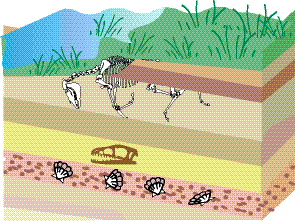
According to the law of superposition, the oldest fossils are found
a)
At the top of the rock layers
b)
Near the bottom of the rock layers
c)
In the middle of the rock layers
d)
Somewhat near the surface
26.
The Law of Superposition helps scientists to determine what?
a)
The absolute age of rock layers
b)
The age of fossils
c)
The relative age of rock layers
d)
the super powers of rocks
27.

Which rock layer in the diagram seems to be the oldest?
a)
F
b)
E
c)
B
d)
A
28.

Letter "F" is a....
a)
inclusion
b)
intrusion
c)
fault
d)
unconformity
29.

In this rock layer diagram there are two unconformities, a fault at E and an intrusion at D. Which unconformity occurred first? How do you know?
a)
Intrusion D occurred first because the instrusion has been moved by the fault.
b)
The fault occurred first because it has moved the intrusion D.
c)
Intrusion D occurred first because it can be seen in all of the rock layers.
d)
Fault E occurred first because it is a normal fault.
30.

Choose the correct order of relative ages for the rock layers below, starting with the youngest, and finishing with the oldest layer.
a)
A, E, B, C, D
b)
A, B, C, D, E
c)
E, A, D, C, B
d)
E, D, C, B, A
31.
How is radioactive dating used to determine the absolute age of rocks?
a)
The percent of radioactive parent isotopes remaining in the rock is compared to the amount of stable daughter isotopes that are present
b)
it compares the radioactive isotope in a younger layer of rock to an older layer
c)
isotopes of different compounds are compared
d)
daughter isotopes are compared to sister isotopes
32.
If a sample starts with 400 radioactive isotopes, how many are left after 3 half lives?
a)
200
b)
100
c)
50
d)
25
33.
If an identical index fossil is found in two rock layers that are separated by an ocean, what do you know about the relationship between the two rock layers?
a)
they are about the same age
b)
both areas were dry
c)
the are made of the same kind of rock
d)
the rock layers are unrelated
34.
What is Half-life?
a)
The amount of time it takes for some of the nuclei in a sample of the isotope to decay
b)
The amount of time it takes for half the electrons in a sample of the isotope to decay
c)
The amount of time it takes for half the nuclei in a sample of the isotope to decay
d)
the amount of time it takes to double the nuclei in a sample of the isotope to decay
35.
If a radioactive substance has a half life of 200 years, how much time has passed if ¼ (25%) of the original isotope is left?
a)
25 years
b)
600 years
c)
50 years
d)
400 years
36.
How much of a parent isotope is left in a sample after 2 half lives?
a)
1/2
b)
1/8
c)
1/4
d)
1/6
37.
The half-life of strontium-90 is 25 years. How much strontium-90 will remain after 100 years if the initial amount is 4.0 g?
a)
3.0g
b)
0.25mg
c)
0.3g
d)
0.25g
38.
You have 40,000 grams of a radioactive substance. How much remains radioactive after 4 Half Lives?
a)
20,000 grams
b)
5,000 grams
c)
2,500 grams
d)
10,000 grams
39.
The half life of a substance is 2,000 years. How old is the substance if you had 800g radioactive and now have 50g radioactive? (Figure out how many half-lives happened first.)
a)
4,000 years
b)
10,000 years
c)
20,000 years
d)
8,000 years
40.
A rock formed with 1000 atoms of a radioactive parent element, but only contains 250 radioactive parent atoms today. If the half-life of the parent element is one million years, how old is the rock?
a)
250,000 years old
b)
500,000 years old
c)
1,000,000 years old
d)
2,000,000 years old
100 %

