wayground logo

Free Printable Worksheets

NEW

Font size

S
M
L
XL
Worksheets

Cardiovascular System Quiz 2

Total questions: 45

Worksheet time: 28mins

Name
Class
Date
1.

Blood cell that protect the body against infection

a)

Platelets

b)

Plasma

c)

Hemoglobin

d)

White Blood Cells

e)

Blood

2.

The fluid in which other parts of the blood are suspended

a)

Platelets

b)

Blood

c)

Plasma

d)

Hemoglobin

e)

White Blood Cells

3.

Types of cells in the blood that causes blood clots to form

a)

Platelets

b)

Blood

c)

Plasma

d)

Hemoglobin

e)

White blood cells

4.

The fluid that delivers oxygen, hormones, and nutrients to the cells and carries away wastes

a)

Platelets

b)

Blood

c)

Plasma

d)

Hemoglobin

e)

White Blood Cells

5.

The oxygen-carrying protein in blood

a)

Platelets

b)

Blood

c)

Plasma

d)

Hemoglobin

e)

White Blood Cells

6.

A wall of tissue that separates the 4 chambers of the heart

a)

Pulmonary Circulation

b)

Valves

c)

Atria

d)

Ventricles

e)

Septum

7.

The top two chambers of the heart

a)

Pulmonary Cirvulation

b)

Valves

c)

Atria

d)

Ventricles

e)

Septum

8.

These are between the atria and ventricles that allow blood to flow through the chambers

a)

Pulmonary Circulation

b)

Valves

c)

Atria

d)

Ventricles

e)

Septum

9.

The lower two chambers of the heart

a)

Pulmonary Circulation

b)

Valves

c)

Atria

d)

Ventricles

e)

Septum

10.

Small vessels that carry blood from arterioles and to small vessels called venules which then empty into veins

a)

Arterioles

b)

Arteries

c)

Veins

d)

Venules

e)

Capillaries

11.

Blood vessels that return blood to the heart

a)

Arterioles

b)

Arteries

c)

Venules

d)

Veins

e)

Capillaries

12.

Blood vessels that carry oxygenated blood away from the heart

a)

Arterioles

b)

Arteries

c)

Veins

d)

Venules

e)

Capillaries

13.
The heart has multiple sides. How many does it have?
a)
2
b)
3
c)
4
14.
How many chambers does the heart have?
a)
1
b)
2
c)
3
d)
4
15.
This is the largest artery in our bodies.
a)
vena cava
b)
aorta
c)
pulmonary artery
16.
a)
Pulmonary veins
b)
Pulmonary artery
c)
Aorta
d)
Vena cava
17.
a)
Left atrium
b)
Right atrium
c)
Left ventricle
d)
Right ventricle
18.
a)
Left atrium
b)
Right atrium
c)
Left ventricle
d)
Right ventricle
19.
Name this part.
a)
Pulmonary veins
b)
Left atrium
c)
Aorta
d)
Pulmonary artery
20.
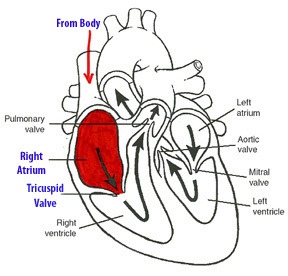
When blood enters the right atrium, where is it coming from?
a)
The body
b)
Left ventricle
c)
Right Atrium
d)
Lungs
21.
A flap of tissue that prevents blood from flowing backward
a)
Aorta
b)
Atrium
c)
Septum
d)
Valve
22.
platelets are also known as
a)
leukocytes
b)
erthryocytes
c)
thrombocytes
d)
monocytes
23.
liquid portion of the blood
a)
leukocytes
b)
erthryocytes
c)
plasma
d)
thrombin
24.
white blood cells are also known as
a)
thrombocytes
b)
erthryocytes
c)
monocytes
d)
leukocytes
25.
molecule that combines with oxygen to transport it
a)
albumin
b)
globulin
c)
haemoglobin
d)
seratonin
26.
What does blood consist of?
a)
plasma, red blood cells, white blood cells, platelets
b)
hormones, oxygen, nutrients, water
c)
red blood cells
d)
carbon dioxide and minerals
27.
What does blood transport?
a)
Nutrients
b)
Oxygen 
c)
Carbon Dioxide
d)
All of the above
28.

Small vessels that carry blood from arterioles and to small vessels called venules which then empty into veins

a)

Arterioles

b)

Arteries

c)

Veins

d)

Venules

e)

Capillaries

29.

What is the function of white blood cells?

a)

carry oxygen

b)

fight infection

c)

carry nutrients

d)

clot blood

30.

What is the average life span of an erythrocyte?

a)

10 days

b)

12 days

c)

120 days

d)

8000 days

31.

Which of the following cells are able to leave the bloodstream?

a)

erythrocytes

b)

leukocytes

c)

electrocytes

d)

thrombocytes

32.

What makes up around 55% of the blood?

a)

Plasma

b)

Red Blood Cells

c)

White Blood Cells

d)

Platelets

33.

What causes the blood to be the distinct red colour?

a)

Haemoglobin

b)

Glucose

c)

Hormones

d)

Oxygen

34.

What is the function (job) of the platelets?

a)

To form clots (i.e. scabs) when you have cuts and grazes.

b)

To transport oxygen to the muscles

c)

To carry dissolved sugars.

d)

To produce antibodies

35.

What is the function (job) of the plasma?

a)

To release antibodies to fight infections.

b)

To transport oxygen around the body.

c)

To carry dissolved nutrients and sugars.

d)

To transport oxygen around the body.

36.

Which is the smallest of the 3 blood vessels?

a)

Veins

b)

Arteries

c)

Capillaries

37.

What type of blood do the arteries usually carry?

a)

Oxygenated Blood

b)

Deoxygenated Blood

38.

True or False: The mitral valve is located on the left side of the heart.

a)

True

b)

False

39.
True or False: Blood flows in the following sequence in the heart: Superior vena cava/Inferior vena cava, right atrium, tricuspid valve, right ventricle, pulmonic valve, pulmonary artery, lungs, pulmonary veins, left atrium, bicuspid valve, left ventricle, aortic valve, aorta
a)
True
b)
False
40.
On the right side of the heart, blood flows from the right ventricle to the _______.
a)
Pulmonic valve to the pulmonary artery
b)
Tricuspid valve to the pulmonary vein
c)
Tricuspid valve to pulmonary artery
d)
Inferior vena cava to the aorta
41.
Place the pathway of blood through the heart in the correct sequence.
a)
L-K-H-B-G-E-C-F-A-I-E-D
b)
I-J-D-C-F-A-H-B-G-E-K-L
c)
A-B-J-C-D-E-F-K-L-G-H-I
d)
I-J-E-D-C-F-A-B-G-H-K-L
42.
The tricuspid valve is found in between the _____________.
a)
left atrium and left ventricle
b)
right atrium and right ventricle
c)
pulmonary artery and aorta
43.
The mitral (bicuspid) valve is found in between the _____________.
a)
left atrium and left ventricle
b)
right atrium and right ventricle
c)
pulmonary artery and aorta
44.
What separates the left ventricle and left atrium?
a)
Septum
b)
Bicuspid valve
c)
Coronary artery
d)
Tricuspid valve
45.

What are the 3 Main Components of the Cardiovascular System?

a)

Blood, Heart, Lungs

b)

Heart, Blood, Blood Vessels

c)

Heart, Blood and Vessels

d)

Plasma, Red and White blood cells