wayground logo

Free Printable Worksheets

NEW

Font size

S
M
L
XL
Worksheets

Plate Tectonics Review

Total questions: 42

Worksheet time: 21mins

Name
Class
Date
1.
___________________ helps explain why there are a large number of marsupial species in Australia and South America, two continents that were once connected.
a)
ozone production
b)
continental drift
c)
the fifth mass extinction
d)
the sixth mass extinction
2.
There are three types of plate boundaries. Which choice is NOT a type of boundary?
a)
convergent
b)
divergent
c)
thrust
d)
transform
3.
In some areas of the world, like California and Japan, earthquakes are a common occurrence. How can this best be explained?
a)
The strong ocean currents are undermining both areas causing earthquakes.
b)
Both areas are subject to strong ocean wind and waves cause earthquakes.
c)
Both areas are located near the edge of the Pacific Ocean, the unstable sand causes earthquakes.
d)
Both areas are on the boundary of active plate margins, the motion of the plates causes earthquakes.
4.
Observe this diagram of a plate boundary. One statement BEST describes what is happening. It is that
a)
the tectonic plates are moving away from each other
b)
new oceanic crust is forming
c)
this is typical of a subduction zone
d)
mountains are forming
5.
In this diagram of the ocean basin, where is the oldest oceanic crust found?
a)
A
b)
B
c)
C
d)
D
6.
Where are earthquakes MOST LIKELY to occur?
a)
close to the equator
b)
along coastal regions
c)
close to the center of tectonic plates
d)
along the boundaries of tectonic plates
7.
The map shown would be helpful in predicting the location of future
a)
droughts
b)
volcanoes
c)
hurricanes
d)
tornadoes
8.
The movement of Earth's plates cause all EXCEPT this type of catastrophic event.
a)
Ice Age
b)
tsunami
c)
volcano
d)
earthquake
9.
Ocean trenches are formed when
a)
two oceanic plates slide past each other
b)
an oceanic plate goes under another oceanic plate
c)
two oceanic plates grind past each other along transform faults
d)
two oceanic plates hit each other causing both plates to rise up
10.
 The movement of the tectonic plates is caused by
a)
convection currents in the mantle
b)
the gravity of the iron-nickle core
c)
the rotation of the Earth
d)
the Moho discontinuity
11.
Subduction zones occur on Earth where dense oceanic crust dives under less dense continental crust. These boundaries are characterized by a deep ocean trench next to a high continental mountain range, large numbers of earthquakes and volcanoes. All of this is further evidence for the 
a)
Big Bang Theory
b)
origin of the species
c)
Theory of Plate Tectonics
d)
Theory of Natural Selection
12.
What is the main method of heat transfer from the core to the crust of Earth?
a)
conduction
b)
convection
c)
insulation
d)
radiation
13.
If you were to travel from the surface to the center of Earth, the temperature would
a)
increase minimally
b)
stay the same
c)
increase dramatically (a lot)
d)
decrease dramatically (a lot)
14.
How does the density of the Earth's core compare to the other layers of Earth?
a)
The core is the most dense layer
b)
The core is the least dense layer
c)
The core is only less dense than the crust
d)
the core is only less dense than the mantle
15.
Which best describes the composition of Earth's core?
a)
semi-molten
b)
water and organic substances
c)
a solid lower part and a liquid upper part
d)
contains volcanic, sedimentary and granite rocks
16.
How is the crust DIFFERENT from the other layers of Earth?
a)
it is hotter
b)
it is thinner
c)
it Is mostly liquid
d)
it is under pressure
17.
When two plates carrying continental crust collide at a convergent boundary, what will MOST LIKELY happen?
a)
one will subduct under the other
b)
they will form mountains
c)
both plates will subduct down into the mantle
d)
continental plates don't collide with continental plates
18.
California has a higher risk of large earthquakes than Georgia because
a)
there are many volcanoes
b)
it is along a plate boundary
c)
there is very little rain
d)
it is in the middle of a tectonic plate
19.
 Which type of plate boundary can cause mountains to form?
a)
transform
b)
divergent
c)
convergent
d)
sliding
20.
The Theory of Plate Tectonics explains the formation, movement, and subduction of the Earth's plates.
a)
true
b)
false
21.

Which substance would best represent the outer core?

a)

Bread

b)

Honey

c)

Peanut

d)

Chicken nugget

22.

Which letter represents the crust?

a)

A

b)

B

c)

C

d)

D

23.

Which letter represents the inner core?

a)

A

b)

B

c)

C

d)

D

24.

Which letter represents the mantle?

a)

A

b)

B

c)

C

d)

D

25.

Which letter represents the outer core?

a)

A

b)

B

c)

C

d)

D

26.

Solids are denser than liquids

a)

True

b)

False

27.

Geothermal energy comes from the heat inside Earth. You need a layer that is hot but not too far from the surface. Which layer would be the most efficient to use for geothermal energy?

a)

Crust

b)

Mantle

c)

Outer Core

d)

Inner Core

28.

Which layer of Earth is the thickest?

a)

Crust

b)

Mantle

c)

Outer Core

d)

Inner Core

29.

Palm trees grow in areas that are tropical (warm). If palm tree fossils were found in Alaska, what would that tell us about how Alaska's climate has changed?

a)

The climate must have been much warmer than it is today.

b)

The climate must have been much colder than it is today.

c)

The climate has not changed.

30.

What evidence supports that the climate of Earth has changed?

a)

Fern fossils in Antarctica

b)

Evidence of glaciers in Africa

c)

Coal deposits in Antarctica

d)

All of the above

31.

Which layer is the oldest?

a)

X

b)

W

c)

A

d)

G

32.

Finding a freshwater fish fossil in the desert provides evidence for which of the following?

a)

The desert was near an ocean.

b)

The ocean once covered the desert.

c)

A river flowed through the desert.

d)

Grass once covered the desert.

33.

What evidence is used to support that the surface and climate of Earth has changed over time?

a)

Erosion

b)

Global Warming

c)

Fossils

d)

Weathering

34.

What evidence did Alfred Wegener NOT know about his Theory of Continental Drift?

a)

Convection currents in the mantle are what moves the plates

b)

Continents fit like puzzle pieces

c)

The same fossils were found on continents far apart

d)

Landforms matched when the continents were put togther

35.

Which supports that layer B and layer W are the same age?

a)

Both contain dinosaur and bird fossils

b)

Both contain the same organisms

c)

Both formed after an extrusion

d)

Both layers contain an intrusion

36.

As two plates push together at the boundary, one part goes beneath the other plate causing temperature and pressure to increase, and magma erupts. What type of geologic activity is likely to form at the described boundary?

a)

Earthquakes

b)

Volcano

c)

Mountains

d)

Tsunami

37.

Most earthquakes and volcanoes occur along _____________ boundaries.

a)

Divergent

b)

Convergent

c)

Transform

38.

When two plates with continental crust (same density) converge together, what will form?

a)

Mountains

b)

Undersea canyon

c)

Geyser

d)

Volcano

39.

As the plates collide, one plate sinks under the other plate, creating a subduction zone where liquid mantle is forced upward through the crust, creating a _______.

a)

volcano

b)

mountain

c)

earthquake

d)

divergent boundary

40.

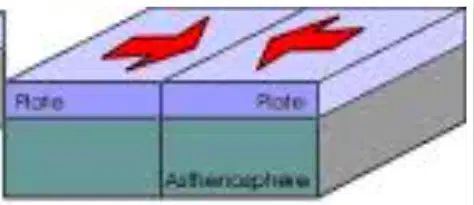
What type of boundary is shown?

a)

Convergent

b)

Divergent

c)

Transform

41.

What type of boundary is shown?

a)

Convergent

b)

Divergent

c)

Transform

42.

What type of boundary is shown?

a)

Convergent

b)

Divergent

c)

Transform