wayground logo

Free Printable Worksheets

Font size

S
M
L
XL
Worksheets

Sem1PsciReview1

Total questions: 75

Worksheet time: 46mins
Name
Class
Date
1.
What  is the rate of change of speed or direction?
a)
velocity
b)
acceleration
c)
momentum
d)
energy
2.
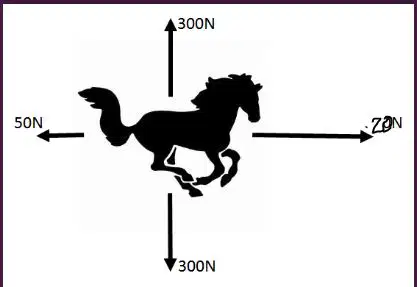
 In what direction and with how much force will the mustang be moved?
a)
50N up
b)
450N right
c)
300N down
d)

30N Left

3.

White light is all the colors & the ones you see are the ones that are usually ________ off of objects. 

a)
reflected
b)
refracted
c)
absorbed
d)
conducted
e)

separated

4.

This distance is called the ____________

a)
amplitude
b)
wavelength
c)
crest
d)
frequency
e)

trough

5.
 __________is the transfer of thermal energy through touching objects or particles.
a)
conduction
b)
convection
c)
induction
d)
friction
e)

radiation

6.
Increasing the wavelength will _______ the frequency and ______ the energy.
a)
increase, decrease 
b)
decrease, decrease
c)
decrease, increase
d)
increase, increase
7.
Waves in a medium are caused by ___________?
a)
vibrations
b)
inertia
c)
frequency 
d)
amplitude
e)

heat

8.
When a wave changes medium and continues through it will often ___________?
a)
reflect
b)
refract 
c)
amplify
d)
undergo interference
e)

change speed

9.
What is the average speed of the dancing baby?
a)
4m/s
b)
24m/s 
c)
8m/s
d)
0m/s
10.
With a transverse wave, what happens?
a)
The wave doesn’t move, the particles do. 
b)

The particles move at right angles to its direction 

c)
The particles move parallel to its direction 
d)

The particles stay still and the wave moves past them

e)

the waves are due to constructive and destructive interference

11.

Law of conservation states that Energy CANNOT be _________ or _________

a)
created or destroyed
b)
invented or deconstructed
c)
transformed or transferred
d)
in or out
e)

transmitted or refracted

12.

A rock at the edge of a cliff is an example of

a)

Potential Energy

b)

Kinetic Energy

c)

Sliding Friction

d)

Rolling Friction

e)

Electromagnetic Waves

13.
At which point is potential energy greatest
a)
W
b)
X
c)
Y
d)
Z
14.
What type of heat transfer is A?
a)
convection
b)
radiation
c)
conduction
d)

Cold

e)

electromagnetic

15.
What type of heat transfer is B?
a)
convection
b)
radiation
c)
conduction
d)
heat
e)

electromagnetic

16.
What type of heat transfer is C?
a)
convection
b)
radiation
c)
conduction
d)
heat
e)

electromagnetic

17.
A wave with a large wavelength will have a ______ frequency and _____ energy
a)
high, low
b)
high, high
c)
low, high
d)
low, low
18.
The blue section of the wave is measuring _________________.
a)
wavelength
b)
crest
c)
trough
d)
amplitude 
e)

frequency

19.
How are electromagnetic waves different from other waves? 
a)
They have very short wavelengths 
b)
They transmit energy instead of matter 
c)
They can travel through a vacuum 
d)
They can change direction by reflection 
e)

They can be refracted

20.
Which of the following lists components of the electromagnetic spectrum  in order from the lowest frequency to the highest frequency?
a)
microwaves, infrared, gamma rays, xrays 
b)
infrared, xrays,  gamma rays, microwaves 
c)
radio waves, visible spectrum, xrays,  gamma rays
d)
 gamma rays, xrays,  visible spectrum, radio waves
21.

The lowest energy Electromagnetic waves have the __________ wavelength

a)

Longest

b)

Shortest

c)

Most Chaotic

d)

Fastest

e)

Slowest

22.
Which has the most energy?
a)
Radio waves
b)
Gamma waves
c)
Visible Light
d)

Microwaves

e)

Ultraviolet

23.
When the frequency of a wave increases, what happens to the wavelength?
a)
The wavelength is not directly affected by the frequency of a wave.
b)
The wavelength increases.
c)
The wavelength decreases.
d)
More specific information is needed to form a conclusion about the wavelength.
24.
An object that blocks all of the light from passing through is...
a)
transparent 
b)
clear
c)
opaque
d)
translucent
25.
This type of object lets some light through.
a)
transparent
b)
translucent
c)
co-parent
d)
opaque
26.
This type of object lets all light through.
a)
transparent
b)
translucent
c)
co-parent
d)
opaque
27.
True or False: Sound travels better through solids than through liquids
a)
True 
b)
False
28.
Light waves travel at different speeds through different media. Which list  shows the correct order of increasing speed of light waves in media, from  slowest to fastest? 
a)
solids → liquids → gases → vacuum
b)
vacuum → gases → liquids → solids
c)
gases → liquids → solids → vacuum
d)
liquids → solids → gases → vacuum
29.
Movers slide a box down the ramp of a truck.
What helps slow the box as it slides to the bottom of the ramp?
a)
friction
b)
gravity
c)
inertia
d)
magnetism
30.
"The amount of chemical energy in a flashlight's battery is equal to the radiant energy transferred to the environment." Is this statement correct?
a)
Yes, flashlights are 100% efficient at transferring the chemical energy of the battery into radiant energy.
b)
No, all energy transformations are inefficient. Some of the chemical energy will be lost as thermal energy. 
c)
No, the Law of Conservation of Energy does not apply to this situation because thesystem is not closed
d)
 Yes, the Law of Conservation of Energy states that the total energy in a system can never be created or destroyed. 
31.
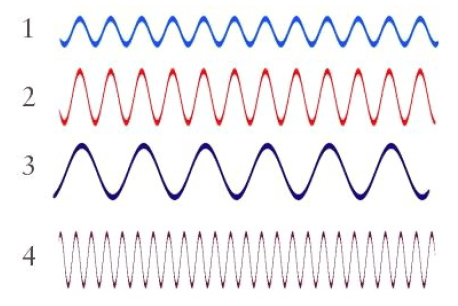
Which wave in the diagram has the greatest frequency?
a)
1
b)
2
c)
3
d)
4
32.
T/F? all energy transformations are inefficient.
a)
True
b)
False
33.
High frequency waves have _________ wavelengths.
a)
varying
b)
long
c)
the same
d)
short
34.
Light travels by _________ waves but sound travels by ____________ waves
a)
transverse, longitudinal 
b)
longitudinal, transverse
c)
transverse, transverse
d)
medium, rarefied
35.
What happens to molecules when they get “hotter?”
a)
they get more dates
b)

they vibrate faster 

c)
they move slower
d)
the motion stays the same but their potential increases
e)

they undergo halitosis

36.
Waves carry _________.
a)
energy 
b)
particles
c)
medium
d)
space
e)

on my wayward son

37.
Where is the ample aardvark moving at a constant speed forward? 
a)
A to B
b)
B to C
c)
C to D
d)
D to E
38.
Where is the fickle ferret accelerating?
a)
A to B
b)
B to C
c)
C to D
d)
D to E
39.
Where is the obnoxious ocelot sitting still?
a)
A to B
b)
B to C
c)
C to D
d)
D to E
40.
Where did the obnoxious ocelot stop moving?
a)
A
b)
B
c)
C
d)
D
41.

When an object gets an area that has more positive or negative ions due to being near another charged object.

a)

Static Electricity

b)

Charging by Contact

c)

Charging by Induction

d)

Ohm's Law

42.

When an object gains an uneven number of either positively or negatively charged particles, or at the very least has an area that has more positive or negative ions.

a)

Static Electricity

b)

Charging by Contact

c)

Charging by Induction

d)

Ohm's Law

43.

A flow of electricity that moves through several resistors all on separate branching paths.

a)

Static Electricity

b)

Parallel Circuit

c)

Series Circuit

d)

Ohm's Law

44.

A flow of electricity that moves through several resistors all along the same path.

a)

Parallel Circuit

b)

Ohm's Law

c)

Series Circuit

d)

Static Electricity

45.

When a charged object touches a neutral object, the flow of charges into the neutral object is described this way.

a)

Charging by Induction

b)

Charging by Contact

c)

Ohm's Law

d)

Static Electricity

46.

This rule describes the relationship between a circuit's resistance, voltage difference and current.

a)

Law of Conservation of charge

b)

Ampere's Law

c)

Volt's Law

d)

Watt's Law

e)

Ohm's Law

47.

This is the amount of electricity that is flowing through a wire at a given time (unit is Amps)

a)

Current

b)

Voltage

c)

Resistance

d)

Electrical Power

48.

This is the when a material slows down the flow of electricity and converts some of the electrical energy into heat (units is Ohms).

a)

Current

b)

Voltage

c)

Resistance

d)

Electrical Power

49.

This is an object that will allow a flow of current through it with very low resistance.

a)

Insulator

b)

Conductor

c)

Flower

d)

Electrolytes

50.

This is an object that will not allow a flow of current through it (it has a very high resistance).

a)

Insulator

b)

Conductor

c)

Flower

d)

Electrolytes

51.
True or False The total amount of energy in a system will changed depending on its surroundings.
a)
true
b)
false
52.
Which of the following is not one of the six forms of energy?
a)
nuclear
b)
thermal
c)
electrical
d)
conduction
53.
Calculate the velocity of a cyclist traveling 60 kilometers south over a period of 6 hours.
a)
10 km/hr
b)
10 km/hr south
c)
10 mi/hrnsouth
d)
360 km/hr south
54.

On a cold day, Jamarria puts a hot bowl of soup down on a concrete table. Describe the energy transformation that will occur.

a)

Heat from the air is transferred to Jamarria's hand.

b)

Heat from the hot bowl of soup is transferred to the car door.

c)

Heat from the concrete table is transferred to the hot bowl of soup.

d)

Heat from the hot bowl of soup is transferred to the concrete table.

55.

Heat always travels from...

a)

Warm to cool

b)

Cool to warm

c)

Warm to warm

d)

Cool to cool

56.

anything that has mass and takes up space

a)

matter

b)

weight

c)

solid

d)

solution

57.

A person is standing in the middle of a boxcar on a train moving 100 km per hour. If the motion of the boxcar

, where in the boxcar will the person most likely land after he jumps straight up?

a)
b)
c)
d)
58.

Which bar magnet will experience the greatest magnetic attraction?

a)

Magnet 1

b)

Magnet 2

c)

Magnet 3

d)

Magnet 4

59.

There are two ends of a magnet.

What are they called?

a)

North and East

b)

North and West

c)

North and South

d)

South and East

60.

Which illustration correctly shows how the spheres will behave?

a)
b)
c)
d)
61.

Which bunny will fall fastest?

a)

Bunny 1

b)

Bunny 2

c)

Bunny 1 and Bunny 2 will fall at the same time.

62.

Click on each action that will reduce the rate at which the speed of the basket changes.

a)

Pull with less force

b)

Pull with more force

c)

Add an apple to the basket

d)

Take an apple out of the basket

e)

Roughen the surface to increase friction

63.
What is Newtons 1st law of motion?
a)
Force= Mass multiplied by acceleration 
b)
An object at rest stays at rest unless acted on an unbalanced force. (inertia)
c)
For every action there is a equal and opposite  re-action.
d)
law of gravity 
64.
What law of motion does this picture represent?
a)
Newtons 3rd law
b)
Newtons 4th law
c)
Newtons 1st law
d)
Newtons 2nd law 
65.
What is Newtons 2nd law of motion?
a)
Pancakes 
b)
Force= Mass multiplied by acceleration
c)
For every action there is a equal and opposite  re-action.
d)
Law of gravity 
66.
What law of motion does this picture represent?
a)
Newtons 1st law
b)
law of gravity 
c)
Newtons 4th law 
d)
Newtons 2nd law
67.
What law of motion does this picture represent?
a)
Newtons 1st law
b)
Newtons 4th law 
c)
Newtons 3rd law 
d)
Newtons 2nd law
68.

A net force of 20 N is exerted on an encyclopedia to cause it to accelerate at a rate of 5 m/s2. Determine the mass of the encyclopedia?

a)
 m = 3.0 kg
b)
m = 4.0 kg 
c)
m = 3.0 ml 
d)
m = 30.0 g
69.
What Newtons law does this picture represent
a)
Newtons 2nd law 
b)
Law of gravity 
c)
Newtons 1st law
d)
Newtons 5th law
70.
Mass is a measure of an object's inertia. Objects with greater mass have a greater inertia; objects with less mass have less inertia.
a)
true 
b)
false 
71.
What is the tendency of an object to resist a change in motion?
a)
coffee
b)
motion
c)
inertia
d)
gravity
72.

The upward force on an object falling through the air is__________

a)

air resistance

b)

inertia

c)

momentum

d)

terminal velocty

73.

The acceleration due to gravity is _____.

a)

98 m/s2

b)

9.8 m/s2

c)

9.8 m/s

d)

0.98 m/s

74.

In the absence of air, a penny and a feather that are dropped from the same height at the same time will ____________

a)

fall at different days

b)

fall at the same rate

c)

float

d)

not have momentum

75.

To increase acceleration, you need to increase

a)

mass

b)

force

c)

momentum

d)

velocity