wayground logo

Free Printable Worksheets

NEW

Font size

S
M
L
XL
Worksheets

Electricity Review

Total questions: 77

Worksheet time: 1hrs 18mins

Name
Class
Date
1.
A material in which electrons are able to move easily
a)
Circuit
b)
Insulator 
c)
Resistance 
d)
Conductor 
2.
The process of transferring charge by touching or rubbing 
a)
Induction 
b)
Conduction 
c)
Friction 
d)
Conductor 
3.
A material in which electrons are not able to move easily 
a)
Circuit 
b)
Insulator 
c)
Resistance 
d)
Conductor
4.
A student wants to use the diagram below to explain what happens when the light bulb turns on. How could she best explain what is happening?
a)
Light energy is transformed to electric energy.
b)
Electric energy is transformed to light energy.
c)
Electric energy is transformed to motion energy.
d)
Motion energy is transformed to electric energy.
5.
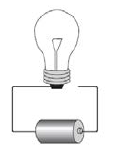
Will this circuit light the bulb? 
a)
Yes
b)
No
6.
Will this circuit light the bulb? 
a)
Yes
b)
No
7.
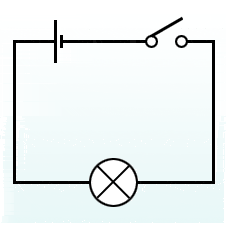
Will the light bulb light up if the switch remains open as shown?
a)
Yes, because the circuit will be complete.
b)
Yes, because the battery will push the electric current.
c)
No, because the electric circuit is not complete.
d)
No, because the battery will push the electric current.
8.
The circuit  lights the light bulb. What is the purpose of the switch in the circuit?
a)
to push the electric current
b)
to open and close the circuit
c)
to insulate the circuit
d)
to make the electricity
9.
Tasha tested several items to see if they could conduct electricity.  Her data is shown below. What is the best claim she could make from her data?
a)
Wood is an insulator.
b)
Metal is an insulator.
c)
Keys are insulators.
d)
Toothpicks are conductors.
10.
A circuit that has more than one path for electricity to follow is a...
a)
series
b)
static
c)
broken
d)
parallel
11.
Copper is used in wiring because it is an excellent______________ of electricity.
a)
circuit breaker
b)
conductor
c)
insulator
d)
fuse
12.
The only charges that can move from one object to another are___________ charges.
a)
electric
b)
neutral
c)
positive
d)
negative
13.
If you take one light bulb out of a parallel circuit, all the lights will go out.
a)
true
b)
false
14.
Rubber is a good insulator.
a)

true

b)
false
15.
Protons have a negative charge and electrons have a positive charge.
a)
true
b)
false
16.
The buildup of electric charges on an object is called static electricity.
a)
true
b)
false
17.
Lightning is an example of static electricity.
a)
true
b)
false
18.
Current electricity flows through
a)
wires
b)
string
c)
rubber
d)
plastic
19.
Electricity flows from which side of the battery?
a)
negative
b)
positive
c)
I have no idea
20.
What supplies the energy in an electric circuit?
a)
light bulb
b)
conductor
c)
wire
d)
battery
21.
Which of these could be used as a resistor in a circuit?
a)
pencil
b)
gas engine
c)
rubber eraser
d)
electric motor
22.
The unit for current is the 
a)
Volt
b)
Ohm
c)
Electron
d)
Amp
23.
In a ________ circuit there are multiple paths for the current to take.
a)
Series
b)
Parallel
24.
What is the unit for resistance?
a)
Volts
b)
Amperes
c)
Ohms
25.
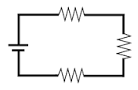
What type of circuit is pictured?
a)
series
b)
parallel
26.
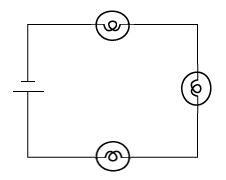
What kind of circuit is this?
a)
Series
b)
Consecutive
c)
Parallel
d)
Training
27.
As the resistance in a circuit increases, the electric current __________.
a)
increases
b)
decreases
c)
stays the same
28.
What is a closed path for electrons to flow through?
a)
static electricity
b)
circuit
c)
amperes
29.
What type of circuit is pictured?
a)
series
b)
Parallel
30.

If the light bulb in the middle burned out, what would happen to the other two?

a)

The light bulb to the left would stay lit, but the one to the right would turn off.

b)

They would both stay lit.

c)

The light bulb to the right would stay lit, but the one to the left would turn off.

d)

They would both turn off.

31.
A class prepared some electrical circuits using battery, connecting wires, and three light bulbs.  Which of these circuits can make the three bulbs light?
a)
A
b)
B
c)
C
d)
D
32.
This instrument can be used to see if materials conduct electricity.  Which of these groups contains items that could all conduct electricity to complete the circuit?
a)
rubber ball, plastic comb, nail
b)
paper clip, penny, screw
c)
cork, dollar bill, tweezers
d)
pencil, eraser, spoon
33.
Glass is a 
a)
conductor
b)
insulator
34.

The flow of electricity is an _____________________.

a)

battery

b)

resistor

c)

electric current

35.
The picture shows an electrical circuit. This circuit is a series circuit because: 
a)
It has 3 light bulbs.
b)
The same current flows through all three light bulbs.
c)
It uses a single battery.
d)
The electrical current has more than one path to flow through
36.
Which of these best completes the circuit?
a)
rubber band
b)
metal nail
c)
leather shoelace
d)
wooden toothpick
37.
Would would best complete this circuit?
a)
A wire
b)
A switch
c)
A battery
d)
A light bulb
38.
What type of circuit is show in the image?
a)
Series Circuit
b)
Parallel Circuit
39.
Which best describes a parallel circuit?
a)
Electricity flows along one pathway.
b)
The flow of electricity comes from one source. 
c)
Electricity flows along more than one pathway. 
d)
The flow of electricity comes from more than one source. 
40.
This circuit is _________.
a)
open
b)
parallel
c)
closed
d)
The cutest little circuit evah!
41.
what is this symbol for?
a)
light bulb
b)
switch
c)
battery
d)
resistor
42.
this is the symbol for a _____?
a)
switch
b)
light 
c)
battery
d)
wires
43.
This is the symbol for a ...
a)
Wire
b)
Battery
c)
Buzzer
d)
Fuse
44.
This is the symbol for 
a)
An Ammeter
b)
A Voltmeter
c)
A Meter
d)
A Motor
45.
Which of the following answer choices correctly describes the image? 
a)
Series circuit - Bulbs are lit
b)
Series circuit - Bulbs are off
c)
Parallel circuit - Bulbs are lit
d)
Parallel circuit - Bulbs are off
46.
This is the circuit symbol for ...
a)
an AC current source
b)
a DC current source
c)
an ammeter
d)
a voltmeter
47.
This is the circuit symbol for ...
a)
an AC current source
b)
a DC current source
c)
an ammeter
d)
a voltmeter
48.
This is the symbol for a _____?
a)
Lamp
b)
Water wheel
c)
Loudspeaker
d)
Motor
49.
a)
Closed switch
b)
Push switch
c)
Trap door
d)
AC Power supply
50.

What is the following symbol represent?

a)

Wire

b)

Resistor

c)

Battery

d)

Switch

51.

Why do electricians always wrap wires in plastic?

a)

Plastic comes in many different colors

b)

Plastic is a good electrical conductor

c)

Plastic makes the wires easy to bend

d)

Plastic is a good electrical insulator

52.

How can it be explained that someone's hair can stick to a balloon?

a)

There is static electricity

b)

There is too much dust in the air

c)

A parallel circuit was too long

d)

The person needs to wash his hair

53.
a device that converts chemical energy into electrical energy
a)
battery
b)
cell
c)
electrolyte
d)
electrode
54.
liquid in a battery that allows electrons to move from one metal to the other (fruit juice, vinegar)
a)
Wet Cells
b)
Dry Cells
c)
Electrolyte
d)
Electrodes
55.
What charge does a proton have?
a)
negative (-)
b)
positive (+)
c)
neutral or no charge (0)
56.
all matter is made of what 
a)
energy 
b)
atoms 
c)
electrons 
d)
compounds 
57.
All matter is made of what?
a)
energy 
b)
atoms 
c)
electrons 
d)
compounds 
58.
electrons have this type of charge?
a)
negative
b)
positive
c)
neutral
59.

Atoms consist of parts called protons, neutrons, and

a)

Electons

b)

Haptons

c)

Neptons

d)

Wontons

60.

The nucleus of an atom contains protons and_______________

a)

Electrons

b)

Haptons

c)

Neutrons

d)

Wontons

61.
The wire that gives off the light in a light bulb.
a)
fahnestock clip
b)
support wires
c)
filament
62.

Why is a battery important in an electrical circuit?

a)

As a source of energy.

b)

As a path for electricity to flow through.

c)

As a connector to connect all parts of a circuit.

63.

What components are in this schematic diagram?

a)

battery, switch, bulb, wire

b)

switch, switch, bulb

c)

battery, switch, bulb, motor

64.

Which schematic circuit matches this circuit picture?

a)
b)
c)
65.

An electric current requires which of the following to flow?

a)

A closed path

b)

A switch

c)

An insulator

66.
If one light burns out in this parallel circuit what will happen to the rest?
a)
The others will stay lit
b)
All will go out
c)
Two or more will go out
d)
Check the battery
67.

_________ are used in drawing circuits instead of drawing pictures.

a)

Symbols

b)

Marks

68.

What makes up an electric circuit?

a)

Bulb and battery

b)

Bulb, battery and switch

c)

Bulb, battery and wire

69.

Look at the circuits in the diagram. In which circuit will the bulb be brighter?

a)

Circuit A

b)

Circuit B

c)

Both circuits, the bulbs will have the same brightness.

70.
Two batteries in a circuit make the lights in the circuit brighter than one battery.
a)
true
b)
false
71.
If the lights are on, the circuit is
a)
closed
b)
open
72.
Two types of circuits are
a)
parallel and magnetic
b)
electromagnetic and series
c)
series and parallel
73.
The flow of electricity requires a
a)
complete path
b)
incomplete path
c)
insulated current
74.
When socks get stuck to towels in your dryer, this is an example of________________
a)
current electricity
b)
static electricity
75.
What is the major difference between static electricity and current electricity?
a)
Current electricity involves a continuous flow of neutrons; static electricity is a sudden transfer of protons
b)
Current electricity can be deadly; static electricity is almost always safe
c)
In current electricity, there's a single transfer of electrons; in static electricity, there's a steady flow of electrons
d)
Current electricity involves a flow of electrons; static electricity involves a single transfer of electrons
76.
True or False, Lighting is a form of static electricity.
a)
True
b)
False
77.
This is an example of a _______ circuit
a)
open
b)
series
c)
parallel
d)
square