
 Worksheets
Seasons on the Planets and Tides
Total questions: 80
Worksheet time: 7hrs 40mins
The Earth is tilted on its axis, like a spinning top. This tilt causes different parts of the Earth to get more or less sunlight throughout the year. When the Northern Hemisphere is tilted towards the sun, it gets more sunlight and has longer days. This is summer in the Northern Hemisphere. What is the Earth tilted on?
Its orbit
Its axis
The equator
The North Pole
The Earth is tilted on its axis, like a spinning top. This tilt causes different parts of the Earth to receive more or less sunlight throughout the year. When the Northern Hemisphere is tilted towards the sun, it gets more sunlight and has longer days. This is summer in the Northern Hemisphere. What does the tilt of the Earth cause?
Earthquakes
Ocean tides
Changes in sunlight throughout the year
The rotation of the Earth
The Earth is tilted on its axis, like a spinning top. This tilt causes different parts of the Earth to receive more or less sunlight throughout the year. When the Northern Hemisphere is tilted towards the sun, it gets more sunlight and has longer days. This is summer in the Northern Hemisphere. When the Northern Hemisphere is tilted toward the sun, what happens?
It gets less sunlight and shorter days
It gets more sunlight and longer days
It gets the same amount of sunlight all year
It becomes winter in the Northern Hemisphere
The Earth is tilted on its axis, like a spinning top. This tilt causes different parts of the Earth to receive more or less sunlight throughout the year. When the Northern Hemisphere is tilted towards the sun, it gets more sunlight and has longer days. This is summer in the Northern Hemisphere. What season is it in the Northern Hemisphere when it is tilted toward the sun?
Winter
Spring
Fall
Summer
The Earth is tilted on its axis, like a spinning top. This tilt causes different parts of the Earth to receive more or less sunlight throughout the year. When the Northern Hemisphere is tilted towards the sun, it gets more sunlight and has longer days. This is summer in the Northern Hemisphere. What comparison is used to describe Earth’s tilt?
Like a rolling ball
Like a spinning top
Like a flat disk
Like a swinging pendulum
When the Northern Hemisphere is tilted away from the sun, it gets less sunlight and has shorter days. This is winter in the Northern Hemisphere. The Southern Hemisphere has the opposite seasons. When it's summer in the Northern Hemisphere, it's winter in the Southern Hemisphere, and vice versa. What happens when the Northern Hemisphere is tilted away from the sun?
It gets more sunlight and longer days
It gets less sunlight and shorter days
It has no change in sunlight
It becomes summer
When the Northern Hemisphere is tilted away from the sun, it gets less sunlight and has shorter days. This is winter in the Northern Hemisphere. The Southern Hemisphere has the opposite seasons. When it's summer in the Northern Hemisphere, it's winter in the Southern Hemisphere, and vice versa. What season is it in the Northern Hemisphere when it is tilted away from the sun?
Spring
Summer
Fall
Winter
When the Northern Hemisphere is tilted away from the sun, it gets less sunlight and has shorter days. This is winter in the Northern Hemisphere. The Southern Hemisphere has the opposite seasons. When it's summer in the Northern Hemisphere, it's winter in the Southern Hemisphere, and vice versa. What happens in the Southern Hemisphere when it is winter in the Northern Hemisphere?
It is also winter
It is fall
It is summer
It is spring
When the Northern Hemisphere is tilted away from the sun, it gets less sunlight and has shorter days. This is winter in the Northern Hemisphere. The Southern Hemisphere has the opposite seasons. When it's summer in the Northern Hemisphere, it's winter in the Southern Hemisphere, and vice versa. What causes the opposite seasons in the Northern and Southern Hemispheres?
The Earth’s tilt on its axis
The distance of the Earth from the sun
The rotation of the moon
The speed of Earth’s rotation
When the Northern Hemisphere is tilted away from the sun, it gets less sunlight and has shorter days. This is winter in the Northern Hemisphere. The Southern Hemisphere has the opposite seasons. When it's summer in the Northern Hemisphere, it's winter in the Southern Hemisphere, and vice versa. When it is summer in the Southern Hemisphere, what season is it in the Northern Hemisphere?
Winter
Summer
Spring
Fall
There are four main seasons: spring, summer, autumn (fall), and winter. Each season has its own special weather and changes in nature. In spring, the weather gets warmer, plants start to grow, and animals wake up from their winter sleep. How many main seasons are there?
Two
Three
Four
Five
Summer is the hottest time of the year. The days are long and sunny. Many people enjoy swimming, going to the beach, and having picnics. In autumn, the weather starts to cool down. Leaves on trees change color and fall to the ground. Animals prepare for winter by storing food or migrating to warmer places. What is the hottest time of the year?
Spring
Summer
Autumn
Winter
We are all familiar with the four seasons of the year: spring, summer, autumn, and winter. The seasons on Earth change every 90 to 93 days as the planet revolves around the Sun. Other planets in our solar system also experience seasons. The lengths and characteristics of the seasons on other planets, however, differ from those of the seasons on Earth. This is due to several factors. What causes the seasons on Earth to change?
The Earth’s rotation on its axis
The Earth revolving around the Sun
The movement of the Moon
Changes in weather patterns
We are all familiar with the four seasons of the year: spring, summer, autumn, and winter. The seasons on Earth change every 90 to 93 days as the planet revolves around the Sun. Other planets in our solar system also experience seasons. The lengths and characteristics of the seasons on other planets, however, differ from those of the seasons on Earth. This is due to several factors. About how long does each season on Earth last?
30 to 40 days
60 to 70 days
90 to 93 days
120 to 150 days
We are all familiar with the four seasons of the year: spring, summer, autumn, and winter. The seasons on Earth change every 90 to 93 days as the planet revolves around the Sun. Other planets in our solar system also experience seasons. The lengths and characteristics of the seasons on other planets, however, differ from those of the seasons on Earth. This is due to several factors. According to the text, do other planets have seasons?
No, only Earth has seasons
Yes, all planets have the same seasons as Earth
Yes, but their seasons differ from Earth’s
Only the outer planets have seasons
We are all familiar with the four seasons of the year: spring, summer, autumn, and winter. The seasons on Earth change every 90 to 93 days as the planet revolves around the Sun. Other planets in our solar system also experience seasons. The lengths and characteristics of the seasons on other planets, however, differ from those of the seasons on Earth. This is due to several factors. Based on the text, what can you infer about the relationship between a planet’s movement and its seasons?
The rotation of a planet causes all of its seasons to happen in one day.
The revolution of a planet around the Sun influences how its seasons change.
Seasons only occur when a planet is very close to the Sun.
Seasons do not depend on a planet’s movement.
We are all familiar with the four seasons of the year: spring, summer, autumn, and winter. The seasons on Earth change every 90 to 93 days as the planet revolves around the Sun. Other planets in our solar system also experience seasons. The lengths and characteristics of the seasons on other planets, however, differ from those of the seasons on Earth. This is due to several factors. If a planet’s orbit around the Sun took twice as long as Earth’s, what could be true about its seasons?
Each season would likely last about half as long.
Each season would likely last about twice as long.
The planet would have no seasons at all.
The seasons would occur randomly.
We are all familiar with the four seasons of the year: spring, summer, autumn, and winter. The seasons on Earth change every 90 to 93 days as the planet revolves around the Sun. Other planets in our solar system also experience seasons. The lengths and characteristics of the seasons on other planets, however, differ from those of the seasons on Earth. This is due to several factors. What does the text suggest about why seasons on other planets differ from those on Earth?
Other planets have fewer days in a year.
Different factors, such as tilt or orbit, affect each planet’s seasons.
Other planets do not revolve around the Sun.
The Sun changes temperature for each planet.
We are all familiar with the four seasons of the year: spring, summer, autumn, and winter. The seasons on Earth change every 90 to 93 days as the planet revolves around the Sun. Other planets in our solar system also experience seasons. The lengths and characteristics of the seasons on other planets, however, differ from those of the seasons on Earth. This is due to several factors. What conclusion can be drawn from the text about the seasons in the solar system?
All planets have the same length of seasons.
Seasons are unique to each planet depending on its conditions.
Only Earth has seasons that change regularly.
Seasons depend only on the planet’s size.
The lengths of the seasons on other planets vary greatly. Seasonal length depends on a planet’s period of revolution—the time it takes the planet to make one orbit around the Sun. A planet’s period of revolution depends on its distance from the Sun. Planets that are farther from the Sun take longer to travel around it. What does the length of a planet’s seasons depend on?
The planet’s size
The planet’s period of revolution
The number of moons it has
The planet’s rotation speed
The lengths of the seasons on other planets vary greatly. Seasonal length depends on a planet’s period of revolution—the time it takes the planet to make one orbit around the Sun. A planet’s period of revolution depends on its distance from the Sun. Planets that are farther from the Sun take longer to travel around it. What is meant by a planet’s “period of revolution”?
The time it takes to spin once on its axis
The time it takes to make one orbit around the Sun
The time it takes for a season to change
The time it takes for the planet to cool down
The lengths of the seasons on other planets vary greatly. Seasonal length depends on a planet’s period of revolution—the time it takes the planet to make one orbit around the Sun. A planet’s period of revolution depends on its distance from the Sun. Planets that are farther from the Sun take longer to travel around it. According to the text, what determines a planet’s period of revolution?
Its number of seasons
Its atmosphere
Its distance from the Sun
Its surface temperature
The lengths of the seasons on other planets vary greatly. Seasonal length depends on a planet’s period of revolution—the time it takes the planet to make one orbit around the Sun. A planet’s period of revolution depends on its distance from the Sun. Planets that are farther from the Sun take longer to travel around it. Why do planets that are farther from the Sun take longer to complete their orbits?
Because they move slower and have longer distances to travel
Because they are smaller
Because they are hotter
Because they have no gravity
The shape of a planet’s orbit also affects its seasons. Some planets have orbits that are nearly circular, like Earth’s orbit, while others have orbits that are more elliptical. Planets with more elliptical orbits are likely to have greater temperature variations between seasons. What affects the seasons of a planet besides its tilt?
The size of the planet
The shape of the planet’s orbit
The number of moons it has
The speed of its rotation
The shape of a planet’s orbit also affects its seasons. Some planets have orbits that are nearly circular, like Earth’s orbit, while others have orbits that are more elliptical. Planets with more elliptical orbits are likely to have greater temperature variations between seasons. What is true about Earth’s orbit?
It is highly elliptical
It changes shape every year
t is nearly circular
It does not affect the seasons
The shape of a planet’s orbit also affects its seasons. Some planets have orbits that are nearly circular, like Earth’s orbit, while others have orbits that are more elliptical. Planets with more elliptical orbits are likely to have greater temperature variations between seasons. What happens to planets with more elliptical orbits?
They have little or no change in temperature
They have greater temperature variations between seasons
Their seasons stay the same all year
They do not have seasons
The shape of a planet’s orbit also affects its seasons. Some planets have orbits that are nearly circular, like Earth’s orbit, while others have orbits that are more elliptical. Planets with more elliptical orbits are likely to have greater temperature variations between seasons. Which of the following best describes an elliptical orbit?
A perfect circle
An orbit shaped like a straight line
An orbit that is more stretched out than a circle
An orbit with no movement
The shape of a planet’s orbit also affects its seasons. Some planets have orbits that are nearly circular, like Earth’s orbit, while others have orbits that are more elliptical. Planets with more elliptical orbits are likely to have greater temperature variations between seasons. Why do planets with nearly circular orbits, like Earth, have milder seasons?
They spin faster
They are closer to the Sun
Their distance from the Sun changes very little during the year
They have larger moons
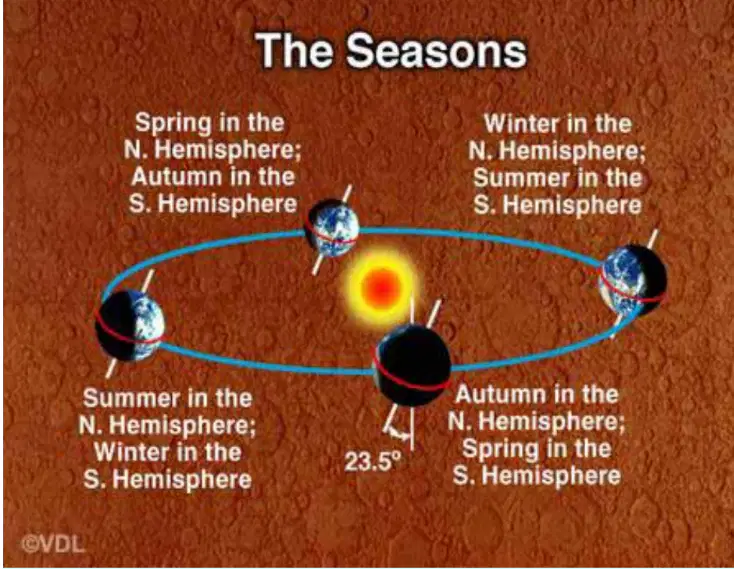
A very important factor that affects how a planet experiences its seasons is how much its axis is tilted. A planet’s axis is the imaginary line that extends from one pole through the planet’s center to the other pole. Every planet in the solar system except for Mercury tilts at least slightly on its axis. The degree of axial tilt affects how much difference in temperature occurs between seasons. For example, Earth has an axial tilt of about 23.5 degrees. This tilt has a significant effect on the temperature differences between the seasons. While the This diagram shows the relative distances from the Sun to the planets in the solar system, as well as from the Sun to the dwarf planet Pluto. The orbits shown are not drawn to scale. Seasons on Earth are caused by the planet’s axial tilt. During part of Earth’s orbit, the Northern Hemisphere is tilted toward the Sun and experiences summer. During another part of Earth’s orbit, the Southern Hemisphere is tilted toward the Sun and experiences summer. Seasons on the Planets Northern Hemisphere is tilted toward the Sun, the Southern Hemisphere is tilted away from the Sun. During this time, the Northern Hemisphere receives more direct sunlight and experiences summer, while the Southern Hemisphere receives less direct sunlight and experiences winter. Midway through Earth’s orbit, this alignment reverses. The Southern Hemisphere tilts toward the Sun and experiences summer, while the Northern Hemisphere tilts away from the Sun and experiences winter. In contrast, Venus and Jupiter have axial tilts of only about three degrees. This makes the seasonal variations on these planets so slight that they are almost undetectable. What is a planet’s axis?
The path it takes around the Sun
The imaginary line that runs from one pole through the center to the other pole
The distance between the planet and the Sun
The amount of sunlight the planet receives
A very important factor that affects how a planet experiences its seasons is how much its axis is tilted. A planet’s axis is the imaginary line that extends from one pole through the planet’s center to the other pole. Every planet in the solar system except for Mercury tilts at least slightly on its axis. The degree of axial tilt affects how much difference in temperature occurs between seasons. For example, Earth has an axial tilt of about 23.5 degrees. This tilt has a significant effect on the temperature differences between the seasons. While the This diagram shows the relative distances from the Sun to the planets in the solar system, as well as from the Sun to the dwarf planet Pluto. The orbits shown are not drawn to scale. Seasons on Earth are caused by the planet’s axial tilt. During part of Earth’s orbit, the Northern Hemisphere is tilted toward the Sun and experiences summer. During another part of Earth’s orbit, the Southern Hemisphere is tilted toward the Sun and experiences summer. Seasons on the Planets Northern Hemisphere is tilted toward the Sun, the Southern Hemisphere is tilted away from the Sun. During this time, the Northern Hemisphere receives more direct sunlight and experiences summer, while the Southern Hemisphere receives less direct sunlight and experiences winter. Midway through Earth’s orbit, this alignment reverses. The Southern Hemisphere tilts toward the Sun and experiences summer, while the Northern Hemisphere tilts away from the Sun and experiences winter. In contrast, Venus and Jupiter have axial tilts of only about three degrees. This makes the seasonal variations on these planets so slight that they are almost undetectable. What is the main factor that affects how a planet experiences its seasons?
The number of moons it has
Its distance from the Sun
How much its axis is tilted
The size of its atmosphere
A very important factor that affects how a planet experiences its seasons is how much its axis is tilted. A planet’s axis is the imaginary line that extends from one pole through the planet’s center to the other pole. Every planet in the solar system except for Mercury tilts at least slightly on its axis. The degree of axial tilt affects how much difference in temperature occurs between seasons. For example, Earth has an axial tilt of about 23.5 degrees. This tilt has a significant effect on the temperature differences between the seasons. While the This diagram shows the relative distances from the Sun to the planets in the solar system, as well as from the Sun to the dwarf planet Pluto. The orbits shown are not drawn to scale. Seasons on Earth are caused by the planet’s axial tilt. During part of Earth’s orbit, the Northern Hemisphere is tilted toward the Sun and experiences summer. During another part of Earth’s orbit, the Southern Hemisphere is tilted toward the Sun and experiences summer. Seasons on the Planets Northern Hemisphere is tilted toward the Sun, the Southern Hemisphere is tilted away from the Sun. During this time, the Northern Hemisphere receives more direct sunlight and experiences summer, while the Southern Hemisphere receives less direct sunlight and experiences winter. Midway through Earth’s orbit, this alignment reverses. The Southern Hemisphere tilts toward the Sun and experiences summer, while the Northern Hemisphere tilts away from the Sun and experiences winter. In contrast, Venus and Jupiter have axial tilts of only about three degrees. This makes the seasonal variations on these planets so slight that they are almost undetectable. Why does Earth experience significant temperature differences between seasons?
Because it rotates faster than other planets
Because of its axial tilt of about 23.5 degrees
Because it is the third planet from the Sun
Because it has an atmosphere with oxygen
A very important factor that affects how a planet experiences its seasons is how much its axis is tilted. A planet’s axis is the imaginary line that extends from one pole through the planet’s center to the other pole. Every planet in the solar system except for Mercury tilts at least slightly on its axis. The degree of axial tilt affects how much difference in temperature occurs between seasons. For example, Earth has an axial tilt of about 23.5 degrees. This tilt has a significant effect on the temperature differences between the seasons. While the This diagram shows the relative distances from the Sun to the planets in the solar system, as well as from the Sun to the dwarf planet Pluto. The orbits shown are not drawn to scale. Seasons on Earth are caused by the planet’s axial tilt. During part of Earth’s orbit, the Northern Hemisphere is tilted toward the Sun and experiences summer. During another part of Earth’s orbit, the Southern Hemisphere is tilted toward the Sun and experiences summer. Seasons on the Planets Northern Hemisphere is tilted toward the Sun, the Southern Hemisphere is tilted away from the Sun. During this time, the Northern Hemisphere receives more direct sunlight and experiences summer, while the Southern Hemisphere receives less direct sunlight and experiences winter. Midway through Earth’s orbit, this alignment reverses. The Southern Hemisphere tilts toward the Sun and experiences summer, while the Northern Hemisphere tilts away from the Sun and experiences winter. In contrast, Venus and Jupiter have axial tilts of only about three degrees. This makes the seasonal variations on these planets so slight that they are almost undetectable. When the Northern Hemisphere is tilted toward the Sun, what happens in the Southern Hemisphere?
It also experiences summer
It receives more direct sunlight
It is tilted away from the Sun and experiences winter
Both hemispheres experience the same season
A very important factor that affects how a planet experiences its seasons is how much its axis is tilted. A planet’s axis is the imaginary line that extends from one pole through the planet’s center to the other pole. Every planet in the solar system except for Mercury tilts at least slightly on its axis. The degree of axial tilt affects how much difference in temperature occurs between seasons. For example, Earth has an axial tilt of about 23.5 degrees. This tilt has a significant effect on the temperature differences between the seasons. While the This diagram shows the relative distances from the Sun to the planets in the solar system, as well as from the Sun to the dwarf planet Pluto. The orbits shown are not drawn to scale. Seasons on Earth are caused by the planet’s axial tilt. During part of Earth’s orbit, the Northern Hemisphere is tilted toward the Sun and experiences summer. During another part of Earth’s orbit, the Southern Hemisphere is tilted toward the Sun and experiences summer. Seasons on the Planets Northern Hemisphere is tilted toward the Sun, the Southern Hemisphere is tilted away from the Sun. During this time, the Northern Hemisphere receives more direct sunlight and experiences summer, while the Southern Hemisphere receives less direct sunlight and experiences winter. Midway through Earth’s orbit, this alignment reverses. The Southern Hemisphere tilts toward the Sun and experiences summer, while the Northern Hemisphere tilts away from the Sun and experiences winter. In contrast, Venus and Jupiter have axial tilts of only about three degrees. This makes the seasonal variations on these planets so slight that they are almost undetectable. Why are seasonal variations on Venus and Jupiter almost undetectable?
They are too far from the Sun
They have no atmosphere
Their orbits are perfectly circular
Their axes are tilted only about three degrees

Mercury, the closest planet to the Sun, has virtually no axial tilt. Therefore, any seasonal changes that it experiences are likely to be very slight. Also, Mercury orbits the Sun about once every 88 days, so each season is very short, lasting only about 22 days. Why does Mercury experience very slight seasonal changes?
Because it has a thick atmosphere
Because it has virtually no axial tilt
Because it is far from the Sun
Because it rotates very quickly
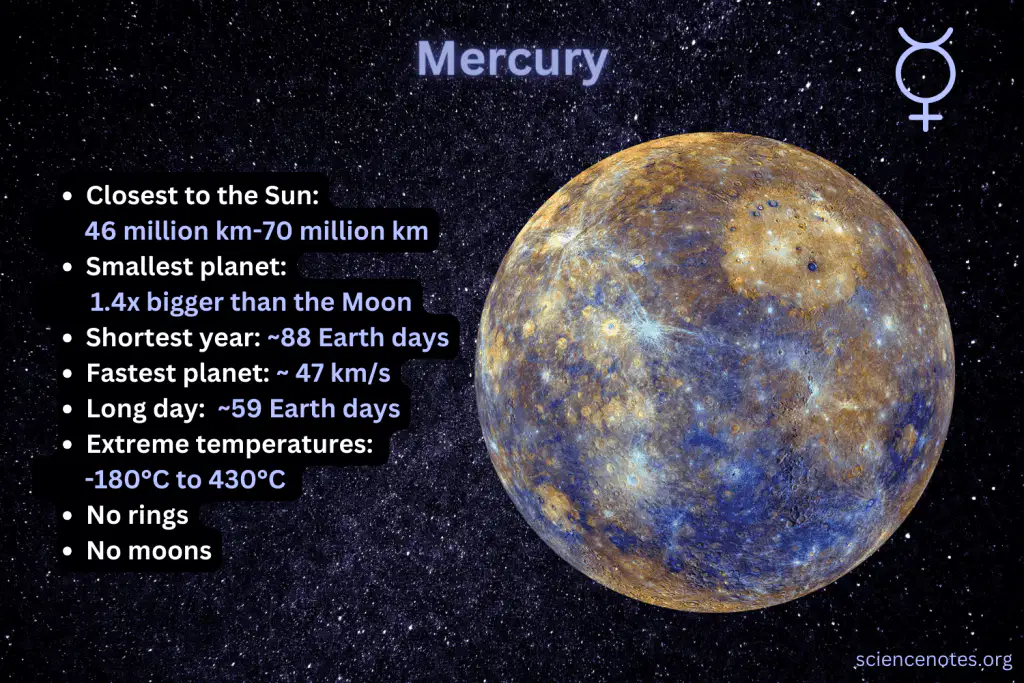
Mercury, the closest planet to the Sun, has virtually no axial tilt. Therefore, any seasonal changes it experiences are likely to be very slight. Also, Mercury orbits the Sun about once every 88 days, so each season is very short, lasting only about 22 days. How long does it take Mercury to orbit the Sun?
22 days
44 days
66 days
88 days
Mercury, the closest planet to the Sun, has virtually no axial tilt. Therefore, any seasonal changes it experiences are likely to be very slight. Also, Mercury orbits the Sun about once every 88 days, so each season is very short, lasting only about 22 days. About how long does each season last on Mercury?
22 days
44 days
66 days
88 days
Mercury, the closest planet to the Sun, has virtually no axial tilt. Therefore, any seasonal changes it experiences are likely to be very slight. Also, Mercury orbits the Sun about once every 88 days, so each season is very short, lasting only about 22 days. What is true about Mercury’s position in the solar system?
It is between Earth and Mars
It is the farthest planet from the Sun
It is the closest planet to the Sun
It is located beyond Saturn
Mercury, the closest planet to the Sun, has virtually no axial tilt. Therefore, any seasonal changes it experiences are likely to be very slight. Also, Mercury orbits the Sun about once every 88 days, so each season is very short, lasting only about 22 days. What does Mercury’s short orbital period mean for its seasons?
Each season lasts for several years
Each season is long and intense
Each season is short
Mercury has no seasons at all
Venus, Earth’s nearest planetary neighbor in space, also experiences little difference from season to season. Venus’s thick atmosphere of carbon dioxide does not allow much of the Sun’s heat to escape back into space. Carbon dioxide is known as a greenhouse gas because it traps heat like the glass of a greenhouse. Scientists refer to this phenomenon on Venus as a runaway greenhouse effect. This extreme greenhouse effect, combined with the planet’s relatively slight axial tilt, keeps surface temperature on Venus at a near-constant 460° C. Why does Venus experience little difference from season to season?
It has a very long orbit around the Sun.
It has a thick atmosphere and a slight axial tilt.
It is far away from the Sun.
It spins very quickly.
Venus, Earth’s nearest planetary neighbor in space, also experiences little difference from season to season. Venus’s thick atmosphere of carbon dioxide does not allow much of the Sun’s heat to escape back into space. Carbon dioxide is known as a greenhouse gas because it traps heat like the glass of a greenhouse. Scientists refer to this phenomenon on Venus as a runaway greenhouse effect. This extreme greenhouse effect, combined with the planet’s relatively slight axial tilt, keeps surface temperature on Venus at a near-constant 460° C. What gas makes up most of Venus’s atmosphere?
Oxygen
Nitrogen
Carbon dioxide
Hydrogen
Venus, Earth’s nearest planetary neighbor in space, also experiences little difference from season to season. Venus’s thick atmosphere of carbon dioxide does not allow much of the Sun’s heat to escape back into space. Carbon dioxide is known as a greenhouse gas because it traps heat like the glass of a greenhouse. Scientists refer to this phenomenon on Venus as a runaway greenhouse effect. This extreme greenhouse effect, combined with the planet’s relatively slight axial tilt, keeps the surface temperature on Venus at a near-constant 460° C. What is the “runaway greenhouse effect” on Venus?
When Venus’s clouds reflect all sunlight away.
When heat is trapped by the atmosphere and cannot escape.
When Venus cools rapidly during its long nights.
When Venus’s surface freezes due to distance from the Sun.
Venus, Earth’s nearest planetary neighbor in space, also experiences little difference from season to season. Venus’s thick atmosphere of carbon dioxide does not allow much of the Sun’s heat to escape back into space. Carbon dioxide is known as a greenhouse gas because it traps heat like the glass of a greenhouse. Scientists refer to this phenomenon on Venus as a runaway greenhouse effect. This extreme greenhouse effect, combined with the planet’s relatively slight axial tilt, keeps the surface temperature on Venus at a near-constant 460° C. What is the approximate surface temperature on Venus?
100° C
250° C
460° C
900° C
Venus, Earth’s nearest planetary neighbor in space, also experiences little difference from season to season. Venus’s thick atmosphere of carbon dioxide does not allow much of the Sun’s heat to escape back into space. Carbon dioxide is known as a greenhouse gas because it traps heat like the glass of a greenhouse. Scientists refer to this phenomenon on Venus as a runaway greenhouse effect. This extreme greenhouse effect, combined with the planet’s relatively slight axial tilt, keeps the surface temperature on Venus at a near-constant 460° C. Why is carbon dioxide called a greenhouse gas?
It traps heat like the glass of a greenhouse.
It cools the atmosphere.
It turns into solid ice in space.
It reflects sunlight away from the planet.
Earth is not the only planet in the solar system that has seasons. Other planets experience seasons as well. Seasonal length and the differences between summer and winter depend on several factors, including the planet’s period of revolution, how elliptical its orbit is, and how much its axis is tilted. Some planets have substantially different conditions from one season to the next. On other planets, however, the changes are barely detectable. What does the text say about seasons on other planets?
Only Earth experiences seasons.
All planets have identical seasons.
Other planets also experience seasons.
No other planet has seasonal changes.
Earth is not the only planet in the solar system that has seasons. Other planets experience seasons as well. Seasonal length and the differences between summer and winter depend on several factors, including the planet’s period of revolution, how elliptical its orbit is, and how much its axis is tilted. Some planets have substantially different conditions from one season to the next. On other planets, however, the changes are barely detectable. Which factor affects the length and differences of a planet’s seasons?
The size of the planet’s moons
The planet’s period of revolution and axial tilt
The number of craters on the planet
The planet’s distance from Earth
Earth is not the only planet in the solar system that has seasons. Other planets experience seasons as well. Seasonal length and the differences between summer and winter depend on several factors, including the planet’s period of revolution, how elliptical its orbit is, and how much its axis is tilted. Some planets have substantially different conditions from one season to the next. On other planets, however, the changes are barely detectable. What does the term “period of revolution” refer to?
The time a planet takes to rotate once on its axis
The time a planet takes to orbit the Sun once
The number of moons a planet has
The speed of a planet’s atmosphere
Earth is not the only planet in the solar system that has seasons. Other planets experience seasons as well. Seasonal length and the differences between summer and winter depend on several factors, including the planet’s period of revolution, how elliptical its orbit is, and how much its axis is tilted. Some planets have substantially different conditions from one season to the next. On other planets, however, the changes are barely detectable. What determines whether a planet has noticeable seasonal changes?
How elliptical its orbit is and how much its axis is tilted
The color of its surface
Its distance from Earth
The number of asteroids nearby
Earth is not the only planet in the solar system that has seasons. Other planets experience seasons as well. Seasonal length and the differences between summer and winter depend on several factors, including the planet’s period of revolution, how elliptical its orbit is, and how much its axis is tilted. Some planets have substantially different conditions from one season to the next. On other planets, however, the changes are barely detectable. How do seasonal changes vary among the planets?
Some have big changes, others have almost none.
All planets have the same temperature all year.
Every planet experiences extreme seasonal differences.
None of the planets have measurable seasons.
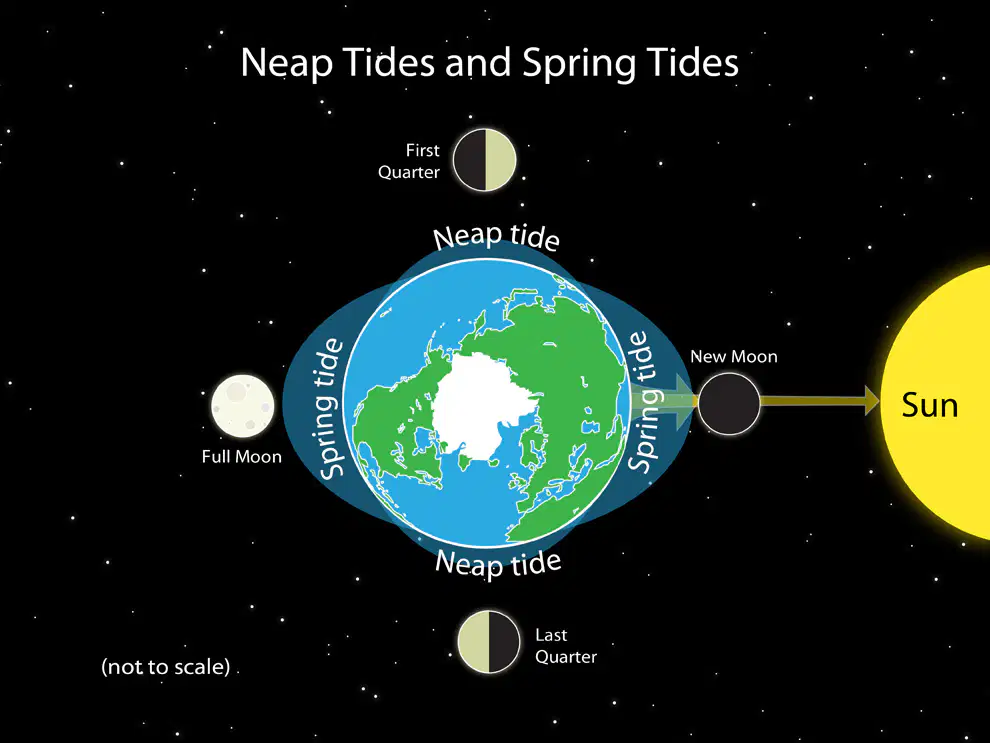
As the moon orbits the Earth, its gravity drags water around our planet. This mass movement of water is what we call tides. There are two types of tides called Spring and Neap tides. Spring tides are particularly deep high and low tides because the Earth, Moon, and Sun are aligned, so that their gravity tug water into the same direction. Neap tides are particularly shallow high and low tides because the Moon and the Sun are perpendicular, pulling Earth’s water in different directions causing the water to be spread around in shallow tides. What causes tides on Earth?
The rotation of the Earth on its axis
The gravity of the Moon dragging Earth’s water
Winds pushing ocean water around
The Earth’s tilt on its axis
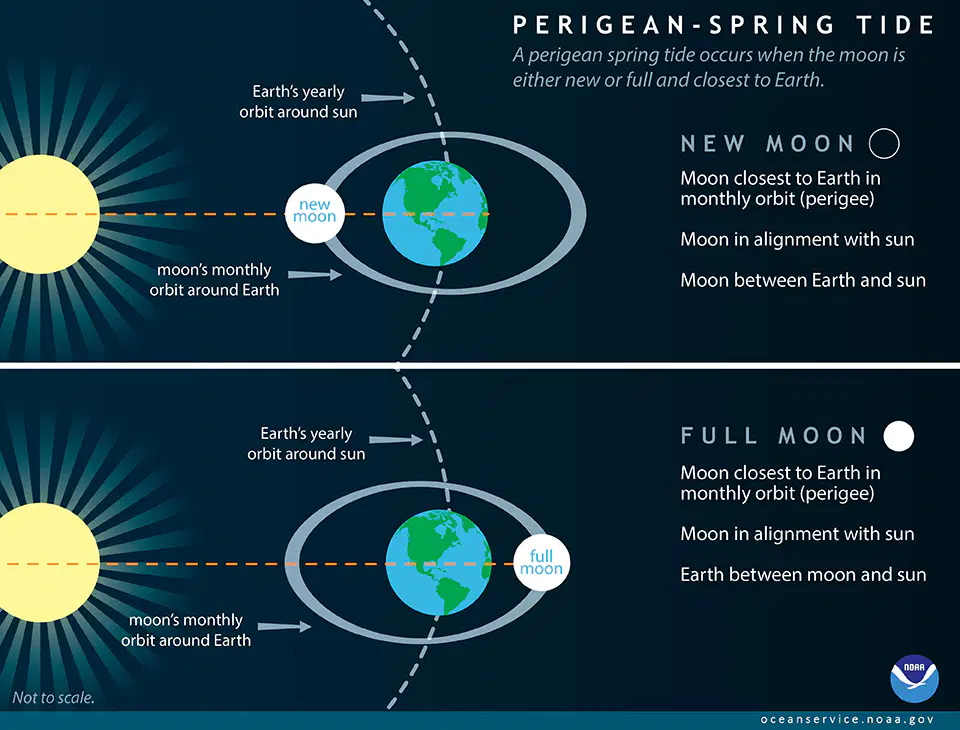
As the moon orbits the Earth, its gravity drags water around our planet. This mass movement of water is what we call tides. There are two types of tides called Spring and Neap tides. Spring tides are particularly deep high and low tides because the Earth, Moon, and Sun are aligned, so that their gravity tug water into the same direction. Neap tides are particularly shallow high and low tides because the Moon and the Sun are perpendicular, pulling Earth’s water in different directions causing the water to be spread around in shallow tides. What are the two main types of tides?
Lunar and Solar tides
Deep and Shallow tides
Spring and Neap tides
High and Low tides

As the moon orbits the Earth, its gravity drags water around our planet. This mass movement of water is what we call tides. There are two types of tides called Spring and Neap tides. Spring tides are particularly deep high and low tides because the Earth, Moon, and Sun are aligned, so that their gravity tug water into the same direction. Neap tides are particularly shallow high and low tides because the Moon and the Sun are perpendicular, pulling Earth’s water in different directions causing the water to be spread around in shallow tides. Why are Spring tides higher and lower than usual?
Because the Moon is farther from the Earth
Because the Earth, Moon, and Sun are aligned
Because the Moon is perpendicular to the Sun
Because the Earth rotates faster during this time
As the moon orbits the Earth, its gravity drags water around our planet. This mass movement of water is what we call tides. There are two types of tides called Spring and Neap tides. Spring tides are particularly deep high and low tides because the Earth, Moon, and Sun are aligned, so that their gravity tug water into the same direction. Neap tides are particularly shallow high and low tides because the Moon and the Sun are perpendicular, pulling Earth’s water in different directions causing the water to be spread around in shallow tides. What happens during Neap tides?
The Earth, Moon, and Sun pull in the same direction
The Moon and Sun pull Earth’s water in different directions
The Moon’s gravity is stronger than usual
There are no tides
As the moon orbits the Earth, its gravity drags water around our planet. This mass movement of water is what we call tides. There are two types of tides called Spring and Neap tides. Spring tides are particularly deep high and low tides because the Earth, Moon, and Sun are aligned, so that their gravity tug water into the same direction. Neap tides are particularly shallow high and low tides because the Moon and the Sun are perpendicular, pulling Earth’s water in different directions causing the water to be spread around in shallow tides. Compared to Spring tides, Neap tides are:
Deeper and more extreme
Higher and lower at the same time
Shallow and less extreme
Completely absent

The moon is 384,400 kilometers away from the Earth. The gravitational pull from the moon is so strong that it has an effect on the ocean, causing tides. As the moon orbits our planet, while the Earth is rotating around the sun, the part of the Earth that is facing the moon experiences a stronger gravitational pull towards the moon from the Earth’s centre. It is so strong that it causes the water in the ocean to ‘bulge’ outwards towards the moon. The centre gravity of the earth is also pulled at the same time. This causes a bulge on the opposite side of the planet. The ‘bulges’ also move along with the pull of the moon as it orbits Earth. The areas of the Earth where the
‘bulging’ of the ocean is occurring is experiencing high tides. How far is the Moon from the Earth?
38,400 kilometers
384,400 kilometers
3,844,000 kilometers
384 kilometers
The moon is 384,400 kilometers away from the Earth. The gravitational pull from the moon is so strong that it has an effect on the ocean, causing tides. As the moon orbits our planet, while the Earth is rotating around the sun, the part of the Earth that is facing the moon experiences a stronger gravitational pull towards the moon from the Earth’s centre. It is so strong that it causes the water in the ocean to ‘bulge’ outwards towards the moon. The centre gravity of the earth is also pulled at the same time. This causes a bulge on the opposite side of the planet. The ‘bulges’ also move along with the pull of the moon as it orbits Earth. The areas of the Earth where the
‘bulging’ of the ocean is occurring is experiencing high tides. What causes tides on Earth?
The wind blowing across the ocean
The gravitational pull of the Moon
The Earth’s rotation on its axis
The Sun heating the ocean water
The moon is 384,400 kilometers away from the Earth. The gravitational pull from the moon is so strong that it has an effect on the ocean, causing tides. As the moon orbits our planet, while the Earth is rotating around the sun, the part of the Earth that is facing the moon experiences a stronger gravitational pull towards the moon from the Earth’s centre. It is so strong that it causes the water in the ocean to ‘bulge’ outwards towards the moon. The centre gravity of the earth is also pulled at the same time. This causes a bulge on the opposite side of the planet. The ‘bulges’ also move along with the pull of the moon as it orbits Earth. The areas of the Earth where the
‘bulging’ of the ocean is occurring is experiencing high tides. What happens to the ocean water on the side of the Earth facing the Moon?
It moves away from the Moon
It bulges outward toward the Moon
It sinks toward the Earth’s center
It stays completely still
The moon is 384,400 kilometers away from the Earth. The gravitational pull from the moon is so strong that it has an effect on the ocean, causing tides. As the moon orbits our planet, while the Earth is rotating around the sun, the part of the Earth that is facing the moon experiences a stronger gravitational pull towards the moon from the Earth’s centre. It is so strong that it causes the water in the ocean to ‘bulge’ outwards towards the moon. The centre gravity of the earth is also pulled at the same time. This causes a bulge on the opposite side of the planet. The ‘bulges’ also move along with the pull of the moon as it orbits Earth. The areas of the Earth where the
‘bulging’ of the ocean is occurring is experiencing high tides. Why does a bulge also form on the opposite side of the Earth?
Because the Earth’s center is pulled toward the Moon
Because the Sun pulls the water in that direction
Because the Moon’s light heats that side of Earth
Because Earth’s gravity disappears on that side
The moon is 384,400 kilometers away from the Earth. The gravitational pull from the moon is so strong that it has an effect on the ocean, causing tides. As the moon orbits our planet, while the Earth is rotating around the sun, the part of the Earth that is facing the moon experiences a stronger gravitational pull towards the moon from the Earth’s centre. It is so strong that it causes the water in the ocean to ‘bulge’ outwards towards the moon. The centre gravity of the earth is also pulled at the same time. This causes a bulge on the opposite side of the planet. The ‘bulges’ also move along with the pull of the moon as it orbits Earth. The areas of the Earth where the
‘bulging’ of the ocean is occurring is experiencing high tides. What do the areas experiencing the ocean’s ‘bulges’ represent?
Low tides
Calm ocean waters
High tides
No tides at all
Wind can move ocean water and produce waves. Other forces can also move ocean water in regular patterns, such as tides. Tides are daily changes in the level of the ocean water. Both the sun and the moon influence the level of tides.The moon’s gravity pulls on every particle on Earth. However, the moon’s gravity doesn’t pull on every particle with the same strength. The moon’s gravitational pull on Earth decreases with distance from the moon. Therefore, the pull on some parts of Earth is stronger than on others. The part of Earth that faces the moon is pulled toward the moon with the greatest force. Therefore, the water on the side of Earth that faces the moon bulges toward the moon. The water on Earth’s opposite side is pulled toward the moon the least. Therefore, it bulges away from the moon. What can move ocean water and produce waves?
Earth’s rotation
Wind
Moonlight
Earthquakes
Wind can move ocean water and produce waves. Other forces can also move ocean water in regular patterns, such as tides. Tides are daily changes in the level of the ocean water. Both the sun and the moon influence the level of tides.The moon’s gravity pulls on every particle on Earth. However, the moon’s gravity doesn’t pull on every particle with the same strength. The moon’s gravitational pull on Earth decreases with distance from the moon. Therefore, the pull on some parts of Earth is stronger than on others. The part of Earth that faces the moon is pulled toward the moon with the greatest force. Therefore, the water on the side of Earth that faces the moon bulges toward the moon. The water on Earth’s opposite side is pulled toward the moon the least. Therefore, it bulges away from the moon. What are tides?
Movements of air in the atmosphere
Daily changes in the level of ocean water
Ocean waves caused by storms
Underwater currents caused by temperature differences
Water currents, waves, and tides are caused by different events and can impact Earth’s systems in many ways. Throughout the day, water levels in oceans and lakes around the planet rise and fall. These regular movements, or tides, are made by the motions and positions of three objects in space. These objects are Earth, the Moon, and the Sun. Each day, Earth makes one rotation on its axis. (Earth’s axis is an imaginary line that runs through the planet’s center, between its north and south geographic poles.) The Moon revolves, or moves, around Earth. One revolution of the Moon around Earth takes about 28 days, or one month. Meanwhile, Earth revolves around the Sun. One revolution of Earth around the Sun takes about 365 days, or one year. What causes tides to rise and fall throughout the day?
The temperature of the ocean
The motions and positions of Earth, the Moon, and the Sun
The amount of rainfall
The shape of the ocean floor
Water currents, waves, and tides are caused by different events and can impact Earth’s systems in many ways. Throughout the day, water levels in oceans and lakes around the planet rise and fall. These regular movements, or tides, are made by the motions and positions of three objects in space. These objects are Earth, the Moon, and the Sun. Each day, Earth makes one rotation on its axis. (Earth’s axis is an imaginary line that runs through the planet’s center, between its north and south geographic poles.) The Moon revolves, or moves, around Earth. One revolution of the Moon around Earth takes about 28 days, or one month. Meanwhile, Earth revolves around the Sun. One revolution of Earth around the Sun takes about 365 days, or one year. What is Earth’s axis?
A line drawn on maps to show the equator
A real pole built through Earth
An imaginary line that runs through Earth’s center between the poles
A path that Earth follows around the Moon
Water currents, waves, and tides are caused by different events and can impact Earth’s systems in many ways. Throughout the day, water levels in oceans and lakes around the planet rise and fall. These regular movements, or tides, are made by the motions and positions of three objects in space. These objects are Earth, the Moon, and the Sun. Each day, Earth makes one rotation on its axis. (Earth’s axis is an imaginary line that runs through the planet’s center, between its north and south geographic poles.) The Moon revolves, or moves, around Earth. One revolution of the Moon around Earth takes about 28 days, or one month. Meanwhile, Earth revolves around the Sun. One revolution of Earth around the Sun takes about 365 days, or one year. How long does it take the Moon to make one revolution around Earth?
About one day
About one week
About 28 days
About one year
Water currents, waves, and tides are caused by different events and can impact Earth’s systems in many ways. Throughout the day, water levels in oceans and lakes around the planet rise and fall. These regular movements, or tides, are made by the motions and positions of three objects in space. These objects are Earth, the Moon, and the Sun. Each day, Earth makes one rotation on its axis. (Earth’s axis is an imaginary line that runs through the planet’s center, between its north and south geographic poles.) The Moon revolves, or moves, around Earth. One revolution of the Moon around Earth takes about 28 days, or one month. Meanwhile, Earth revolves around the Sun. One revolution of Earth around the Sun takes about 365 days, or one year. What term describes the Moon’s movement around Earth?
Rotation
Revolution
Orbit
Tidal shift
Water currents, waves, and tides are caused by different events and can impact Earth’s systems in many ways. Throughout the day, water levels in oceans and lakes around the planet rise and fall. These regular movements, or tides, are made by the motions and positions of three objects in space. These objects are Earth, the Moon, and the Sun. Each day, Earth makes one rotation on its axis. (Earth’s axis is an imaginary line that runs through the planet’s center, between its north and south geographic poles.) The Moon revolves, or moves, around Earth. One revolution of the Moon around Earth takes about 28 days, or one month. Meanwhile, Earth revolves around the Sun. One revolution of Earth around the Sun takes about 365 days, or one year. How long does it take Earth to revolve around the Sun once?
One day
One week
One month
One year
Water currents, waves, and tides are caused by different events and can impact Earth’s systems in many ways. Throughout the day, water levels in oceans and lakes around the planet rise and fall. These regular movements, or tides, are made by the motions and positions of three objects in space. These objects are Earth, the Moon, and the Sun. Each day, Earth makes one rotation on its axis. (Earth’s axis is an imaginary line that runs through the planet’s center, between its north and south geographic poles.) The Moon revolves, or moves, around Earth. One revolution of the Moon around Earth takes about 28 days, or one month. Meanwhile, Earth revolves around the Sun. One revolution of Earth around the Sun takes about 365 days, or one year. What happens to water levels in oceans and lakes throughout the day?
They always stay the same
They disappear completely
They rise and fall
They only rise
As they move through space, the Moon, Earth, and the Sun exert forces on one another. The force of gravity is affected by two variables: the masses of the objects and the distance between them. Although the Moon is much less massive than the Sun, the Moon is much closer to Earth than Earth is to the Sun. As a result, the force of the Moon’s gravity on Earth is more than double the force of the Sun’s gravity on Earth. Substances that are free to move on Earth’s surface, such as ocean water, are more greatly affected by the Moon’s gravity than by the Sun’s. This is important for Earth’s tides. As the Moon revolves around Earth, it pulls water in oceans and lakes toward it. This causes water levels to rise in some places and to fall in others. What two variables affect the force of gravity between objects?
Shape and size
Mass and distance
Temperature and pressure
Color and texture
As they move through space, the Moon, Earth, and the Sun exert forces on one another. The force of gravity is affected by two variables: the masses of the objects and the distance between them. Although the Moon is much less massive than the Sun, the Moon is much closer to Earth than Earth is to the Sun. As a result, the force of the Moon’s gravity on Earth is more than double the force of the Sun’s gravity on Earth. Substances that are free to move on Earth’s surface, such as ocean water, are more greatly affected by the Moon’s gravity than by the Sun’s. This is important for Earth’s tides. As the Moon revolves around Earth, it pulls water in oceans and lakes toward it. This causes water levels to rise in some places and to fall in others. Why does the Moon have a stronger gravitational effect on Earth than the Sun does?
The Moon is larger than the Sun
The Sun is too hot to exert gravity
The Moon is much closer to Earth
The Moon revolves faster
As they move through space, the Moon, Earth, and the Sun exert forces on one another. The force of gravity is affected by two variables: the masses of the objects and the distance between them. Although the Moon is much less massive than the Sun, the Moon is much closer to Earth than Earth is to the Sun. As a result, the force of the Moon’s gravity on Earth is more than double the force of the Sun’s gravity on Earth. Substances that are free to move on Earth’s surface, such as ocean water, are more greatly affected by the Moon’s gravity than by the Sun’s. This is important for Earth’s tides. As the Moon revolves around Earth, it pulls water in oceans and lakes toward it. This causes water levels to rise in some places and to fall in others. Which substances on Earth are most affected by the Moon’s gravity?
Mountains
Soil
Ocean water
Trees
As they move through space, the Moon, Earth, and the Sun exert forces on one another. The force of gravity is affected by two variables: the masses of the objects and the distance between them. Although the Moon is much less massive than the Sun, the Moon is much closer to Earth than Earth is to the Sun. As a result, the force of the Moon’s gravity on Earth is more than double the force of the Sun’s gravity on Earth. Substances that are free to move on Earth’s surface, such as ocean water, are more greatly affected by the Moon’s gravity than by the Sun’s. This is important for Earth’s tides. As the Moon revolves around Earth, it pulls water in oceans and lakes toward it. This causes water levels to rise in some places and to fall in others. What causes water levels on Earth to rise and fall in different places?
Winds blowing across the ocean
The Moon pulling on Earth’s water as it revolves
Earth rotating faster during the day
Changes in air temperature
As they move through space, the Moon, Earth, and the Sun exert forces on one another. The force of gravity is affected by two variables: the masses of the objects and the distance between them. Although the Moon is much less massive than the Sun, the Moon is much closer to Earth than Earth is to the Sun. As a result, the force of the Moon’s gravity on Earth is more than double the force of the Sun’s gravity on Earth. Substances that are free to move on Earth’s surface, such as ocean water, are more greatly affected by the Moon’s gravity than by the Sun’s. This is important for Earth’s tides. As the Moon revolves around Earth, it pulls water in oceans and lakes toward it. This causes water levels to rise in some places and to fall in others. What natural event is directly influenced by the Moon’s gravitational pull on Earth?
Earthquakes
Tides
Seasons
Volcanic eruptions
The Earth is tilted on its axis by about 23.4 degrees. This tilt is why we have seasons. As the Earth moves around the Sun, different parts of Earth get more direct sunlight. When the North Pole tilts towards the Sun, it's summer in the Northern Hemisphere and winter in the Southern Hemisphere. When the South Pole tilts towards the Sun, it's summer in the Southern Hemisphere and winter in the Northern Hemisphere. There are special times of the year called solstices and equinoxes that mark the changing of the seasons. The equinoxes happen in March and September. The word equinox comes from Latin words meaning "equal night". What causes the change of seasons on Earth?
The Earth's distance from the Sun
The tilt of the Earth's axis
The size of the Earth
The speed of Earth’s rotation
The Earth is tilted on its axis by about 23.4 degrees. This tilt is why we have seasons. As the Earth moves around the Sun, different parts of Earth get more direct sunlight. When the North Pole tilts towards the Sun, it's summer in the Northern Hemisphere and winter in the Southern Hemisphere. When the South Pole tilts towards the Sun, it's summer in the Southern Hemisphere and winter in the Northern Hemisphere. There are special times of the year called solstices and equinoxes that mark the changing of the seasons. The equinoxes happen in March and September. The word equinox comes from Latin words meaning "equal night". When the North Pole tilts toward the Sun, which season is it in the Northern Hemisphere?
Spring
Autumn
Winter
Summer
The Earth is tilted on its axis by about 23.4 degrees. This tilt is why we have seasons. As the Earth moves around the Sun, different parts of Earth get more direct sunlight. When the North Pole tilts towards the Sun, it's summer in the Northern Hemisphere and winter in the Southern Hemisphere. When the South Pole tilts towards the Sun, it's summer in the Southern Hemisphere and winter in the Northern Hemisphere. There are special times of the year called solstices and equinoxes that mark the changing of the seasons. The equinoxes happen in March and September. The word equinox comes from Latin words meaning "equal night". What happens during the equinoxes?
The Sun is directly above one of the poles
Day and night are of equal length
The Northern Hemisphere is tilted most toward the Sun
The Southern Hemisphere is tilted most toward the Sun
The Earth is tilted on its axis by about 23.4 degrees. This tilt is why we have seasons. As the Earth moves around the Sun, different parts of Earth get more direct sunlight. When the North Pole tilts towards the Sun, it's summer in the Northern Hemisphere and winter in the Southern Hemisphere. When the South Pole tilts towards the Sun, it's summer in the Southern Hemisphere and winter in the Northern Hemisphere. There are special times of the year called solstices and equinoxes that mark the changing of the seasons. The equinoxes happen in March and September. The word equinox comes from Latin words meaning "equal night". In which months do the equinoxes occur?
January and July
February and August
March and September
April and October
During an equinox, the Sun is right above the Equator. This makes day and night almost the same length all over the world. The March equinox is called the spring equinox, and the September equinox is called the fall equinox in the Northern Hemisphere. The solstices happen in June and December. They mark when the Sun's path is farthest north or south from the Equator. The summer solstice is the longest day of the year, and the winter solstice is the shortest day of the year. What happens during an equinox?
The Sun is directly above one of the poles.
The Sun is right above the Equator
The Sun is farthest north or south from the Equator
The Sun does not rise or se
During an equinox, the Sun is right above the Equator. This makes day and night almost the same length all over the world. The March equinox is called the spring equinox, and the September equinox is called the fall equinox in the Northern Hemisphere. The solstices happen in June and December. They mark when the Sun's path is farthest north or south from the Equator. The summer solstice is the longest day of the year, and the winter solstice is the shortest day of the year. What is true about day and night during an equinox?
Days are longer than nights everywhere
Nights are longer than days everywhere
Day and night are almost the same length everywhere
. There is no sunlight anywhere on Earth
During an equinox, the Sun is right above the Equator. This makes day and night almost the same length all over the world. The March equinox is called the spring equinox, and the September equinox is called the fall equinox in the Northern Hemisphere. The solstices happen in June and December. They mark when the Sun's path is farthest north or south from the Equator. The summer solstice is the longest day of the year, and the winter solstice is the shortest day of the year. In the Northern Hemisphere, when does the spring equinox occur?
September
June
December
March
During an equinox, the Sun is right above the Equator. This makes day and night almost the same length all over the world. The March equinox is called the spring equinox, and the September equinox is called the fall equinox in the Northern Hemisphere. The solstices happen in June and December. They mark when the Sun's path is farthest north or south from the Equator. The summer solstice is the longest day of the year, and the winter solstice is the shortest day of the year. What do solstices mark?
When the Sun’s path is directly above the Equator
When the Sun’s path is farthest north or south from the Equator
When Earth’s axis is not tilted
When day and night are equal
During an equinox, the Sun is right above the Equator. This makes day and night almost the same length all over the world. The March equinox is called the spring equinox, and the September equinox is called the fall equinox in the Northern Hemisphere. The solstices happen in June and December. They mark when the Sun's path is farthest north or south from the Equator. The summer solstice is the longest day of the year, and the winter solstice is the shortest day of the year. Which statement is true about the solstices?
The summer solstice is the longest day of the year
The winter solstice is the longest day of the year
Both solstices have equal day and night lengths
Solstices only happen in the Southern Hemisphere

