
 Worksheets
Module 5 part 1
Total questions: 103
Worksheet time: 2hrs 35mins
Name
Class
Date
1.
Bacteria is what kind of cell?
a)
Eukaryotic
b)
Prokaryotic
2.
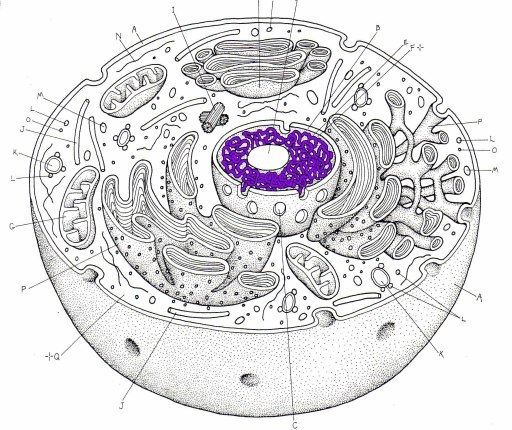
What kind of cell is this?
a)
Eukaryotic
b)
Prokaryotic
3.
Cells can only be seen with the help of a...
a)
hand lens
b)
magnifying glass
c)
3D glasses
d)
microscope
4.
All living things are made of...
a)
atoms
b)
cells
c)
bacteria
d)
plants
5.
What is unicellular?
a)
one cell
b)
many cells
c)
no nuclues
d)
DNA
6.
What is multicellular?
a)
one cell
b)
no cells
c)
many cells
d)
no nucleus
7.
All cells come from other...
a)
cells
b)
plants
c)
nucleus
d)
microscopes
8.
What type of cell has a nucleus?
a)
eukaryotic
b)
prokaryotic
9.
What type of cell does not have a nucleus?
a)
eukaryotic
b)
prokaryotic
10.
Plants and animal cells are examples of ___ cells
a)
prokaryotic cells
b)
eukaryotic cells
11.
Prokaryotes are unlike all other organisms in that their cells
a)
do not have a nucleus
b)
have organelles
c)
have cell walls
12.
Bacteria cells are exactly like animal cells
a)
True
b)
False
13.
Bacteria are unicellular
a)
True
b)
False
14.
All bacteria are harmful to humans
a)
True
b)
False
15.
Bacteria help you digest food.
a)
True
b)
False
16.
Bacteria are
a)
prokaryotes
b)
eukaryotes
17.
How are prokaryotes and eukaryotes similar?
a)
They both contain membrane-bound organelles.
b)
They both have cell membranes.
c)
The both have nuclei.
d)
They both have chloroplasts.
18.
______________ are the basic unit of living things.
a)
Kittens
b)
Organisms
c)
Cells
d)
Organelles
19.
The basic unit of life is called a (n)
a)
atom
b)
compound
c)
cell
d)
energy
20.
Rocks are not living because
a)
they never move
b)
they aren't needed for humans
c)
they are not made of cells
d)
they don't break down
21.
There are three parts to the cell theory. Which is NOT one of those parts?
a)
All organisms are composed of one or more cells.
b)
The cell is the basic unit of structure and organization in organisms.
c)
Cells spontaneously arise from carbon and nutrients carried in the bloodstream.
d)
All cells come from pre-existing cells.
22.
A cat is living because
a)
it breathes
b)
it reproduces on its own
c)
it eats
d)
all of these are correct
23.
Which is true of prokaryotic and eukaryotic cells?
a)
Prokaryotic cells are larger than eukaryotic cells.
b)
Eukaryotic cells do not have nuclei, and prokaryotic cells do have nuclei.
c)
Prokaryotic cells lack membrane-bound organelles, and eukaryotic cells contain membrane-bound organelles.
d)
Eukaryotic cells are simpler than prokaryotic cells.
24.
Which of the following would be found in both eukaryotic AND prokaryotic cells?
a)
chloroplast
b)
cytoplasm
c)
nucleus
d)
endoplasmic reticulum
25.

What type of cells are humans made up of?
a)
Prokaryotic
b)
Eukaryotic
c)
Plant
26.

Prokaryotes have a nucleus.
a)
True
b)
False
27.

Every cell is surrounded by a cell membrane.
a)
True
b)
False
28.

Plant cells are the same as animal cells.
a)
True
b)
False
29.
Osmosis is the diffusion of _____ across a selectively permeable membrane.
a)
food
b)
air
c)
water
d)
oxygen
30.
During diffusion
a)
substances (things) moves from high to low concentration
b)
water moves when energy is used
c)
large or oddly shaped molecules move across a cell membrane
d)
water moves from high to low concentration
31.

The picture is an example of _________________.
a)
isotonic
b)
diffusion
c)
osmosis
d)
active transport
32.
What does selectively-permeable mean?
a)
The cell controls what passes in and out of the cell
b)
Nothing gets through
c)
The cell lets only large substances through
33.

Which diagram best shows the end result of diffusion?
a)
F
b)
G
c)
H
d)
J
34.

Where is there a high concentration of water?
a)
in the flower
b)
cannot be determined by picture.
c)
in the vase
d)
in the leaves
35.

A student put a few drops of lemon juice into an uninflated balloon.The student tied a knot in the balloon, placed it in a shoe box, and covered it with a lid. The following day, the student opened the box and was able to smell lemon in the box. Through what process were molecules able to pass through the balloon?
a)
respiration
b)
digestions
c)
osmosis
d)
diffusion
36.

Where is there a low concentration of perfume?
a)
in the bottle
b)
on the hand
c)
in the room
d)
in the top
37.

The inside of this cell is _______________ compared to the outside.
a)
Isotonic
b)
Hypertonic
c)
Hypotonic
d)
Diffusion
38.
A cell placed in a hypertonic solution will
a)
Stay the same
b)
Shrink- get smaller
c)
Swell- get bigger
39.
When both inside and outside of a cell have the same amount of water it is said that the cell has reached a state of ___________.
a)
osmosis
b)
equilibrium
c)
diffusion
d)
hypertonic
40.
If you looked at red blood cells under a microscope and saw that several of the blood cells had burst, what would you say happened?
a)
The cells were placed in a hypotonic solution.
b)
The cells were placed in a hypertonic solution.
c)
The cells were placed in an isotonic solution.
41.
What does selectively-permeable mean?
a)
Only certain substances are able to pass through
b)
Nothing is able to pass through
c)
Everything is able to pass through
42.
If a cell is placed in a hypotonic solution, the cell will _______.
a)
stay the same
b)
swell (get bigger)
c)
shrink (get smaller)
43.
In the given scenario what will happen to the organism: salt is poured onto eggplant.
a)
Water will move out of the eggplant cells and the cells will shrink.
b)
Water will move out of the eggplant cells and the cells will swell.
c)
Water will move into the eggplant cells and the cells will swell.
44.
What process occurs when WATER diffuses across a membrane?
a)
endocytosis
b)
mitosis
c)
osmosis
d)
nuclear fission
45.

The cell below is in a _________ solution.
a)
Hypotonic
b)
Hypertonic
c)
Isotonic
46.

The cell below is in a _____________ solution.
a)
Hypertonic
b)
Hypotonic
c)
Isotonic
47.
If a cell containing 5% salt is placed into a glass of water with 20% salt, the water is _______ compared to the cell.
a)
hypertonic-
b)
hypotonic
c)
isotonic
48.

What type of solution is this cell in?
a)
Isotonic
b)
Hypertonic
c)
Hypotonic
d)
diffused
49.

What type of solution is this cell in?
a)
Isotonic
b)
Hypertonic
c)
Hypotonic
d)
diffused
50.

What type of solution allows water to enter the plant cell?
a)
hypotonic solution
b)
hypertonic solution
c)
isotonic solution
d)
active transport
51.

This egg has shrunk, what type of solution was it placed in?
a)
hypotonic solution
b)
hypertonic solution
c)
isotonic solution
d)
active transport
52.

What type of solution is this cell in?
a)
Isotonic
b)
Hypertonic
c)
Hypotonic
d)
diffused
53.

Compared to the solution it is sitting in, the cell is _____________
a)
Isotonic
b)
Hypertonic
c)
Hypotonic
d)
diffused
54.

Fruit fly body cells have 8 chromosomes. After mitosis, you would expect a resulting fruit fly daughter cell to have ...
a)
16 chromosomes.
b)
46 chromosomes.
c)
8 chromosomes.
d)
4 chromosomes.
55.
The process by which the nuclear material is divided equally between two new cells
a)
mitosis
b)
cancer
c)
spindle
d)
centromere
56.

Structure (a) is a ____.
a)
chromosome
b)
chromatid
c)
centromere
57.

Name the phase:
a)
Anaphase
b)
Telophase
c)
Metaphase
d)
Prophase
58.

Name the phase:
a)
Anaphase
b)
Telophase
c)
Metaphase
d)
Prophase
59.

What is the next phase of mitosis?
a)
Prophase
b)
Metaphase
c)
Anaphase
d)
Telophase
60.

What is the next phase of mitosis?
a)
Prophase
b)
Metaphase
c)
Anaphase
d)
Telophase
61.

What is the next phase of mitosis?
a)
Prophase
b)
Metaphase
c)
Anaphase
d)
Telophase
62.

Name the previous phase.
a)
Prophase
b)
Metaphase
c)
Anaphase
d)
Telophase
63.

Name the phase:
a)
Prophase
b)
Metaphase
c)
Anaphase
d)
Telophase
64.

Name the phase:
a)
Prophase
b)
Metaphase
c)
Anaphase
d)
Telophase
65.

Name the phase:
a)
Prophase
b)
Metaphase
c)
Anaphase
d)
Telophase
66.

Name the phase:
a)
Prophase
b)
Metaphase
c)
Anaphase
d)
Telophase
67.

Name the phase:
a)
Prophase
b)
Metaphase
c)
Anaphase
d)
Telophase
68.

The organelle that helps in cell division and produces spindle fibers.
a)
Chromosome
b)
Centriole
c)
Cytoplasm
d)
Chloroplast
69.

The stages of mitosis in order
a)
Metaphase, Anaphase, Prophase, Telophase
b)
Prophase, Anaphase, Metaphase, Telophase
c)
Prophase, Metaphase, Anaphase, Telophase
d)
Anaphase, Prophase, Telophase, Metaphase
70.
Nuclear membrane forms around chromosomes and begins to separate.
a)
Anaphase
b)
Telophase
71.

a)
Prophase
b)
Interphase
c)
Anaphase
d)
Telophase
72.

a)
Anaphase
b)
Cytokinesis
c)
Telophase
d)
Metaphase
73.

a)
Cytokinesis
b)
Interphase
c)
Anaphase
d)
Metaphase
74.

a)
Anaphase
b)
Cytonkinesis
c)
Interphase
d)
Prophase
75.

a)
Cytokinesis
b)
Anaphase
c)
Telophase
d)
Prophase
76.
The phase in mitosis where chromosomes move away and are pulled apart by spindles to opposite sides of the cell.
a)
prophase
b)
anaphase
c)
metaphase
d)
telephase
77.
Chromosomes condense from long stands into rod like structures.
a)
Prophase
b)
Interphase
78.

Which is Metaphase?
a)
A
b)
E
c)
C
d)
F
79.

Why would it be important to replicate DNA before a cell divides in mitosis or meiosis?
a)
In order for genetic information to be transferred into daughter cells.
b)
In order for the cell to be able to increase in size.
c)
In order for the DNA to be contained in the nucleus.
d)
In order for the cell to re-order the DNA sequencing in the new cells.
80.

In mitosis, the two resulting cells are
a)
different from the starting cell and identical to each other.
b)
different from the starting cell and different from each other.
c)
identical to the starting cell and different from each other.
d)
identical to the starting cell and identical to each other.
81.

How many chromosomes do humans have?
a)
46
b)
21
c)
10
82.
The time between cell divisions in the life cycle of the cell is called
a)
anaphase
b)
interphase
c)
prophase
d)
metaphase
83.
The cells produced via meiosis are called:
a)
sex cells
b)
somatic cells
c)
body cells
d)
skin cells
84.
What is it called when a sperm and egg meet?
a)
meiosis
b)
fertilization
c)
cell division
d)
mitosis
85.

What phase is shown in the picture?
a)
anaphase 1
b)
anaphase 2
c)
metaphase 1
d)
telophase 1
86.

Meiosis makes sperm and egg cells. In humans, sperm and egg cells each have _____ chromosomes. Therefore a fertilized human egg cell (sperm and egg cell combined) would create a cell with _____ chromosomes.
a)
23, 46
b)
46, 23
c)
2, 4
d)
50, 100
87.
Unlike mitosis, meiosis in male mammals results in the formation of
a)
one haploid gamete
b)
three diploid gametes
c)
four diploid gametes
d)
four haploid gametes
88.
What kind of cells are made in MEIOSIS?
a)
Haploid gametes
b)
Diploid body cells
c)
Skin Cells
d)
Liver Cells
89.
If the Diploid number of Carrots is 18, the haploid number is
a)
18
b)
9
c)
27
d)
36
90.
If a body cell in a butterfly contains 24 chromosomes, a butterfly egg would contain
a)
3
b)
6
c)
12
d)
24
91.
The chromosomes that pair up during meiosis, are called __________ chromosomes.
a)
homozygous
b)
asexual
c)
homologous
d)
genes
92.
In mitosis cells are genetically _______, but in meiosis cells are genetically ______.
a)
different, identical
b)
identical, different
c)
identical, identical
d)
different, different
93.
Which of these cells would be produced through meiosis?
a)
skin cells
b)
liver cells
c)
brain cells
d)
sperm cells
94.
A male shark has 40 chromosomes in each of its sex cells. How many would be present in its body cells?
a)
20
b)
40
c)
80
d)
160
95.
You inherited...
a)
most of your chromosomes from your mother
b)
most of your chromosomes from your father
c)
a random number of chromosomes from each parent
d)
half your chromosomes from your mother and half from your father.
96.

What phase is represented?
a)
metaphase 1
b)
metaphase 2
c)
anaphase 1
d)
anaphase 2
97.
How many daughter cells are produced at the end of meiosis?
a)
1
b)
2
c)
3
d)
4
98.
Based only on the sex chromosomes in a human egg and sperm cells at fertilization, the probability of producing a female is
a)
25%
b)
50%
c)
75%
d)
90%
99.
The female sex cell is called
a)
zygote
b)
sperm
c)
fertilization
d)
egg
100.
The male sex cell is called
a)
egg
b)
zygote
c)
sperm
d)
mitosis
101.
Human eggs and sperm are _____, and each has ____ chromosomes.
a)
diploid, 23
b)
diploid, 46
c)
haploid, 23
d)
haploid, 46
102.
Most of the cells in the human body are produced by
a)
mitosis
b)
meiosis
103.
You get one homologous chromosome from your ________ and one from your _______.
a)
dad, mom
b)
brother, sister
c)
grandmother, grandfather
d)
the stork, the stork
100 %

