wayground logo

Free Printable Worksheets

Font size

S
M
L
XL
Worksheets

Heredity and Adaptation - Unit Test

Total questions: 101

Worksheet time: 3hrs 22mins

Name
Class
Date
1.
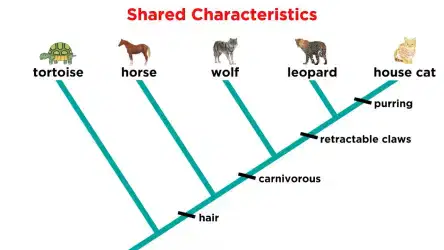
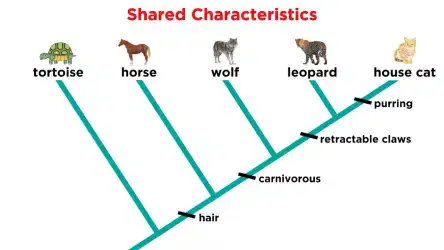
Which species evolved first?
a)
tortoise
b)
wolf
c)
house cat
d)
horse
2.
Which species is NOT carnivorous?
a)
leopard
b)
wolf
c)
house cat
d)
horse
3.
How is the tortoise different from ALL the other species?
a)
It has 4 legs
b)
It is not carnivorous
c)
It has no hair
d)
The skeleton is different
4.
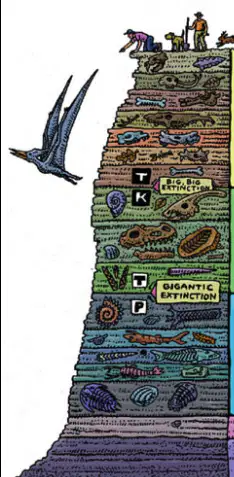
The collection of fossils and their placement in chronological order through the location of the sedimentary layers in which they are found is called?
a)
geologic time scale
b)
fossil record
c)
archaeology
d)
geology
5.
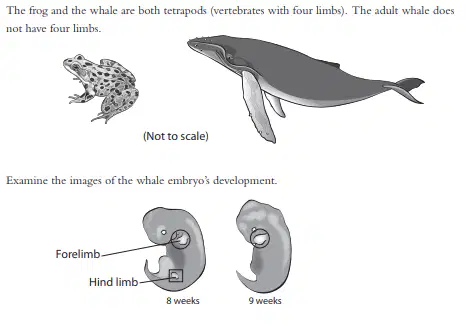
What is a tetrapod?
a)
an extinct species
b)
a vertebrate with 2 limbs
c)
a fish
d)
a vertebrate with 4 limbs
6.
The 8-week-old whale embryo has forelimbs and hind limbs. The hind limbs disappear in later development. What information can you gain from looking at the development of an embryo?
a)
The embryo development identifies a relationship that is not always apparent when comparing adults.
b)
The embryo shows that the adult whale will have four limbs.
c)
The whale’s embryo development is most likely the same as the frog’s.
d)
Embryos are important in order to compare what environment the organism lives in.
7.
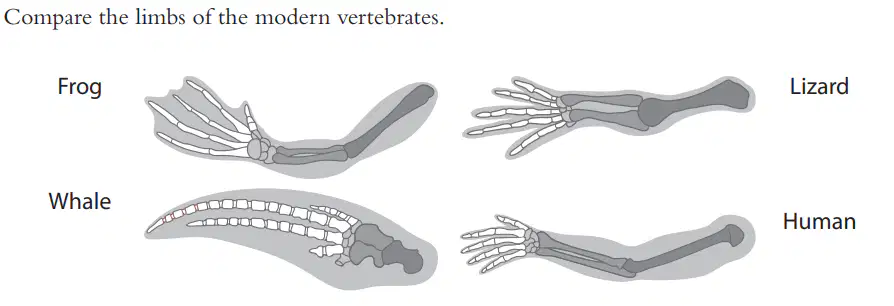
Which statement best explains the similarities between the limbs?
a)
All four vertebrates move in the same way.
b)
These four vertebrates share a common ancestor.
c)
The limbs can be used in water or on land.
d)
A lizard is an ancestor of a frog.
8.
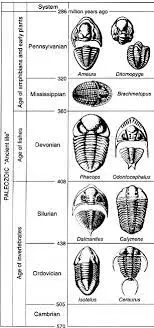
Trilobite fossils have been found in rock that is 521 million years old. They have also been found in rocks that are more than 252 million years old. Trilobite fossils have not been found in younger or older rocks. What does this tell you?
a)
Trilobites became extinct 252 million years ago.
b)
Trilobites became extinct 521 million years ago.
c)
Trilobites lived on Earth for 252 million years.
d)
Trilobites lived on Earth more than 521 million years ago.
9.
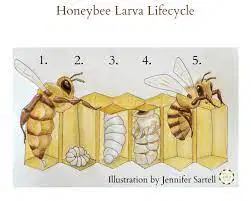
A queen honeybee can lay up to 2000 eggs in one day. This is an example of...
a)
competition
b)
overpopulation
c)
variation
d)
natural selection
10.
The process that results in changes in the genetic material of a population over time is...
a)
creation
b)
dovolution
c)
evolution
d)
speciation
11.
What are segments of DNA that carry instructions for a trait called?
a)
genes
b)
chromosomes
c)
cells
d)
nucleus
12.
The molecule that contains an organism’s genetic information is called?
a)
gene
b)
protein
c)
DNA
d)
nucleus
13.
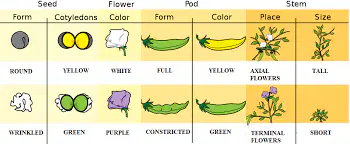
Who is known as the "Father of Genetics" with his yellow and green pea pods?
a)
Mendel
b)
Darwin
c)
Hooke
d)
Cooper and Duffield
14.
What type of reproduction results in offspring that are identical or a clone to their parent?
a)
sexual
b)
asexual
c)
twins
d)
chromosomes
15.
The "father of evolution" is ___________. He studied a lot of animals on the Galapagos Islands and we watched scientists do more modern research on Finches in the movie called Origins of Species.
a)
Charles Darwin
b)
Marie Curie
c)
Albert Einstein
d)
Gregor Mendel
16.
What are preserved remains of once living organisms called?
a)
tetrapod
b)
embryology
c)
igneous rocks
d)
fossils
17.
What is the interaction among organisms that fight for the same resource in an ecosystem called?
a)
predation
b)
competition
c)
parasitism
d)
mutualism
18.
A form of a gene that is always expressed as the trait when it is present is called?
a)
recessive
b)
dominant
c)
allele
d)
genotype
19.
An organism’s particular genetic makeup for a gene (such as Aa) is called?
a)
DNA
b)
genotype
c)
phenotype
d)
Aa
20.
A gene composed of two different alleles is called?
a)
heterozygous
b)
homozygous
c)
genotype
d)
phenotype
21.
A gene composed of two identical alleles is called?
a)
heterozygous
b)
homozygous
c)
phenotype
d)
genotype
22.
The physical traits produced by the genotype; the expression of genes is called?
a)
genotype
b)
mutation
c)
phenotype
d)
Punnett square
23.
A mathematical model that predicts the probability of possible genotypes and phenotypes is called?
a)
Punnett square
b)
population
c)
graph
d)
chart
24.
A form of a gene that is expressed only when a dominant allele is not present is called?
a)
variation
b)
evolution
c)
dominant
d)
recessive
25.
If an organism is homozygous dominant for a trait, what could its genotype look like?
a)
YY
b)
Yy
c)
yy
d)
All of the above
26.
If an organism is homozygous recessive for a trait, what could its genotype look like?
a)
RR
b)
Rr
c)
rr
d)
All of the above
27.
If an organism is heterozygous for a trait, what could its genotype look like?
a)
BB
b)
Bb
c)
bb
d)
All of the above
28.
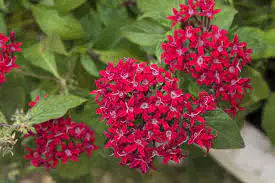
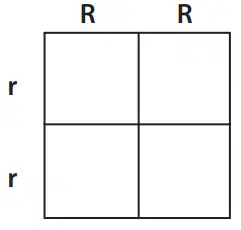
A flowering shrub has two possible flower color traits: red and white. The dominant allele (R) codes for red flowers, the recessive allele (r) codes for white flowers. A heterozygous redflowered shrub is cross-pollinated by a white-flowered shrub. Which Punnett square would you use to predict the probability of shrub offspring having red or white flowers?
a)
A
b)
B
c)
C
d)
D
29.
A flowering shrub has two possible flower color traits: red and white. The dominant allele (R) codes for red flowers, the recessive allele (r) codes for white flowers. A heterozygous redflowered shrub is cross-pollinated by a white-flowered shrub. What is the probability that an offspring of the parent generation will have white flowers? Make a Punnett square if you need to.
a)
0%
b)
25%
c)
50%
d)
100%
30.
If both parents are heterozygous for a trait, what is the probability of a recessive offspring? Make a Punnett square if you need to.
a)
25%
b)
50%
c)
75%
d)
100%
31.
What does sexual reproduction produce in offspring that asexual reproduction does not?
a)
evolution
b)
mutations
c)
DNA
d)
variation
32.
Which process best explains how antibiotic resistance in bacteria can occur?
a)
Bacteria gradually become more resistant to an antibiotic and pass on their resistance to their offspring.
b)
While being treated with an antibiotic, some bacteria will become stronger and survive to pass on the resistance to their offspring.
c)
A patient becomes resistant to antibiotics, depending upon the conditions of the hospital.
d)
Bacteria that already have a genetic resistance to an antibiotic will survive and pass on the resistance to their offspring.
33.
Pick the one condition that is NOT necessary for natural selection to occur within a population.
a)
Several species must have recently become extinct.
b)
Traits must be inherited.
c)
Variation of traits must exist in the population.
d)
Individuals with beneficial traits have more offspring than other individuals in a population.
34.
Peppered moths live in forests in Europe. Coloring is a genetic trait. Some moths are light-colored and some are dark. Peppered moths typically live on trees covered by a light-colored lichen. Birds eat moths that they can find. Many years ago, scientists observed that smoke from factories killed the lichen on the trees and the bark appeared darker. Which statement best explains what happened to the moth population?
a)
Light-colored moths that survived did not have offspring because their offspring would have been easily seen and eaten by birds.
b)
Light-colored moths that survived had dark offspring because the change in the environment caused the parents to have offspring that would do better in the new environment.
c)
Dark-colored moths were less likely to be eaten, so the light-colored moths made themselves dark.
d)
Dark-colored moths were less likely to be eaten, so their numbers increased.
35.
What adaptation doesn't help the organism to survive and reproduce better?
a)
a bear hibernating while there is snow and no food
b)
human blue eyes
c)
a finch beak that can get the seeds open
d)
a longer giraffe neck when the food is really high in the trees
36.
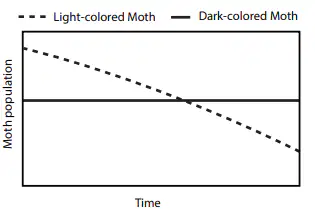
Which statement is true according to this particular graph?
a)
the light colored moth increased, the dark moth increased
b)
the light and dark moths increased
c)
both moths stayed the same
d)
the light colored moth decreased, the dark moth stayed the same
37.
How can genetic variation be introduced into a population of asexual organisms such as bacteria?
a)
Bacteria change and begin to reproduce sexually.
b)
The environment where the bacteria lives changes so the bacteria change.
c)
Mutations occur randomly in the bacterial DNA.
d)
A bacteria receives genetic information from both parent cells.
38.
“Mutations are random. Natural selection is not.” Which of the following statements is NOT true of the above statement?
a)
Mutations for positive traits are more likely to be passed on to the next generation.
b)
Mutations are caused by changes in the environment.
c)
The environment determines if a mutation is positive, negative, or neutral.
d)
Natural selection favors some mutations but not others.
39.
Which of the following statements about mutations is NOT true?
a)
Mutations can be beneficial.
b)
Mutations are a change of the genotype of an organism.
c)
Mutations are adaptations to the environment.
d)
Mutations are always a change in an organism's DNA.
40.
Giraffes that have longer necks are able to reach higher food sources. Those that can reach higher food sources tend to survive better and pass on the long-neck trait to their offspring. This process is called?
a)
phenotype
b)
mutation
c)
speciation
d)
natural selection
41.
The passing of traits from parent to offspring is called?
a)
heredity
b)
biodiversity
c)
adaptation
d)
mutation
42.
Any trait of an organism that increases its chances of surviving and reproducing is called?
a)
mutation
b)
natural selection
c)
adaptation
d)
heredity
43.
Variety of life in the world or in a particular habitat or ecosystem is called?
a)
speciation
b)
biodiversity
c)
mutation
d)
extinction
44.
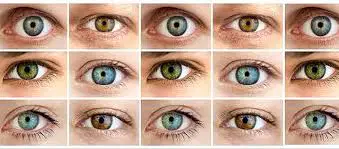
The specific way a feature is expressed is an individual organism; for example, blue and green eyes are ______ for eye color.
a)
trait(s)
b)
gene(s)
c)
genotype(s)
d)
feature(s)
45.
A random change in an organism’s DNA; can have a positive, negative, or neutral effect on the organism.
a)
adaptation
b)
mutation
c)
natural selection
d)
speciation
46.
The process of one species developing into two or more species that can no longer mate is called?
a)
adaptation
b)
mutation
c)
natural selection
d)
speciation
47.
The range of expression of traits within a population is called?
a)
Speciation
b)
Variation
c)
natural selection
d)
adaptation
48.
The process of splicing a piece of healthy DNA into the DNA of a virus so that healthy DNA becomes part of the patient’s genes, replacing the defective genes is called?
a)
artificial selection
b)
gene therapy
c)
GMO
d)
transgenic organisms
49.
Selective breeding is also called?
a)
artificial selection
b)
gene therapy
c)
GMO
d)
transgenic organisms
50.
Aedes aegypti mosquitoes spread deadly diseases like yellow fever, dengue, chikungunya, and Zika. • Mosquitoes must be adults in order to reproduce. • Only adult females bite humans. This is how they transmit diseases to people. • People spray pesticide chemicals to kill the mosquitoes, but those chemicals can have harmful effects on humans and other organisms. • Scientists have modified a gene that causes the offspring of a GM mosquito to die before they become adults. • Scientists are releasing male GM mosquitoes into the wild so they can mate with wild female mosquitoes. How will releasing the GM male mosquitoes reduce the mosquito population? (GM means genetically modified)
a)
The male GM mosquitoes that are released won’t reproduce.
b)
The female mosquitoes that mate with the GM males won’t reproduce.
c)
The offspring of the GM males won’t live long enough to reproduce.
d)
The female mosquitoes will die when they mate with the GM males.
51.

Chromosomes are found in what part of a cell?

a)

mitochrondia

b)

lysosomes

c)

golgi bodies

d)

nucleus

52.

How many pairs of chromosomes do humans have?

a)

0

b)

12

c)

23

d)

46

53.

How many chromosomes did you get from your dad?

a)

0

b)

12

c)

23

d)

46

54.

When you twist DNA up really small, you get a

a)

gene.

b)

chromosome.

c)

organism.

d)

cell.

55.

A section of DNA that has a recipe to make a protein is called a(n)

a)

allele.

b)

gene.

c)

chromosome.

d)

DNA couplet.

56.

Genes are "recipes" used to make

a)

DNA

b)

alleles

c)

chromosomes

d)

proteins

57.
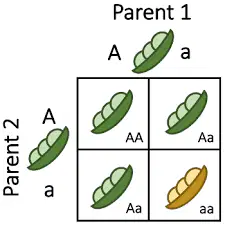
T - tall and t = short
In the punnett square below, what belongs in the missing square
a)
tt
b)
Tt
c)
Bb
d)
TT
58.

The traits a certain genotype produces is called a

a)

phenotype.

b)

variation.

c)

featue.

59.

The specific genes an organism has is called

a)

genotype.

b)

phenotype

60.
B = brown fur  b = white fur
In the punnett square, what is the probability for white fur? 
a)
0%
b)
25%
c)
50%
d)
75%
61.
What allele combination should go in the missing box?
a)
AA
b)
Aa
c)
aa
d)
none of these
62.
Each one of the boxes on the Punnett Square represents what probability of an offsprings' genotype?
a)
25%
b)
1%
c)
10%
d)
0%
63.

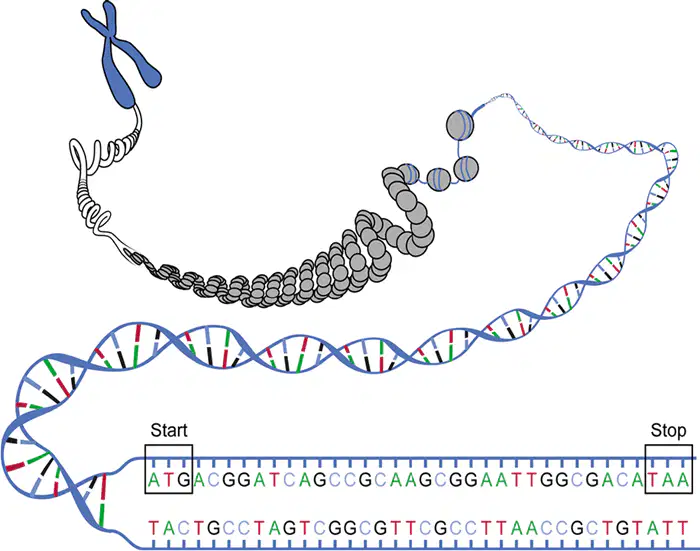
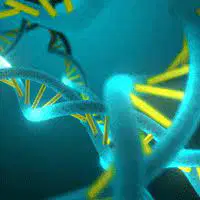
This is a picture of

a)

a gene.

b)

a chromosome.

c)

a DNA strand.

d)

a cell.

64.

Woodpeckers have a strong, sharp beak to drill holes into trees and a stiff tail to support themselves on the tree.

What type of ADAPTATION is this?

a)

Structural/physical

b)

Behavioral

c)

Physiological

65.

Salmon spend most of their lives in the ocean even though they were hatched from eggs in rivers or streams. When they are ready to reproduce, they leave the ocean and return to where they were hatched.

What type of ADAPTATION is this?

a)

Structural/physical

b)

Behavioral

c)

Physiological

66.
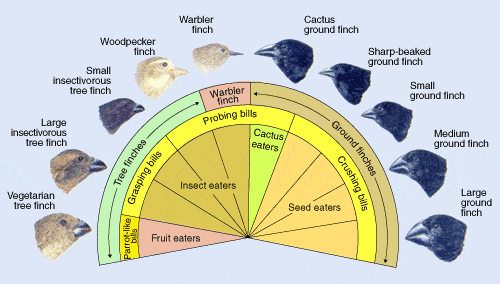
All of these finches have different shaped beaks, they are an adaptation to gain access of 
a)
Water
b)
Food
c)
Shelter
67.
Why might some plants have thorns?
a)
to stay safe from animals that want to eat the plant
b)
to attract insects that spread pollen to other plants
c)
to take in nutrients from the air
d)
to provide shade for the plant
68.
Some grasses grow in hot dry areas. Why might they grow deep roots?
a)
to protect the plant from sun damage
b)
to take in as much light as possible
c)
to spread seeds to new places
d)
to reach water down below
69.

A _______________ adaptation is when an organism's physical form or body is beneficial in its survival.

a)

Structural

b)

Behavioral

70.

A __________ is a difference between individuals of the same species.

a)

Similarity

b)

Variation

c)

Adaptation

d)

None of these

71.

What kind of adaptation is wolves hunting in packs?

a)

Structural

b)

Behavioral

72.

What type of adaptation is the bear's fur?

a)

Structural

b)

Behavioral

73.

____________ provide instructions on how offspring will grow and develop.

a)

Jeans

b)

Mitochondria

c)

Siblings

d)

Genes

74.

What kind of material contains all the information for inherited traits?

a)

Genetic material

b)

Waste

c)

Water

d)

None of these

75.

____________ traits are passed down from parents to offspring.

a)

Inherited

b)

Old

c)

Warm

d)

Acquired

76.

_____________ is a trait an offspring has, but neither parent has.

a)

Adaptation

b)

Mutation

c)

Extinction

d)

Structural

77.

How many species do scientists estimate to be extinct?

a)

5 hundred

b)

5 million

c)

5 thousand

d)

5 billion

78.

The organism's appearance is known as its

a)

heredity

b)

pedigree

c)

phenotype

d)

genotype

79.

Different forms of a gene are called

a)

alleles

b)

traits

80.
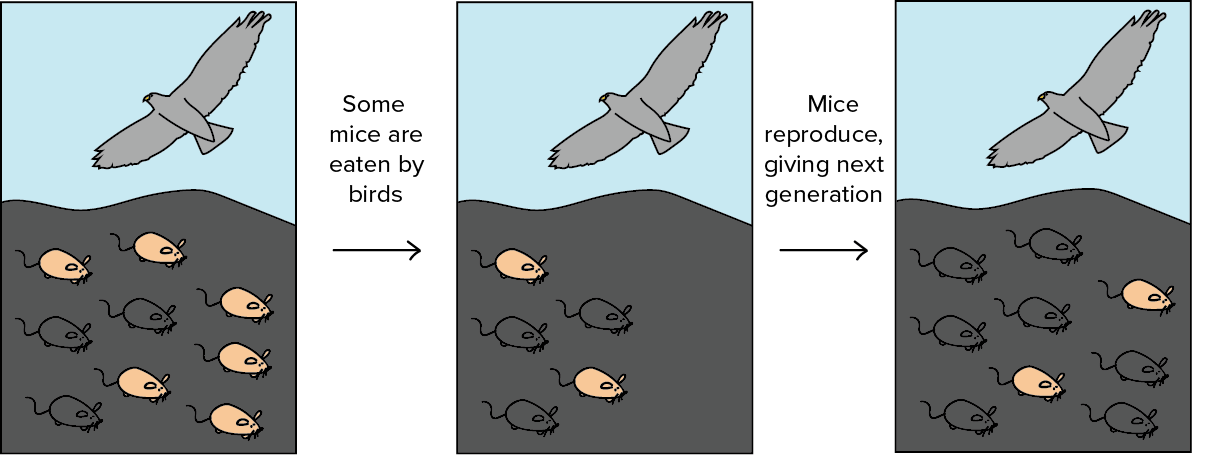
Why is the mouse population changing over time?
a)

The light mice can reproduce more successfully than the dark mice

b)

The hawks eat more dark mice than light mice because the dark mice taste better

c)

The hawks eat more light mice than dark mice because they can see the light mice more easily

d)

The hawks eat more dark mice than light mice because they can see the dark mice more easily
81.
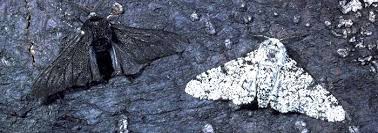
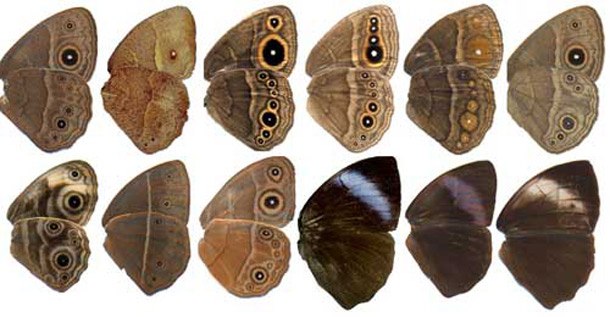
These moths are all the same species. The differences between their wings is an example of ________________
a)

Natural Selection

b)

Variation

c)

Homeostasis

d)

Extinction

82.
Where the better adapted organisms survive to pass traits along to offspring.
a)

Evolution

b)

Natural Selection

c)

Extinction

d)

Artifical Selection

83.
Predict which moth would increase in population
a)
light 
b)
dark
84.
How do adaptations help animals?
a)
To escape animals
b)
to hunt for food
c)
to survive in their habitats
d)
All of these are correct
85.
Which feature helps an animal hide from other animals?
a)
looking like a dangerous animal
b)
being the same color as the place it lives (camoflauge)
c)
having sharp claws or a strong shel
d)
having only a few young and caring for them
86.

Select all that apply: Animals will compete over

a)

territory (land)

b)

resources (food, water)

c)

mates

d)

nothing. They always work together.

87.

Predator/prey is when (a)  

Choose from the below words
animals fight
animals work together for the benefit of all
one animal tries to eat the other
88.

Two blue beetles have a blue offspring. The color blue is a ______ that has been passed on from parent to offspring.

a)

Natural Selection

b)

Heredity

c)

Trait

d)

Learned Behavior

89.

Most kangaroos have large, heavy tails, while spider monkeys have long, thin tails. Kangaroo tails are useful when the kangaroos are hopping and also when they are crawling around on the ground to feed. Spider monkey tails are useful when the spider monkeys are moving through the trees. Both of these animals use their tails primarily for-

a)

grabbing and holding their food

b)

supporting and balancing their body

c)

attracting the attention of other animals

d)

carrying their young

90.

A bright-red male cardinal comes to a school bird feeder every morning. Like other cardinals, this bird makes a sharp chirping sound as it hops around the bird feeder. Which of these is a learned behavior of this bird?

a)

Having red feathers

b)

Eating seeds during the day

c)

Coming to the bird feeder each morning

d)

Making a chirping sound

91.

Which of the following is an instinctive behavior that an animal could inherit from its parents?

a)

A raccoon taking lids off of trash cans to find food

b)

A dog barking loudly when the doorbell rings

c)

A seal balancing a ball on the end of its nose

d)

A bee flying from flower to flower to get nectar

92.

Which of the following is a learned behavior?

a)

A turtle laying its eggs on the beach

b)

A dog retrieving a stick for its owner

c)

A bird migrating south for the winter

d)

A baby chick cracking open its shell

93.

What are the two types of behavioral adaptations?

a)

Learned and natural selection

b)

Instinctive and camouflage

c)

Camouflage and mimicry

d)

Instinctive and learned

94.

_________ is when an organism resembles another animal.

a)

Instinctive behavior

b)

Camouflage

c)

Natural Selection

d)

Mimicry

95.

Which is the stronger gene that always shows itself?

a)

Hybrid

b)

Dominant

c)

Pure

d)

Recessive

96.
What is a gene?
a)
An entire chromosome that  codes for a trait
b)
a piece of clothing
c)
a piece of a DNA on chromosome that codes for a trait
d)
Chemical messengers in your brain that code for a trait
97.
The dominant trait is
a)
yellow pea seeds
b)
green pea seeds
c)
there is no dominant seed
d)
Jolly green giant
98.
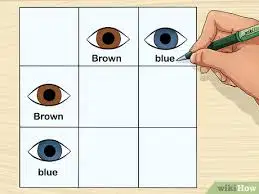
Two brown eyed parents (Bb) have a baby. What is the chance the baby is blue eyed?
a)
0 %
b)
25%
c)
50%
d)
75%
99.

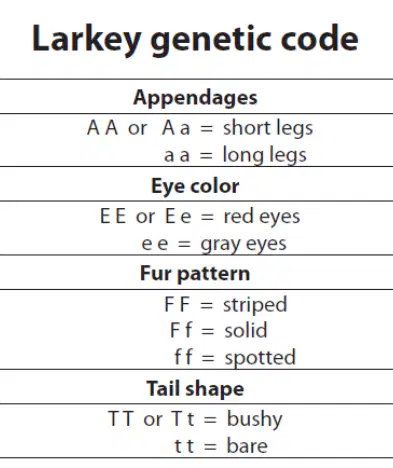
A larkey with a Ff genotype would have

a)

Striped fur

b)

Solid fur

c)

Spotted fur

d)

Red eyes

100.

The dominant trait for appendages

a)

Short legs

b)

Long legs

101.

The dominant trait for eye color

a)

Red eyes

b)

Gray eyes