
 Worksheets
Porifera & Cnidaria Review
Total questions: 20
Worksheet time: 26mins
Name
Class
Date
1.
What type of symmetry do sponges (Porifera) have?
a)
asymmetrical
b)
radial
c)
bilateral
d)
medial
2.
What is the outer most layer of Porifera?
a)
epidermis
b)
gastrodermis
c)
endodermis
d)
mesoglea
3.
What level of organization cnidarians have is...
a)
specialized cells
b)
tissues
c)
organs
d)
organ systems
4.
What type of symmetry do cnidarians have
a)
asymmetrical
b)
bilateral
c)
radial
5.
Which of the following is a correct description of the Cnidarian digestive tract?
a)
A complete digestive tract consisting of two openings.
b)
A complete digestive tract consisting of one opening
c)
An incomplete digestive tract consisting of two openings.
d)
An incomplete digestive tract consisting of one opening.
6.
Which of the following is a correct description of the polyp body form?
a)
It is sessile and the tentacles and mouth point downward.
b)
It is sessile and the mouth and tentacles point upward.
c)
It is mobile and the tentacles and mouth point downward.
d)
It is mobile and the tentacles and mouth point upward.
7.
What are the organelles inside the stinging cells that inject paralyzing toxins into their prey?
a)
pinacocytes
b)
lysomatocyts
c)
choanocytes
d)
nematocysts
8.
What surrounds the mouth of Cnidarians?
a)
guard cells
b)
pinococytes
c)
tentacles
d)
spines
9.
What part of the sponge body is the openings along the sponge's body that allow in water?
a)
Ostia
b)
Mesenchyme
c)
spongecoel
d)
osculum
10.
Which part of the sponge body is a large opening at the top of the central cavity through which water leaves the sponge?
a)
Ostia
b)
Meenchyme
c)
Spongecoel
d)
Osculum
11.
Many cnidarians feature 2 body forms, the asexual ____________, and the sexual _____________.
a)
blastula, planula
b)
medusa, polyp
c)
planula, blastula
d)
polyp, medusa
12.
The hard "skeleton" structures in a sponge are called...
a)
Spongin
b)
Spicules
c)
Amebocytes
d)
Pinococytes
13.
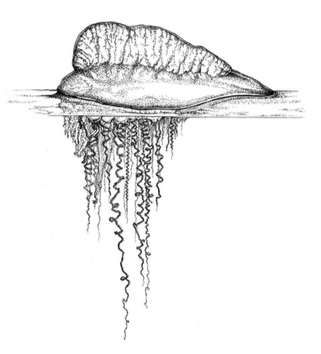
What is this organism?
a)
jellyfish
b)
Portuguese man-of-war
c)
hydra
d)
coral
14.
Sea anemones have a symbiotic relationship with
a)
algae
b)
clown fish
c)
colonies
15.
The ability of a organisms to regrow a lots body part is called
a)
regeneration
b)
budding
c)
parasitism
d)
autotrophism
16.
A sponge gathers its food by
a)
killing it with spicules
b)
trapping food in the collar cells
c)
collecting it with pores
d)
absorbing it through the osculum
17.
A cnidarian captures its prey by
a)
filtering it through pores
b)
paralyzing it with venom
c)
bringing it into the osculum
d)
killing it with spikes
18.
Which class contains freshwater sponges?
a)
Class Calcarea
b)
Class Demospongiae
c)
Class Hexactinellida
19.
Which class of sponges has spicules composed of calcium carbonate?
a)
Calcarea
b)
Demospongiae
c)
Hexactinellida
20.
Members of the Cnidarian Class _______ include sea anemones and coral.
a)
Anthozoa
b)
Cubozoa
c)
Hydrozoa
d)
Scyphozoa
100 %

