
 Worksheets
Layers 's of the Earth and Continental Drift Test
Total questions: 79
Worksheet time: 1hrs 3mins
Name
Class
Date
1.
What layer of the Earth is liquid?
a)
lithosphere
b)
asthenosphere
c)
inner core
d)
outer core
2.
What layer of the Earth is also the tectonic plates?
a)
mantle
b)
core
c)
lithosphere
d)
asthenosphere
3.
What layer of the Earth consists of the crust and the top of the mantle.
a)
inner core
b)
lithosphere
c)
asthenosphere
d)
outer core
4.
The tectonic plates float on the...
a)
asthenosphere
b)
core
c)
crust
d)
lithosphere
5.
The thinnest layer of the Earth is?
a)
Mantle
b)
Lithosphere
c)
Athenosphere
d)
Crust
6.
What happens to temperature as we move from the crust to the inner core?
a)
Decreases
b)
Increases
7.
This layer of Earth is solid Iron and Nickel
a)
Outer Core
b)
Mantle
c)
Inner Core
d)
Crust
8.
This layer of Earth is the thickest part
a)
crust
b)
outer core
c)
mantle
d)
inner core
9.

Identify layer #20.
a)
mantle
b)
asthenosphere
c)
inner core
d)
outer core
10.
Which layer of the earth is under the highest pressure?
a)
Crust
b)
Mantle
c)
Outer Core
d)
Inner Core
11.
Which layer of the earth has the lowest temperature?
a)
Crust
b)
Mantle
c)
Outer Core
d)
Inner Core
12.
Less dense materials rise to the top.
a)
True
b)
False
13.
Which layer of Earth has the GREATEST density?
a)
crust
b)
mantle
c)
outer core
d)
inner core
14.
What is the correct order (starting from the surface) of Earth's layers?
a)
crust, outer core, inner core, mantle
b)
mantle, outer core, inner core, crust
c)
crust, mantle, outer core, inner core
d)
outer core, inner core, crust, mantle
15.
Why have geologists not reached the mantle?
a)
It is too hot for humans to go there.
b)
It is too smelly for humans to go there.
c)
It doesn't have Wi-Fi so none of their instruments work.
d)
Scientists have not figured out how to time travel.
16.
True or FalseThe most abundant elements in the Earth's crust are silicon and oxygen.
a)
True
b)
False
17.

Scientists think that convection currents that move the plates flow in Earth's
a)
Continental crust
b)
oceanic crust
c)
Asthenosphere
d)
Lithosphere
18.
The Great Rift Valley in Africa and the Mid-Atlantic Ridge were both created by this type of plate boundary.
a)
divergent
b)
convergent
c)
transform
d)
subduction
19.
Which type of plate boundary would cause folded mountains to form?
a)
transform
b)
convergent
c)
divergent
d)
subduction
20.
What are the two types of crust?
a)
continental and oceanic
b)
ocean and basin
c)
lower and upper
d)
thick and thin
21.
Earthquakes and volcanoes are most likely found in which locations?
a)
at plate boundaries
b)
in oceans
c)
in the middle of continents
d)
in the middle of plates
22.
When one plate slides underneath another, it ____ and the magma _____.
a)
hardens; sinks
b)
melts; sinks
c)
hardens; rises
d)
melts; rises
23.
Transform boundaries are most likely to produce what phenomenon?
a)
volcanoes
b)
deep sea trenches
c)
underwater mountain ranges
d)
earthquakes
24.
When an oceanic plate and a continental plate collide, which one will subduct?
a)
oceanic
b)
continental
c)
neither
d)
both
25.
This land form can occur at a divergent plate boundary.
a)
trench
b)
mid-ocean ridge
c)
folded mountains
d)
fault
26.
Two tectonic plates collide at a ___ plate boundary.
a)
convergent
b)
divergent
c)
transform
d)
transformer
27.
What is Pangaea?
a)
the name of a German scientist
b)
the name of the super-continent that existed millions of years ago
c)
another name for continental drift
d)
the name of an ancient fossil
28.
What type of evidence was NOT used by Alfred Wegener to support his continental drift hypothesis?
a)
evidence from landforms
b)
evidence from fossils
c)
evidence from human remains
d)
evidence from climate
29.
In Seafloor Spreading, molten material rises from the mantle and erupts or flows out
a)
along the edges of all the continents
b)
along mid-ocean ridges
c)
in the deep ocean trenches
d)
in the north and south poles
30.
The geological theory that states that pieces of Earth's lithosphere are in constant, slow motion is the theory of
a)
subduction
b)
plate tectonics
c)
evolution
d)
seafloor spreading
31.
How did scientists discover that rocks farther away from mid-ocean ridges were older than those near it?
a)
by observing eruptions of molten material on the seafloor
b)
by mapping rocks on the sea floor using sonar
c)
by determining the age or rock samples obtained by drilling on the seafloor
d)
by measuring how fast seafloor spreading occurs
32.
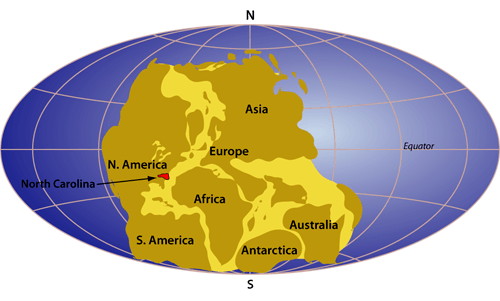
What is this a picture of?
a)
plate tectonics
b)
continental drift
c)
pangea
d)
glacier scaring
33.
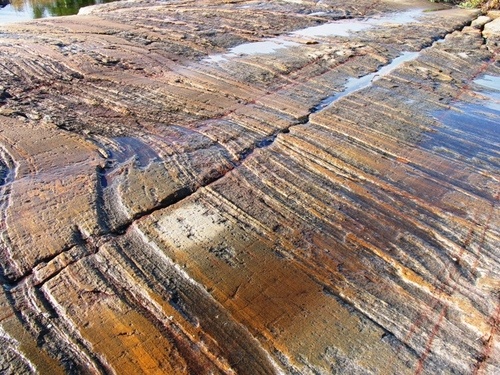
This is a picture of glacier scars found in Africa. What are these evidence for?
a)
Africa has always been near the equator
b)
Africa was once in an area of the Earth that had a very cold climate
c)
The continents have not moved
d)
sea floor spreading
34.
What does the theory of continental drift state?
a)
The continents were once joined in a super-continent and have moved over time
b)
Continents are stationary and do not move
c)
The Earth is broken into lithospheric plates that move due to convection currents
d)
none of the above
35.
What evidence did Wegener use in his theory?
a)
Continents and fossils fitting together/matching-up like puzzle pieces
b)
glacier scars and evidence from temperature
c)
mountain ranges and coal deposits line up across continents
d)
all of the above
36.
What two specific continents fit together most noticeably?
a)
Africa and North America
b)
South America and Europe
c)
South America and Africa
d)
Antartica and Africa
37.

As you travel from the inner core to the crust, how would temperature, pressure and density of the material change?
a)
The would all increase
b)
The would all decrease.
c)
Nothing, the layers are made of the same material throughout
d)
Temperature would decrease, but pressure and density would increase
38.
Where does the heat come from that drives this convection current in the mantle?
a)
The sun
b)
The crust
c)
the mantle
d)
the core
39.

Mesosaurus fossils are found between where?
a)
India
b)
Africa and South America
c)
Antartica
d)
Australia
40.

Glossopteris fossils are found between where?
a)
India
b)
I really don't know 😭😂
c)
Antarctica
d)
All of them
41.
The similarities between the Appalachian mountains and the Scottish highlands provides evidence for which process?
a)
fossilization
b)
climate change
c)
continental drift
d)
glacial retreat
42.
Which statement does NOT summarize one of the lines of evidence used by Alfred Wegener to support his theory of continental drift?
a)
Glacial deposits indicate a different climatic condition.
b)
Similar fossils are found on widely separated continents.
c)
Similar geologic formations occur on both sides of the Atlantic Ocean.
d)
Bands of rock are older the farther their position from a mid-ocean ridge.
43.

What type of plate boundary is occurring between the Pacific Plate and the Nazca Plate?
a)
Divergent Boundary
b)
Convergent Boundary
c)
Transform Boundary
44.

Using the plate boundaries map to help you, why do you think there are so many earthquakes in California?
a)
Along divergent boundary which cause MAJOR earthquakes
b)
Along convergent boundary which cause MAJOR earthquakes
c)
Along transform boundary which cause MAJOR earthquakes
45.

How do you think the Andes Mountains were formed?
a)
from divergent boundary
b)
from convergent boundary
c)
from transform boundary
46.
Which plate boundary does not create volcanoes?
a)
transform
b)
convergent
c)
divergent
47.

When two tectonic plates are moving away from each other, the boundary between them is called...
a)
Divergent boundary
b)
Convergent boundary
c)
Transform boundary
d)
Subduction
48.

When two tectonic plates are moving toward each other, the boundary between them is called...
a)
Divergent boundary
b)
Convergent boundary
c)
Transform boundary
d)
Subduction
49.

When two tectonic plates slide past each other, neither crashing together, nor pulling apart, the boundary between them is called...
a)
Divergent boundary
b)
Convergent boundary
c)
Transform boundary
d)
Subduction
50.

Sometimes, when two tectonic plates collide, one is pushed below the other; this action at the convergent boundary is called...
a)
Divergent boundary
b)
Convergent boundary
c)
Transform boundary
d)
Subduction
51.

When a continental plate is pulled away from another continental plate, the area of crust that is thinned and pulled apart is called.
a)
a trench
b)
a rift zone or rift valley
c)
ocean spreading ridge
d)
Continental crust
52.
The type of stress that squeezes and shortens a body is __
a)
compression.
b)
tension.
c)
shear.
d)
deposition.
53.
A type of fault where the hanging wall slides down...caused by tension.
a)
normal fault
b)
strike-slip fault
c)
reversynclinese fault
54.

Stress that pushes masses of rock in opposite directions, in a sideways movement?
a)
shear
b)
compression
c)
tension
d)
constriction
55.

Stress that stretches rock so that it becomes thinner in the middle!
a)
tension
b)
compression
c)
sheear
d)
rubber-binder
56.
A force that acts on rock to change its shape or volume?
a)
stress
b)
focus
c)
friction
d)
fracture
57.

a)
normal fault
b)
reverse fault
c)
strike-slip fault
58.

a)
normal fault
b)
reverse fault
c)
strike-slip fault
59.

a)
normal fault
b)
reverse fault
c)
strike-slip fault
60.

What type of stress causes these folds?
a)
compression
b)
shearing
c)
tension
61.

a)
normal fault
b)
reverse fault
c)
strike-slip fault
62.

What type of stress is this?
a)
compression
b)
shearing
c)
tension
63.

What type of stress is this?
a)
compression
b)
shearing
c)
tension
64.
a fault caused by rocks moving away from each other
a)
strike slip fault
b)
reverse fault
c)
normal fault
65.
A fault caused by rocks moving together
a)
normal fault
b)
reverse fault
c)
slip strike fault
66.
The stress force that pulls plates past one another sideways is called
a)
shear
b)
compression
c)
tension
67.
What type of boundary experiences shearing stress?
a)
Transform
b)
Convergent
c)
Divergent
d)
Strike-slip
68.
Which fault doesn't move up or down?
a)
Strike-slip
b)
Convergent
c)
Transform
d)
Shearing
69.

What type of stress is involved in creating the great rift valley?
a)
Tension
b)
Shearing
c)
Compression
d)
Divergent
70.

What Geologic Activity is occurring in this picture?
a)
Sea-floor Spreading
b)
Volcano forming
c)
Earthquake
d)
Mountain building
71.
Folded mountains form ___.
a)
when a state of isostasy occurs
b)
when continents collide
c)
when continents diverge
d)
after huge earthquakes
72.
Which of these are types of mountains?
a)
rolling, glacial, subterranean, cascades
b)
rocky, green, smoky, white
c)
fault-block, dome, volcanic, folded
d)
salt-block, dome, magnum, frozen
73.

What island is the oldest?
a)
A
b)
B
c)
E
d)
D
74.

What direction is the plate moving?
a)
west
b)
northeast
c)
southwest
d)
east
75.
What occurs at divergent plate boundaries? (continental - continental)
a)
earthquake
b)
rift valley
c)
subduction zone
d)
trench
76.
What occurs at divergent plate boundaries? (oceanic - oceanic)
a)
mid-ocean ridge
b)
subduction zone
c)
trench
d)
volcano
77.
What occurs at convergent plate boundaries (continental - oceanic)
a)
subduction zone
b)
rift valley
c)
mid-ocean ridge
d)
earthquakes
78.
What occurs at convergent plate boundaries? (continental - continental)
a)
mid-ocean ridges
b)
trench
c)
mountains
d)
subduction zones
79.
What occurs at transform plate boundaries?
a)
earthquakes
b)
mid-ocean ridges
c)
rift valleys
d)
subduction zones
100 %

