wayground logo

Free Printable Worksheets

Font size

S
M
L
XL
Worksheets

Geology PASS Review

Total questions: 82

Worksheet time: 6hrs 10mins

Name
Class
Date
1.
What type of fault moves down and out forming Fault Block Mountains? 
a)
normal fault
b)
reverse fault
c)
strike-slip
2.

What type of fault moves up and in forming mountains?

a)

normal fault

b)

reverse fault

c)

strike-slip fautl

3.

What type of fault slides past formed by shearing stress?

a)

normal fault

b)

reverse fault

c)

strike-slip fault

4.
Which type of crust is the densest and subducts under the other?
a)
oceanic
b)
continental
c)
lithospheric
d)
none of the above
5.

Which type of crust never subducts and is formed from granite?

a)

oceanic

b)

continental

c)

lithospheric

6.
Which of Earth’s layers contains convection currents?
a)
lithosphere
b)
asthenosphere
c)
mantle
d)
inner core
7.
Which of Earth’s layers is broken into chunks that move on convection currents?
a)
lithosphere
b)
asthenosphere
c)
mantle
d)
crust
8.
Which of Earth’s layers is the densest overall?
a)
core
b)
mantle
c)
crust
d)
oceanic crust
9.
The core is made of iron and what other element?   
a)
nickel
b)
magnesium
c)
oxygen
d)
silicon
10.
Which of Earth’s layers is the thinnest and made of silicon and oxygen?
a)
crust
b)
mantle
c)
inner core
d)
outer core
11.
Which of Earth’s layers is made of magnesium and iron?
a)
inner core
b)
outer core
c)
mantle
d)
crust
12.
What type of plate boundary slides past creating faults and shallow earthquakes? (Ex. San Andreas Fault)
a)
transform
b)
convergent
c)
divergent
13.

What type of plate boundary moves apart creating rift valleys and mid-ocean ridges?

a)

transform

b)

divergent

c)

convergent

14.
What do you call the type of mechanical wave produced when faults in the earth shift or move due to stress?
a)
seismic
b)
ocean
c)
light
d)
sound
15.
What do you call the thinnest, outer most layer of the Earth which is composed mostly of silicon and oxygen?
a)
core
b)
crust
c)
mantle
d)
asthenosphere
16.
What do you call the largest layer of the Earth which is subdivided into the upper mantle, asthenosphere, and   mesosphere? It is composed of mostly iron and magnesium.
a)
core
b)
mantle
c)
oceanic crust
d)
continental crust
17.
What do you call the inner most layer of the Earth which is subdivided into 2 sections: a solid inner layer made of iron surrounded by a molten layer of iron and nickel.
a)
core
b)
mantle
c)
asthenosphere
d)
crust
18.
The area where the earthquake begins at the fault is referred to as the ___________.
a)
focus
b)
epicenter
c)
triangulation
d)
seismic station
19.
What do you call the area on the surface above where the earthquake energy is released?
a)
focus
b)
epicenter
c)
triangulation
d)
seismic station
20.
What do you call a tool used to record seismic waves?
a)
seismograph
b)
primary
c)
seismologist
d)
triangulation
21.
This is a method of using the different arrival times of P and S waves to plot circles and determine the epicenter of   an earthquake.
a)
seismic station
b)
triangulation
c)
epicenter location
d)
quadralateral
22.
This rock is formed from the cooling and hardening of molten lava or magma.
a)
igneous
b)
metamorphic
c)
sedimentary
23.
This rock is formed when rocks are exposed to heat and pressure changing them chemically.
a)
intrusive igneous
b)
extrusive igneous
c)
metamorphic
d)
sedimentary
24.
What types of properties are: hardness, luster, color texture, density, and the way the mineral splits?
a)
physical 
b)
chemical
25.
This rock is formed when sediment, sand, pebbles, or organic material is compacted and cemented together to form a new rock.
a)
intrusive igneous
b)
extrusive igneous
c)
metamorphic
d)
sedimentary
26.

What types of properties are: the ability to burn and reactivity to acid?

a)

physical

b)

chemical

27.
This is a naturally occurring solid, which has a definite chemical composition and a definite crystal structure.
a)
mineral
b)
ore
c)
fossil fuel
d)
rock
28.
These are mined for their useful metals or non-metals.
a)
mineral
b)
ore
c)
fossil fuel
d)
rock
29.
These are formed over millions of years from the remains of living things and give off energy when they are   burned.
a)
mineral
b)
ore
c)
fossil fuel
d)
rock
30.
The upper part of the mantle and the crust is a ridged area broken into chunks called __________.
a)
lithosphere
b)
asthenosphere
c)
oceanic crust
d)
continental crust
31.
Convection currents in the Earth’s _________ cause the lithospheric plates to move.
a)
asthenosphere
b)
mesosphere
c)
lithosphere
d)
outer core
32.
What land form is created when two ocean plates separate or diverge?
a)
subduction zone
b)
Island arcs
c)
mid-ocean ridge
d)
great rift valley
33.
What is formed when 2 continental plates collide or move towards one another?
a)
folded mountains
b)
fault block mountains
c)
volcanic mountains
d)
dome mountains
34.
This is a large supercontinent that Alfred Wegener thought existed because the shapes of the continents   looked   like they were puzzle pieces and they shared common plant and animal fossils as well as landforms and   mountain ranges.
a)
pangaea
b)
pandora
c)
gandwandland
d)
eurasaland
35.
What do you call an opening in a volcano where magma and gasses exit?
a)
vent
b)
plug
c)
hotspot
d)
gyser
36.
This is an area around the pacific plate where the world’s most active volcanoes exist.
a)
Aleutian Islands
b)
Ring of Fire
c)
subduction zone
d)
Volcanic Arc
37.
This is a type of fault that move down and out and is caused by tension stress.
a)
normal
b)
reverse
c)
strike-slip
38.

This is a typed of fault that moves up and in and is caused by compression stress.

a)

normal

b)

reverse

c)

strike-slip

39.

This is a type of fault that slides past one another and is associated with shearing stress.

a)

normal

b)

reverse

c)

strike-slip

40.
This is an area in a plate where the mantle is extremely hot causing the lithosphere to be weak above it   often   creating volcanic activity like Yellowstone and the Hawaiian islands.
a)
hotspot
b)
ring of fire
c)
volcanic arc
d)
coastal vocanoes
41.
Breaks in rock that are created by stress of moving plates are called?
a)
faults
b)
fissures
c)
dikes
d)
intrusions
42.
A mountain that is created by layers and layers of cinder, ash, lava, and rocks is called?
a)
volcanic
b)
folded
c)
dome
d)
fault block
43.
This kind of map uses symbols and contour lines to indicate the land features.
a)
topographical
b)
geographical
c)
relief
d)
triangulation
44.
Which are the steeper routes on the map?
a)
where the lines are close together
b)
where the lines are farther apart
c)
neither they are all the same elevation and slope
45.
What type of boundary collides forming mountain ranges and volcanoes?
a)
convergent
b)
divergent
c)
transform
d)
strike-slip
46.

These occur in the asthenosphere and are thought to cause the tectonic plates above to move.

a)

convection currents

b)

ocean currents

c)

spreading plate

d)

density currents

47.

Name this plate boundary where two plates move away from each other in opposite directions. They divide!

a)

divergent

b)

convergent

c)

transform

d)

allegiant

48.

Name this plate boundary. When two plates slide past one another with little up or down movement.

a)

divergent

b)

convergent

c)

transform

d)

transformers

49.

Name this plate boundary, where two plates collide forming island arcs, subduction zones, volcanic mountains, and trenches.

a)

convergent

b)

divergent

c)

transform

d)

strike slip

50.

The process by which the ocean floor sinks beneath a deep ocean trench and back into the mantle is known as

a)

convection

b)

continental drift

c)

subduction

d)

conduction

51.

The youngest rocks on the seafloor are most likely found...

a)

closest to a mid-ocean ridge

b)

farthest from a mid-ocean ridge

c)

near the coastlines

d)

closest to a deep sea trench

52.
What happens when an oceanic plate collides with a continental plate?
a)
the denser oceanic plate  rides on top of the less dense continental plate
b)
the less dense oceanic plate slides under the denser continental plate
c)
the denser oceanic plate slides under the less dense continental plate
d)
the less dense oceanic plate slides past the denser continental plate
53.
What type of land-form is created where two ocean plates move apart or separate?
a)
mid-ocean ridge
b)
divergent boundary
c)
transform boundary
d)
folded mountains
54.

The feature labeled C represents some of the deepest spots on the ocean floor. These areas are called ___.

a)

mid-ocean ridge

b)

trenches

c)

deep-sea vent

d)

abyssal plain

55.

In the image, which type of boundary is shown? Hint: its located in the state of California.

a)

divergent

b)

convergent

c)

transform fault

56.

Scientists think that convection currents that move the plates flow in Earth's

a)

Continental crust

b)

oceanic crust

c)

Asthenosphere

d)

Lithosphere

57.
Transform boundaries are most likely to produce what phenomenon?
a)
volcanoes
b)
deep sea trenches
c)
underwater mountain ranges
d)
earthquakes
58.

The age of volcanic islands in the diagram indicate that the pacific plate is

a)

moving north towards Alaska and Russia

b)

moving south towards Hawaii

c)

is not in motion but is stationary

d)

is moving due east to the west coast of the United States

59.

What landform is created when two continental plates collide?

a)

folded mountains

b)

island arcs

c)

subduction zone

d)

fault block mountains

60.
Give a real world example of a landform created at this type of plate boundary.
a)
San Andreas Fault
b)
Aleutian Islands
c)
Hawaiian Islands
d)
Himalayas
61.
Which of the following is NOT evidence to support the theory of plate tectonics?
a)
Fossils
b)
Mountains
c)
Glaciers
d)
Sand Erosion
62.

How is it possible for new crust to be formed without increasing the surface area of the Earth?

a)

Crust is destroyed at the same rate it is created

b)

New crust is underwater where it sinks

c)

New crust breaks more easily than old crust

63.

Which was NOT evidence of Wegener?

a)

Seafloor spreading

b)

fossils

c)

puzzle piece

d)

glacier evidence

64.
What does the theory of continental drift state?
a)
The continents were once joined in a super-continent and have moved over time
b)
Continents are stationary and do not move
c)
The Earth is broken into lithospheric plates that move due to convection currents
d)
none of the above
65.
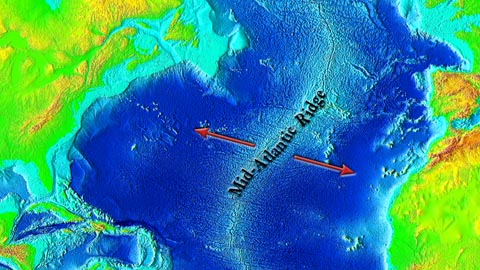
The image shows the Mid Atlantic Ridge. Which type of boundary occurs at this ridge where the ocean floor is spreading apart? 
a)
convergent
b)
divergent 
c)
transform fault
66.

This is the name for the most active chain of volcanoes around the edge of the Pacific Plate.

a)

Circle of Fire

b)

Ring of Lava

c)

Ring of Fire

d)

Circle of Magma

67.

Which theory does the following evidence support: subduction zones, earthquakes, volcanoes, Mid-Atlantic Ridge, and older theories such as continental drift and seafloor spreading.

a)

Continental Drift

b)

Seafloor Spreading

c)

Plate Tectonics

68.
Supporting Evidence: discovery of Mid-Atlantic Ridge, core rock samples showing older rocks the farther that you get from the mid ocean ridge
a)
Continental Drift
b)
Seafloor Spreading
c)
Plate Tectonics
69.

Why was Alfred Wegener's Continental Drift theory rejected?

a)

He had no evidence to support his ideas

b)

He could not explain how the plates moved

c)

He thought the plates floated around the Earth

d)

He was a meteorologist instead of a geologists

70.
Which of these statements is true about Earth’s crust?
a)
A.  It includes the continents but not the ocean floor.
b)
A.  It is a layer of solid rock made up of the same type of rock throughout.
c)
A.  It is a changing, moving, surface with the same thickness everywhere.
d)
A.  It is a made of two separate types of crust with different densities.
71.
If we compare the temperature and pressure of the Earth’s mantle to the core, what differences can we expect as we move downward into the Earth's core?
a)
Both the temperature and pressure increase.
b)
Both the temperature and pressure decrease.
c)
The temperature increases and the pressure decrease.
d)
The temperature decreases and the pressure increases.
72.
Which sublayer is made up of the crust and upper mantle?
a)
Inner Core
b)
Outer Core
c)
Lithosphere
d)
Asthenosphere
73.
What two layers of the Earth have convection currents?
a)
Crust and mantle
b)
Inner core and outer core
c)
Outer core and asthenosphere
d)
Lithosphere and asthenosphere
74.
What is the inner core composed of?
a)
Basalt
b)
Granite
c)
Solid iron and nickel
d)
Molten (liquid) iron and nickel
75.
What is the outer core composed of?
a)
silicon and oxygen
b)
magnesium and iron
c)
Solid iron and  nickel
d)
Molten (liquid) iron and nickel
76.
What is the relationship between the lithosphere and the asthenosphere? 
a)
Convection currents in the lithosphere cause the asthenosphere to move.
b)
The crust and the core make up the lithosphere.
c)
The crust and mantle make up the asthenosphere. 
d)
Convection currents in the asthenosphere cause the lithosphere to move.
77.

Oceanic crust is mostly made of ​ (a)   and continental crust is mostly made of​ ​ (b)   .

Choose from the below words
Basalt
Granite
Granite 
shale
slate
78.
Scientists determine the density and state of matter of Earth’s interior by using:
a)
Evidence from volcanic rocks
b)
Evidence from Seismic Waves
c)
Evidence from Continental Drift
d)
Evidence from Convection Currents
79.
Scientists determine the composition Earth’s interior by using:
a)
Evidence from volcanic rocks
b)
Evidence from Seismic Waves
c)
Evidence from Continental Drift
d)
Evidence from Convection Currents
80.
What is the most abundant mineral on the surface of the Earth?
a)
Quartz
b)
Diamonds
c)
iron
d)
magnesium
81.

What this the order of the Earth's layers from densest to least dense?

a)

inner core

b)

outer core

c)

mantle

d)

oceanic crust

e)

continental crust

1)
2)
3)
4)
5)
82.

Location A ​ (a)   Location B ​ (b)   ​ ​ Location D ​​ (c)   Location G ​ ​ (d)   Location E and F ​ ​ (e)  

Choose from the below words
Inner core
Outer Core
Crust
Mantle
Lithosphere
Asthenosphere