
 Worksheets
Weather 2
Total questions: 111
Worksheet time: 3hrs 53mins
Name
Class
Date
1.
Where do hurricanes form?
a)
Over Mountain ranges
b)
Over warm ocean water
c)
Over cold ocean water
d)
Over open deserts
2.
Hurricanes gather ______________ and ______________ through contact with warm ocean waters.
a)
sand, dust
b)
fish, plants
c)
heat, Sun
d)
heat, energy
3.
The heavy waves of a hurricane are called this.
a)
storm surge
b)
wave storms
c)
thunderstorms
d)
tsumnami
4.
Why don't hurricanes form in polar regions?
a)
the water is not warm enough
b)
the water is not cold enough
c)
there is no water
d)
icebergs stop the hurricanes
5.
How strong must winds be in order to be classified as a hurricane?
a)
5 mph
b)
25 mph
c)
74 mh
d)
300 mph
6.
Hurricanes are classified into how many categories?
a)
2
b)
5
c)
10
d)
20
7.
What is the fuel or the engine that keeps a hurricane alive?
a)
Land
b)
Cold water
c)
Warm water
d)
Wind
8.
What is the name of the scale used to rank hurricanes?
a)
Richter Scale
b)
Saffir Simpson Scale
c)
Tropical Scale
d)
Fujita Scale
9.
What are the 3 ingredients necessary for a hurricane to form?
a)
80 degree water, surface level low pressure, upper level high pressure
b)
100 degree water, surface level high pressure, upper level low pressure
c)
80 degree water, surface level high pressure, upper level low pressure
d)
100 degree water, surface level low pressure, upper level high pressure
10.
These move slowly, usually between 5 and 15 mph
a)
tornado
b)
hurricane
11.
A hurricane is a good example of a catastrophic event to observe with a satellite
a)
true
b)
false
12.
Damage measured with the Saffir/Simpson scale
a)
Tornado
b)
Hurricane
13.
These form when warm, moist air meets cold, dry air
a)
Tornado
b)
Hurricane
14.
Form over warm waters of the Pacific, Atlantic, and Indian Oceans
a)
Tornado
b)
Hurricane
15.
Very large- usually about 342 miles in diameter
a)
Tornado
b)
Hurricane
16.
damage measured by the Fujita Scale
a)
Tornado
b)
Hurricane
17.
wind speeds up to 217 mph
a)
Tornado
b)
Hurricane
18.
these are also called typhoons and cyclones
a)
Tornado
b)
Hurricane
19.
This extreme weather event forms over warm oceans and weakens when it hits land.
a)
Hurricane
b)
Tornado
20.
This extreme weather event forms over flat land.
a)
Hurricane
b)
Tornado
21.
This extreme weather event can be hundreds of miles wide.
a)
Hurricane
b)
Tornado
22.
This extreme weather event is usually not more than 1/4 mile wide.
a)
Hurricane
b)
Tornado
23.
This extreme weather event can last 3 weeks.
a)
Hurricane
b)
Tornado
24.
This extreme weather event usually lasts from 3 minutes to one hour.
a)
Hurricane
b)
Tornado
25.
This extreme weather event has winds from 75mph - 180mph.
a)
Hurricane
b)
Tornado
26.
This extreme weather event has winds that can reach 300 mph.
a)
Hurricane
b)
Tornado
27.
A severe storm that involves winds over 119mph and forms over water is:
a)
tornado
b)
thunderstorm
c)
hurricane
d)
blizzard
28.
The boundary between two air masses is known as:
a)
front
b)
storm
c)
climate
d)
flood
29.
What happens to water vapor as it rises?
a)
It evaporates and disappears.
b)
It condenses and forms clouds.
c)
It travels great distances and precipitates.
d)
It stays hanging in the air and does nothing.
30.
This is a large body of air which has the same temperature, air pressure, and humidity.
a)
air mass
b)
front
c)
cold front
d)
warm front
31.
Our weather generally moves in this direction...
a)
West to East
b)
East to West
c)
North to South
d)
South to North
32.
Low Pressure is associated with this type of weather...
a)
Cloudy/Overcast Weather
b)
Cold Weather
c)
Warm Weather
d)
Fair Weather
33.
High Pressure is associated with this type of weather...
a)
Cloudy/Overcast Weather
b)
Cold Weather
c)
Warm Weather
d)
Fair Weather
34.

What front is moving through
Alabama and Georgia?
Alabama and Georgia?
a)
Warm
b)
Occluded
c)
Stationary
d)
Cold
35.
When the wind speed is high that is a good indication that:
a)
the temp difference between land and ocean is small
b)
the temp difference between land and ocean is large
c)
the temp of land and sea are the same (equilibrium)
d)
nothing can be inferred by the temp difference
36.
An instrument that measures wind speed is called:
a)
thermometer
b)
barometer
c)
an anemometer
d)
accelerometer
37.
Brooklyn is sad that she cannot ride her scooter because it is raining outside. What type of pressure is messing up her day?
a)
High pressure
b)
Low pressure
c)
atmospheric pressure
d)
barometric pressure
38.
Storms generally move in what direction?
a)
from east to west
b)
from north to south
c)
from south to north
d)
from west to east
39.

In which direction is this front moving:
a)
west
b)
northwest
c)
southeast
d)
south
40.
The main reason land and sea breezes exist is because:
a)
the earth revolves around the sun
b)
the earth is tilted on an axis
c)
of the temperature difference between land and water
d)
of global warming
41.
Air masses are large bodies of air that can be many miles wide.
a)
True
b)
False
42.

Cold air moves in ______________direction.
a)
Downward
b)
Upward
c)
Left to right
d)
Circular
43.

Hot air moves in __________________direction.
a)
Upward
b)
Downward
c)
Circular
d)
Sideways
44.
Large body of air with similar temperature, pressure, and humidity.
a)
Cold front
b)
Warm front
c)
High pressure system
d)
Air mass
45.

The general pattern of winds around a high pressure area is clockwise, outward.
The general pattern of winds around a low pressure area is counterclockwise, inward.
Based on the information provided, the winds in Monterrey, Mexico, will be mainly from which direction?
The general pattern of winds around a low pressure area is counterclockwise, inward.
Based on the information provided, the winds in Monterrey, Mexico, will be mainly from which direction?
a)
North
b)
East
c)
South
d)
West
46.
Which instrument measures relative humidity?
a)
Psychrometer
b)
Thermometer
c)
Anemometer
d)
Barometer
47.
Which instrument measures temperature?
a)
Psychrometer
b)
Thermometer
c)
Anemometer
d)
Barometer
48.
Which instrument measures liquid precipitation?
a)
Rain gauge
b)
Wind vane
c)
Anemometer
d)
Barometer
49.
Which instrument measures air pressure?
a)
Psychrometer
b)
Thermometer
c)
Anemometer
d)
Barometer
50.
The _____________ the isobars on a map are to/from one another the ___________ the wind.
a)
closer, slower
b)
closer, faster
c)
farther, faster
51.
What are lines on a weather map connecting points of equal pressure?
a)
Isotherms
b)
Isoclines
c)
Isobars
d)
Isochrons
52.
Which of the following is not data represented on a weather map?
a)
temperature
b)
precipitation
c)
change in air pressure
d)
traffic volume
53.

After a cold front passes through, what type of weather will there be?
a)
Rainy or stormy, and cloudy
b)
Clear, dry, and sunny
54.

After a warm front passes through what type of weather will there be?
a)
Rainy or stormy, and cloudy
b)
Clear, dry, and sunny
55.

What type of weather is associated with areas of low pressure?
a)
Low pressure = humid, because there is room in the air for moisture to get in
b)
Low pressure = dry, because there is not room in the air for moisture to get in
56.

What type of weather is associate with areas of high pressure?
a)
High pressure = dry, because there is not room in the air for moisture to get in
b)
High pressure = humid, because there is room in the air for moisture to get in
57.

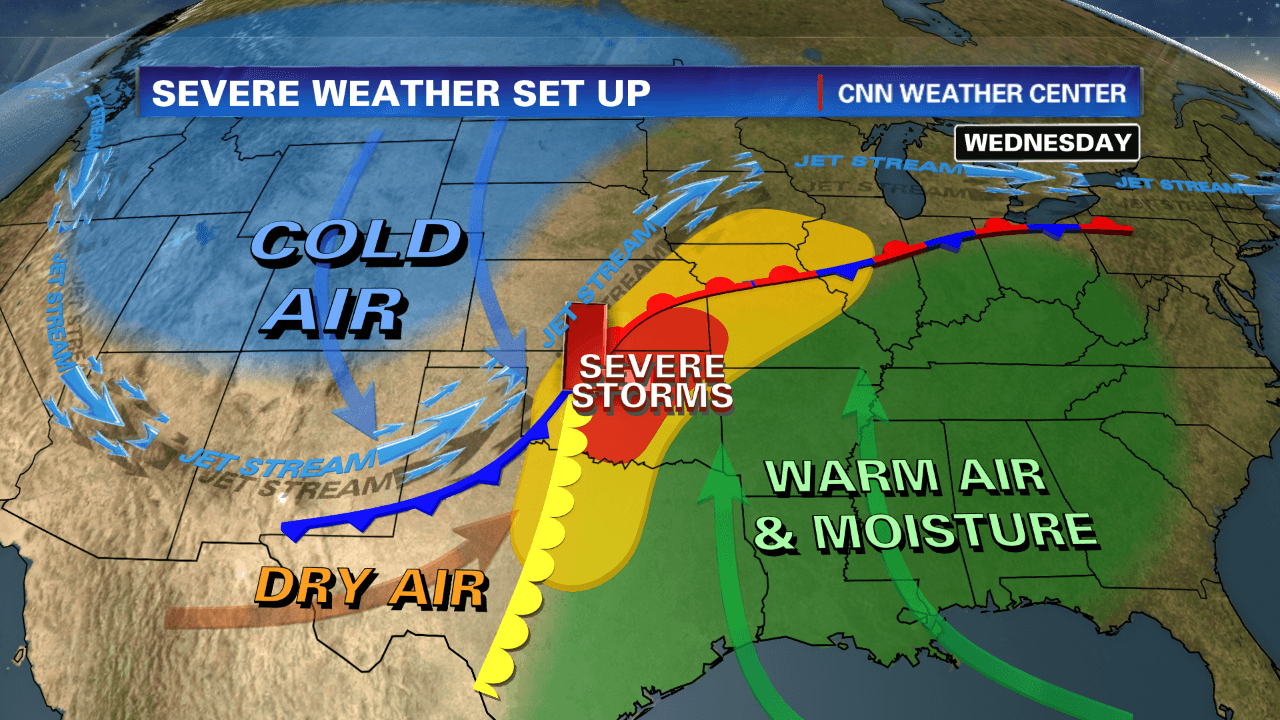
What direction is the cold front moving?
a)
Northwest
b)
Southeast
c)
Northeast
d)
Southwest
58.

What direction is the warm front moving?
a)
Northeast
b)
Northwest
c)
Southeast
d)
Southwest
59.

Which city can expect to see an increase in temperatures over the next 24 hours?
a)
Billings, Montana
b)
Atlanta, Georgia
c)
Minneapolis, Minnesota
d)
Miami, Florida
60.

The chart shows the high temperature for part of a week. If the temperature pattern continues into the weekend, what high temperature would be predicted for Saturday?
a)
25 degrees
b)
22 degrees
c)
20 degrees
d)
15 degrees
61.

Which city on the map did the cold front pass through between Friday and Sunday?
a)
El Paso
b)
Houston
c)
San Antonio
d)
Dallas
62.

Students gathered weather data during the day and recorded it in a table. What tool did the students use to gather the data?
a)
Wind Vane
b)
Thermometer
c)
Rain Guage
d)
Barometer
63.

Students measured the rainfall outside their classroom for five days and recorded their observations. There was an increase in the amount of rainfall between -
a)
June 10 and June 11
b)
June 12 and June 13
c)
June 11 and June 12
d)
June 13 and June 14
64.
Where does rainy weather tend to happen?
a)
At the equator.
b)
At the poles
c)
Along fronts
d)
In Texas
65.
Which term describes a circulation of air or water that is caused by uneven heating?
a)
convection current
b)
conduction current
c)
radiation current
d)
emission current
66.
Every few years, an event occurs in which the waters in the eastern Pacific Ocean become warmer. This event changes weather patterns worldwide, causing drought, floods, blizzards, hurricanes and tornadoes. What is the name of this event?
a)
Kuroshio Current
b)
Global conveyor
c)
El Nino
d)
Typhoon
67.
The ozone is in the stratosphere layer of the atmosphere. The purpose of the ozone is
a)
To generate heat for the earth
b)
To protect earth from the harmful solar radiation
c)
To produce weather
d)
To allow satellites to circle the earth
68.
Which of the following are used to study and forecast most weather-related events?
a)
Doppler radar
b)
satellites and satellite images
c)
weather maps
d)
all of the above
69.

Which statement best describes the difference between weather and climate?
a)
Weather is the conditions when you look outside while climate is the conditions you can expect for the next 6 months.
b)
Climate is the current condition outside while weather is what you can expect for the next 6 months.
70.
Rain, sleet, hail, and freezing rain are all...
a)
precipitation
b)
condensation
c)
evaporation
d)
perspiration
71.
Which of the following will heat the fastest?
a)
water
b)
land
c)
both heat at equal rates
72.
Earth would be too cold to support life without _____________________.
a)
global warming
b)
the greenhouse effect
c)
tropics
d)
seasons
73.
The conditions of the atmosphere at a certain time and place.
a)
weather
b)
climate
c)
precipitation
d)
atmosphere
74.

An instrument used to measure the amount of rainfall
a)
barometer
b)
thermometer
c)
rain guage
d)
wind sock
75.

An instrument used to show the direction of wind and measure the speed
a)
rain guage
b)
Thermometer
c)
barometer
d)
wind sock
76.

the amount of water vapor in the air
a)
warm front
b)
precipitation
c)
humidity
d)
air pressure
77.
An instrument used to measure how hot or cold something is
a)
barometer
b)
thermometer
c)
wind sock
d)
rain guage
78.

An instrument that measures air pressure
a)
thermometer
b)
barometer
c)
rain guage
d)
wind sock
79.

The layer of the atmosphere where weather occurs is the _.
a)
thermosphere
b)
stratosphere
c)
mesosphere
d)
troposphere
80.

An anemometer is used to measure...
a)
air pressure
b)
humidity
c)
precipitation
d)
wind speed
81.

The gradual increase in average global surface temperature is called...
a)
global warming
b)
the greenhouse effect
c)
the trump effect
82.
Which term best describes how the earth's atmosphere is heated?
a)
spirally
b)
unevenly
c)
circularly
d)
kinetically
83.
Which statement describes the main cause of tornadoes?
a)
Air in low pressure system rises above warm water.
b)
Tornadoes form when two air masses of sharply different temperature and humidity meet, normally over land.
c)
Tropical sea air sweeps in to replac ethe rising air, causing condensation.
d)
None of the above.
84.
When a hurricane makes landfall, what is the greatest danger to residents?
a)
Excessive rain
b)
The eye of the hurricane
c)
The temperature drop
d)
the storm surge
85.
What is the main cause for the seasonal variations in temperatures in the Northern and Southern Hemispheres?
a)
Differences in the earth's distance from the sun
b)
Changes in the earth's tilt as it orbits the sun
c)
The earth's rotation on its axis
d)
The phases of the moon
86.

As the air temperature increases, the air's capacity to hold water vapor:
a)
increases
b)
decreases
c)
remains the same
d)
is unrelated to air temperature and can either increase or decrease
87.

What type of weather is usually found in low pressure areas?
a)
hot and dry
b)
wet and stormy
c)
cold and snowy
d)
sunny and humid
88.

What front is moving through
Alabama and Georgia?
Alabama and Georgia?
a)
Warm
b)
Occluded
c)
Stationary
d)
Cold
89.

Which system results in rainy or stormy weather?
a)
high pressure
b)
low pressure
c)
hurricane
d)
weather system
90.

A __________ satellite helps scientists predict the national forecast.
a)
military
b)
weather
c)
rocket
d)
orbit
91.

When air pressure rapidly falls, what weather change usually occurs?
a)
clearing skies
b)
decreasing humidlty
c)
approaching storm
d)
decreasing temperature
92.

What are the characteristics of a high pressure air mass?
a)
warm and dry
b)
warm and humid
c)
cool and dry
d)
cool and humid
93.

The weather data for Columbia shows the barometric pressure reading is rising. Which is the best forecast for the weather in the Columbia area?
a)
Sunny and dry
b)
stormy weather
c)
falling temperatures
d)
no change at all
94.

These lines on a weather map connect areas with equal air pressure.
a)
Isotherms
b)
Isobars
c)
Degrees
d)
Stations
95.

It is a nice, sunny day. There is a large drop in pressure. What weather condition will LIKELY occur in the next 6-8 hours?
a)
Partly sunny and breezy
b)
Partly cloudy and breezy
c)
Sunny and calm
d)
Rainy and windy
96.
The deflection of wind and water due to the rotation of the Earth
a)
Greenhouse Effect
b)
Coriolis Effect
c)
Milankovitch Cycles
d)
Global Warming
97.
______________is the force exerted by the gases pushing on an object.
a)
ozone pressure
b)
cloud pressure
c)
air pressure
d)
stratus pressure
98.
_______ pressure systems usually signal fair weather with winds moving clockwise.
a)
low
b)
medium
c)
high
d)
none of the answers are correct
99.
______ pressure systems usually signal stormy weather with winds moving counter clockwise.
a)
low
b)
medium
c)
high
d)
none of the answers are correct
100.
______ are a rapidly moving funnel-shaped cloud that extends down from a storm cloud.
a)
storms
b)
tornadoes
c)
thunderstorms
d)
hurricanes
101.
_________ is a low pressure tropical storm that forms over warm ocean water. The lower the pressure in the center of this storm, the faster the winds blow towards the center of the storm.
a)
storms
b)
tornadoes
c)
thunderstorms
d)
hurricanes
102.
________ is a condition of Earth’s atmosphere at any time.
a)
weather
b)
air pressure
c)
ozone
d)
rain
103.
The source for heating the Earth and circulating Earth’s atmosphere comes from the______________.
a)
sun
b)
moon
c)
earth
d)
ocean
104.
____________ is the process of heat from the Sun moving back into the troposphere where it cannot get through the atmosphere and is trapped.
a)
evaporation
b)
Greenhouse Effect
c)
convection current
d)
water cycle
105.
What is it called when liquid water turns into water vapor?
a)
condensation
b)
evaporation
c)
sleet
d)
run-off
106.
Where are the warmest climates located?
a)
near the equator
b)
near the North Pole
c)
near the South Pole
d)
in the Northern Hemisphere
107.
Isobars are lines on a map joining places that have the same
a)
wind speed
b)
temperature
c)
humidity
d)
air pressure
108.

an intense, warm ocean current in the western North Atlantic Ocean
a)
doldrum
b)
jet stream
c)
gulf stream
d)
Greenhouse effect
109.
Which type of air pressure causes a storm to form on a spring day?
a)
low pressure, causing air to rise, cool, and form water droplets
b)
high pressure, causing air to rise, cool, and form water droplets
c)
C. low pressure, causing air to sink and bring water droplets to the ground
d)
D. high pressure, causing air to sink and bring water droplets to the ground
110.

The graphic below shows a common daily wind pattern.
Which term best describes the wind pattern in the graphic?
Which term best describes the wind pattern in the graphic?
a)
land breeze
b)
sea breeze
c)
trade wind
d)
gentle breeze
111.
Which will most likely result from a low-pressure weather system?
a)
warm temperatures
b)
cloudy conditions
c)
clear conditions
d)
D. cool temperatures
100 %

