
 Worksheets
Waves Intro
Total questions: 30
Worksheet time: 30mins
Name
Class
Date
1.
Two or more waves on different sides of the equilibrium interfere to form a wave with a smaller amplitude.
a)
Constructive Interference
b)
Destructive Interference
c)
Antinodes
d)
In Phase
2.
What best describes the doppler effect?
a)
An apparent change in frequency of a wave due to the relative motion between a wave source and an observer
b)
When sound changes pitch
c)
When light changes color
d)
An apparent change in the amplitude of a wave due to the relative motion between a wave source and an observer.
3.
A wave carries...?
a)
energy only
b)
matter only
c)
the matter and the energy
d)
neither
4.
The highest point of a wave is?
a)
crest
b)
trough
c)
anti-node
d)
node
5.
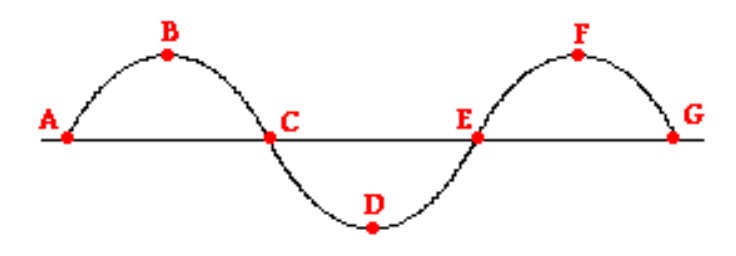
Which letter(s) represent the trough of the wave?
a)
from A to B
b)
from B to D
c)
from C to E
d)
from C to G
6.
In a transverse wave, particles move...?
a)
back and forth
b)
parallel to the direction of wave travel
c)
at right angles to wave travel
d)
only at the antinodes
7.

What property of this wave is represented by the letter "A"
a)
amplitude
b)
crest
c)
trough
d)
wavelength
8.
The time for one cycle.
a)
phase
b)
frequency
c)
period
d)
amplitude
9.
What is the source of all wave motion?
a)
nodes
b)
amplitudes
c)
forces
d)
vibrations
10.
What affects the period of a pendulum?
a)
mass object and length of pendulum
b)
acceleration of gravity and mass
c)
length of pendulum and angle of release
d)
length of pendulum and acceleration of gravity
11.
How are frequency and period related?
a)
They are directly proportional.
b)
Their sum is a constant.
c)
They are not related.
d)
They are inversely proportional.
12.
Where can you touch a standing wave on a rope without disrupting the wave?
a)
Half way down the wave
b)
at an antinode
c)
where the wave is in phase
d)
at a node
13.
The interference of an incident wave and a reflected wave results in __________________.
a)
a standing wave
b)
a transverse wave
c)
a mechanical wave
d)
a longitudinal wave
14.
The motion of the medium is back and forth along the direction the wave is moving.
a)
longitudinal wave
b)
standing wave
c)
optical wave
d)
transverse wave
15.
If the period of the wave triples, what happens to the frequency of the wave?
a)
The frequency triples.
b)
The frequency stays the same.
c)
The frequency decrease to 1/3 of original.
d)
The frequency increases by a factor of 9.
16.
The amplitude of a wave doubles. What happens to the speed of the wave?
a)
The wave speed doubles.
b)
The wave speed reduces to 1/2 the original.
c)
Nothing, the wave speed is unchanged.
d)
The wave speed quadruples
17.
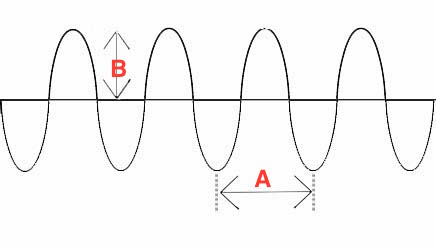
What property of the wave is represented by the letter "B"?
a)
amplitude
b)
crest
c)
trough
d)
wavelength
18.

Which letter correctly represents the amplitude?
a)
A
b)
B
c)
C
d)
D
19.

Which letters represent one wavelength?
a)
A to B
b)
A to C
c)
A to D
d)
A to E
20.
Which letters represent one an amplitude?
a)
A to C
b)
B to F
c)
E to H
d)
G to F
21.
When the source of waves is moving relative to an observer, the result is called ..........
a)
a shock wave.
b)
the Doppler Effect.
c)
a sonic boom.
d)
interference.
22.
If a firetruck is approaching you, the sound you hear......
a)
gets to you faster and has the same pitch.
b)
gets to you slower and has the same pitch.
c)
has a higher pitch and gets to you at the same speed.
d)
has a lower pitch and gets to you at the same speed.
23.
A sonic boom is heard ......
a)
just at the moment a plane breaks the sound barrier.
b)
the whole time the plane is travelling faster than sound.
c)
as the plane gets close to the sound barrier.
d)
when the plane is high in the air.
24.
A wave travelling at 20 m/s completes 5 cycles each second. What is the wavelength?
a)
100m
b)
4.0m
c)
0.25m
d)
15 m
25.
A wave completes two cycles per second. What is the frequency of the wave?
a)
2 Hz
b)
2 seconds
c)
0.5 Hz
d)
0.5 seconds
26.
A wave completes two cycles per second. What is the period of the wave?
a)
2.0 Hz
b)
2.0 seconds
c)
0.5 Hz
d)
0.5 seconds
27.

The picture in an example of .....
a)
standing waves.
b)
wave reinforcement.
c)
waves in phase.
d)
destructive interference.
28.

The image is an example of...
a)
constructive interference.
b)
shock waves.
c)
bow waves.
d)
cancellation.
29.

How many nodes and antinodes are shown in the picture?
a)
4 nodes, 3 antinodes
b)
4 nodes, 6 antinodes
c)
6 nodes, 4 antinodes
d)
3 nodes, 4 antinodes
30.
A physics teacher creates waves on a phone cord. After a few seconds she increases the rate at which she vibrates the cord. What happens to the waves she creates?
a)
The wave speed increases.
b)
The wave speed decreases.
c)
The wavelength increases.
d)
The wave length decreases.
100 %

