
 Worksheets
Electricity Review
Total questions: 39
Worksheet time: 33mins
Name
Class
Date
1.

This is an example of a _______ circuit
a)
open
b)
series
c)
parallel
d)
square
2.

This is an example of a ______ circuit
a)
Series
b)
Parallel
c)
Open
d)
Dihexihedral
3.
What voltage is needed to cause a 2A current flow through a 10Ω resistor?
a)
5V
b)
0.2V
c)
20V
d)
200V
4.
What resistance is needed to cause a 20A current flow because of a 100V battery?
a)
0.2Ώ
b)
2000Ώ
c)
120Ώ
d)
5Ώ
5.
What is the power of a 20V bulb with 5A through it?
a)
100W
b)
100V
c)
6.3W
d)
6.3A
6.

Which of the following circuits is drawn correctly? (click to hide text and show illustration)
a)
A
b)
B
c)
C
d)
D
7.
An example of a parallel circuit is
a)
the wiring in a house
b)
a flashlight
c)
a single circular path
8.
What is an object that does not conduct electricity?
a)
Conductor
b)
Insulator
c)
Circuit
d)
Resistance
9.
What is the measure of how much a material opposes the flow of electricity?
a)
Conductor
b)
Insulator
c)
Circuit
d)
Resistance
10.
What is a circuit that has only one path that electricity can follow?
a)
Series Circuit
b)
Parallel Circuit
11.
What is a circuit that has two or more paths that electricity can follow?
a)
Series Circuit
b)
Parallel Circuit
12.
What do you call an object that allows electricity to flow?
a)
Conductor
b)
Insulator
c)
Resistance
d)
Electromagnet
13.
If one burned out bulb causes all of the lights to fail in a circuit, what might you conclude?
a)
More batteries are needed.
b)
It is a parallel circuit.
c)
A heavier wire is needed.
d)
It is a series circuit.
14.
Which of the following materials would you use to connect a battery and bulb so that the bulb would light?
a)
a strip of plastic
b)
a strip of silver
c)
a wooden toothpick
d)
a rubber band
15.
In a parallel circuit which of the following is the same value throughout the circuit?
a)
Voltage
b)
Current
c)
Resistance
d)
Charge
16.
In a parallel circuit which of the following is different for each resistor?
a)
Voltage
b)
Current
c)
Ohms Law
d)
Charge
17.
How do you find the total resistance in a parallel circuit?
a)
Add all the resistances up
b)
Trick question! All circuits have the same resistance!
c)
1/R = 1/R1 + 1/R2 + 1/R3
18.
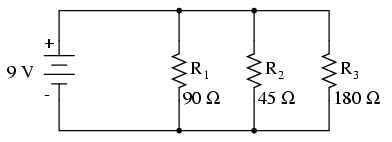
The total resistance of this circuit is
a)
25.7 ohms
b)
315 ohms
c)
324 ohms
d)
90 ohms
19.

The total current going through the battery of this circuit is
a)
0.35 amps
b)
0.0286 amps
c)
0 amps
d)
9 amps
20.
Charges flow from
a)
places of higher electrical potential energy to places of lower electrical potential energy
b)
places of lower electrical potential energy to places of higher electrical potential energy
c)
places of higher electrical resistance to places of lower electrical resistance
d)
places of lower electrical resistance to places of higher electrical resistance
21.

Is this circuit open or closed?
a)
Closed
b)
Open
22.
Current is the ...
a)
pressure of electricity
b)
flow of electricity
c)
tendency of a material to resist the flow of electricity.
d)
total power
23.

A closed pathway through which electricity can flow is called
a)
Closed circuit
b)
switch
c)
load
d)
insulator
24.
What are the materials that make up a simple circuit?
a)
wires, switch, outlet
b)
battery, switch, motor
c)
wires, light bulb, motor
d)
wires, battery, light bulb, switch
25.

This type of electricity does not have a continuous charge. Lightning or rubbing a balloon with wool is an example of ___.
a)
nature
b)
static
c)
current
d)
past
26.

This type of electricity is more useful for people. The continuous flow of energy helps to power lights, motors, and phones.
a)
hot
b)
water balloon
c)
static
d)
current
27.
Potential difference (Voltage) is measured in __.
a)
volts.
b)
watts.
c)
coulombs.
28.
Power is defined as the product of voltage times amperage. The equations is ___.
a)
P=I x V
b)
V+ P = I
c)
I x P = V
29.
What is the formula for resistance?
a)
V x I = R
b)
R = V/I
c)
I = V/R
30.
Resistance is measured in ___.
a)
watts.
b)
amps.
c)
ohms.
31.
A circuit contains two unequal resistances in parallel
a)
current is same in both
b)
larger current flows in larger resistor
c)
potential difference (voltage) across each is same
d)
smaller resistance has smaller conductance.
32.
Resistivity of a wire depends on:
a)
length
b)
material type
c)
cross sectional area
d)
all the above
33.
What size resistor would produce a 3 Amp current flow with a 12 Volt battery
a)
1 Ohm
b)
3 Ohms
c)
4 Ohms
d)
12 Ohms
34.
If a battery produced 12.6 Volts, what would be the current flow for a 6 Ohm resistor?
a)
2.1 Amps
b)
2.4 Amps
c)
4.2 Amps
d)
15 Amps
35.
If you have two 12 Volt batteries with two resistors in series (3 Ohms & 4 Ohms), what would be the current?
a)
2.1
b)
1.71 Amps
c)
3.4 Amps
d)
15 Amps
36.
Opposite charges
a)
attract
b)
repel
37.
An example of a voltage source is
a)
a dry cell.
b)
a generator.
c)
a car battery
d)
photocell.
e)
all of the above.
38.
An iPod that is powered by two 2.5 volt batteries and has 5.2 ohms of resistance. Calculate the current of the iPod?
a)
0.48 A
b)
13 A
c)
2.08 A
d)
0.96 A
39.
Compared to thick wires, electrical resistance in thin wires is
a)
less.
b)
the same.
c)
greater.
100 %

