
 Worksheets
Evolution and Darwin
Total questions: 30
Worksheet time: 1hrs 19mins
Name
Class
Date
1.

what did Charles Darwin observe in finch populations of the Galapagos Islands off the coast of South America?
a)
different species on different islands
b)
all species on one of the islands
c)
identical species on all the islands
d)
the same species as North America
2.

Genetic variation can arise from a random change in the DNA of a gene. The change is called a(n)
a)
mutation
b)
gene flow
c)
gene pool
d)
allele
3.
The disappearance of a species.
a)
Evolution
b)
Extinction
c)
Migration
d)
Mutation
4.

This image shows that
a)
These animals have no simliarities in their structures.
b)
two different species may have evolved from a common ancestor.
c)
These animals are from the same species.
d)
These animals likely evolved from different ancestors due to their differences.
5.

Which type of adaptation is shown?
a)
mimicry
b)
camouflage
c)
artificial selection
d)
homologous structure
6.

Two organisms that are closely related would have
a)
very similar DNA sequence
b)
exactly the same DNA sequences
c)
no proteins in common
d)
completely different DNA sequence
7.
what gave Charles Darwin the idea of evolution?
a)
google
b)
wikipedia
c)
mans attempt to destroy mankind
d)
finches in the Galapagos island
8.
There are three species of birds on an island. Bird A has a heavy bill for eating seeds. Bird B has a pointed bill for eating insects. Bird C has a sharp bill for eating both insects and seeds. If all insects on the island suddenly disappeared, which bird or birds would be the LEAST affected?
a)
Bird A
b)
Bird B
c)
Bird C
d)
Bird A and Bird B
9.
Which of the following is a fossil?
a)
a plant that has recently died
b)
a group of organisms that can reproduce
c)
a structure or organ that no longer functions
d)
a trace of an organisms that existed in the past
10.

All of these finches have different shaped beaks, they are an adaptation to gain access of
a)
Water
b)
Food
c)
Shelter
11.

These different finches descended from a common ancestor but changed or were modified over time, this is
a)
Homologous structures
b)
Descent with modification
12.
What was the name of the ship Charles Darwin sailed on?
a)
Boaty McBoaty Face
b)
HMS Beagle
c)
HMS Britannia
d)
HMS Bulldog
13.
Where did Charles Darwin travel to?
a)
Australia
b)
Barbados
c)
Galapagos
d)
Trinidad
14.
What is the title of Charles Darwin's famous book?
a)
The origin of species
b)
Origin of species
c)
On the origin of species
d)
Species. The origin
15.
What is survival of the fittest?
a)
It is where the fittest die out and therefore reproduce and pass on their genes
b)
It is where the fittest die out and therefore can't reproduce and pass on their genes
c)
It is where the fittest don't die out and therefore can't reproduce and pass on their genes
d)
It is where the fittest don't die out and therefore reproduce and pass on their genes
16.
What is natural selection?
a)
Your natural fate is decided from birth
b)
Nature actively chooses who surivives
c)
Those best suited to demands of environment surivie
d)
The weakest of a species surivie
17.

Which type of evidence is illustrated in this picture
a)
fossil evidence
b)
molecular
c)
anatomical
d)
embryological
18.

An organism has thick white fur, a bushy tail,
and short ears. It often burrows holes and curls into a ball for warmth. For
which environment is this organism most likely adapted?
a)
Grassland
b)
Arctic Tundra
c)
Coniferous Forest
d)
Desert
19.

Farmers breed cows to produce high amounts of milk. This is an example of...
a)
Natural Selection
b)
Variations in a species
c)
Selective Breeding
20.
Why are advantageous traits more likely to be passed onto offspring?
a)
Because they are more likely to survive and reproduce.
b)
Because they come from dominant alleles.
c)
Because they come from recessive alleles.
d)
Because the trait is an acquired phenotype.
21.

characteristic or trait that helps an organism survive in its environment
a)
skills
b)
speciation
c)
natural instinct
d)
adaptation
22.
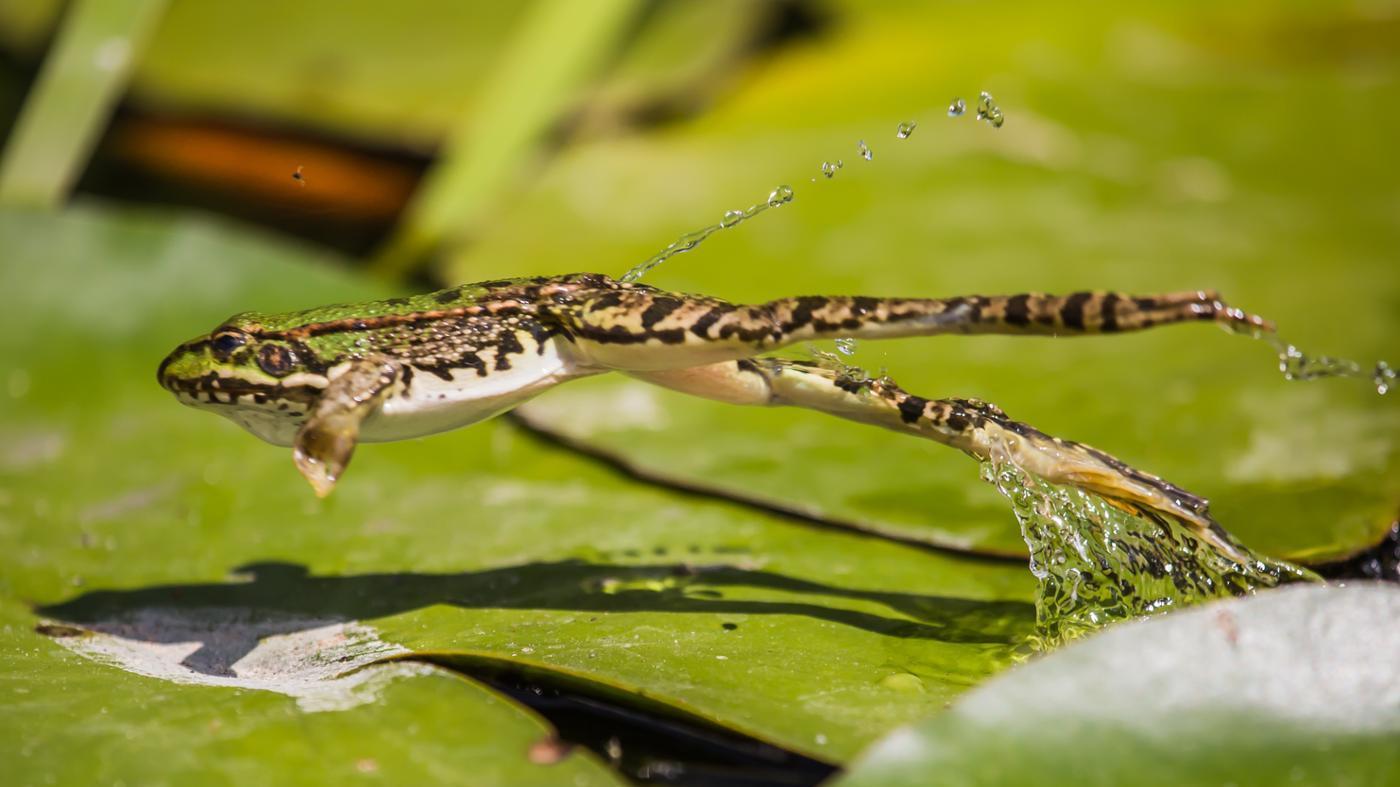
Frogs have webbed feet that help them to swim in water. Webbed feet in frogs are an example of a
a)
niche
b)
variation
c)
adaptation
d)
learned behavior
23.
Darwin's expedition took how many years?
a)
3
b)
4
c)
5
d)
6
24.
The struggle for existence against other members of an organisms species is
a)
Competition
b)
Natural Selection
c)
gene flow
d)
genetic drift
25.

To adjust to a changing environment
a)
Mutation
b)
Adapt
26.
Organisms from which others have descended are called what?
a)
Relatives
b)
Organisms
c)
Ancestors
d)
Species
27.
Butterflies blending their wing color with their environment is an example of what?
a)
Adaptation
b)
Evolution
c)
Camouflage
d)
None of the above
28.
The species Vulpes vulpes, the red fox, will vomit before fleeing from a predator in order to move at a faster pace. This is a _____.
a)
mutation that is an inheritable change
b)
behavior that enables a species to survive
c)
reason that species become extincted
d)
genetic variation that leads to diversity
29.

Throughout time the horse foreleg went from having __________ toes to _________ toe(s)
a)
four, one
b)
one, four
c)
three, one
d)
one, three
30.
The goal of every species on earth is...
a)
to survive and reproduce
b)
divide and conquer
c)
survive and conquer
d)
reproduce and die
100 %

