
 Worksheets
8th Grade Science Final
Total questions: 40
Worksheet time: 32mins
Name
Class
Date
1.

What does the symbol mean?
a)
Biohazard
b)
Caution: Chemicals
c)
Wash Hands
d)
Wear Safety Gloves
2.

This symbol warns of
a)
Fire
b)
Acid
c)
Biohazard
d)
Electrical danger
3.
Before beginning a lab, you should always
a)
clear off your table to ensure a clean workspace
b)
ask the teacher about any questions you have
c)
read all directions
d)
all of the above
4.

The diagram shows a graduated cylinder containing water. From which position will the most accurate measure of the volume of water be made?
a)
Position 1
b)
Position 2
c)
Position 3
d)
Position 4
5.
Factors in an experiment that must be kept the same are called -
a)
constants
b)
variables
c)
experimental error
d)
hypothesis
6.

Who is the person credited with developing the theory of continental drift?
a)
Harry Hess
b)
Alfredo Sauce
c)
Alfred Wegener
d)
Alfred the Butler
7.

The graph shows the amount of rain that fell each day for 5 days. If the pattern continues, what is the BEST prediction for Friday?
a)
There will be no rain on Friday
b)
There will be more than 4 cm of rain.
c)
There will be 2 cm of rain.
d)
There will be 3 cm of rain.
8.
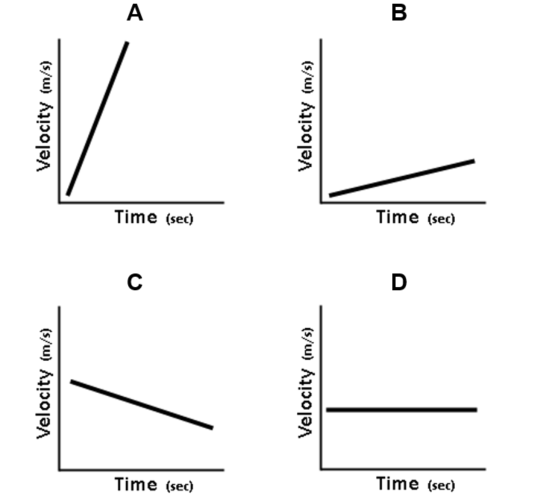
Which graph represents zero acceleration (constant velocity)?
a)
A
b)
B
c)
C
d)
D
9.
What color are the coolest stars?
a)
blue-white
b)
yellow
c)
red
d)
orange
10.
A neap tide is a tide with the greatest difference between low and high tides
a)
true
b)
false
11.
All the organisms in a particular location, including their nonliving environment
a)
ecosystem
b)
carnivore
c)
niche
d)
population
12.

What is speed?
a)
how far you go
b)
how much distance is covered over a period of time
c)
how fast you accelerate
d)
the change in the location of a object
13.

_____ have the longest wavelengths and lowest frequencies of all electromagnetic waves.
a)
microwaves
b)
radio waves
c)
gamma rays
d)
ultraviolet
14.

What is measured with a graduated cylinder?
a)
Passage of time
b)
Distance from one thing to another
c)
Weight of an object
d)
Volume of liquid
15.
Which of the following determines the type of element that an atom makes?
a)
The size of the nucleus.
b)
The number of protons.
c)
How much the atom weighs.
d)
The number of neutrons.
16.
Consider the chemical equation CH4 + 2 O2 → CO2 + 2 H2O. In this equation, CH4 is a
a)
product
b)
reactant
c)
displacement
17.
1. particle with on negative charge.
a)
A. neutron
b)
B. electron
c)
C. proton
d)
D. atom
18.

Which season is taking place in the NORTHERN Hemisphere in Position 2? Hint: What season is it in the NORTHERN hemisphere in location 1? What season will come next?
a)
Winter
b)
Spring
c)
Summer
d)
Fall
19.

Which season has the least amount of daylight hours?
a)
Winter
b)
Spring
c)
Summer
d)
Fall
20.
A decomposer?
a)
Eats dead plants or animals and breaks down to put nutrients in the soil
b)
Eats plants or other animals for food
c)
Makes its own food
d)
Machine that gathers trash
21.
A consumer?
a)
Makes its own food
b)
Eats dead plants and animals
c)
Eats plants and other animals for energy
d)
Buys toys for kids
22.
Which of these describes a mutually beneficial relationship between two organisms?
a)
A dog with worms in its intestine
b)
A turtle and a snail that both eat grass live in a river
c)
A honeybee pollinating a plant and receiving nectar for food
d)
A small fish attached to a shark, eating tiny pieces of the shark's food as it floats
23.

What is happening because humans have added too much carbon dioxide into the air?
a)
Hole in the ozone layer
b)
Climate change
c)
Pollution
d)
Global cooling
24.
What is H2SO4
made up of?
made up of?
a)
2 hydrogen, 1 sulfur, 4 oxygen
b)
1 hydrogen, 2 sulfur, 4 oxygen
c)
2 hydrogen & 4 sodium
d)
1 hydrogen & 6 sodium
25.
In what areas of the world do hurricanes form?
a)
Warm ocean waters
b)
Polar ocean waters
c)
On lakes and rivers
d)
Over the central plains of the U.S
26.
what is the definition of chemical change?
a)
any change that results in the formation of new chemical substances.
b)
changing clothes
c)
matter cannot be created or destroyed, only change form
d)
changes affecting the form of a chemical substance, but not its chemical composition.
27.
Precipitation that is more acidic than normal because of air pollution is called
a)
smog
b)
acid rain
c)
ozone
d)
exhaust
28.

Autotroph or heterotroph?
a)
Autotroph
b)
Heterotroph
29.

At which point is potential energy greatest?
a)
W
b)
X
c)
Y
d)
Z
30.
Which category is our Sun located in?
a)
White Dwarfs
b)
Supergiants
c)
Main Sequence
d)
Giants
31.
Most of the Energy that drives the water cycle comes from _________
a)
Earth's Cores
b)
The Equator
c)
The Sun
d)
Earth's Oceans
32.

The Earth's tides are largely due to
a)
Earth's gravity
b)
Moon's gravitational pull
c)
Rotation and Revolution of Earth
d)
Earth's core
33.
A light year is...
a)
The speed light travels
b)
How long it takes light to get to you from the sun
c)
The distance light can travel in a year
d)
How many years it takes light to be emitted
34.

What type of galaxy is this?
a)
Spiral
b)
Elliptical
c)
Irregular
d)
Irrational
35.

What does the Big Bang theory suggest?
a)
The universe was just there
b)
The Milky Way is the only solar system
c)
The universe is continually expanding
d)
The universe started as a point, expanded, and will return to a point
36.
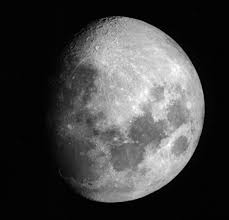
Name the moon phase
a)
waning crescent
b)
waxing crescent
c)
waning gibbous
d)
waxing gibbous
37.
About how long does it take the moon to make one complete cycle around the earth?
a)
65 days
b)
8 days
c)
365 days
d)
28 days
38.
Which type of plate boundary would cause mountains to form
a)
Transform
b)
Convergent
c)
Divergent
d)
Reform
39.
What would you be most likely to find at a convergent boundary between a continental and oceanic plate?
a)
Mountains
b)
Volcanoes
c)
Mid-Ocean Ridge
d)
Rift
40.

What type of storm front is this?
a)
warm front
b)
cold front
c)
stationary front
d)
occluded front
100 %

