
 Worksheets
Earth Science
Total questions: 50
Worksheet time: 45mins
Name
Class
Date
1.

What causes the seasons to change?
a)
The warming and cooling of Earth's core.
b)
The distance from the sun.
c)
Earth's tilt in relation to the sun.
d)
Earth's rotation on its axis.
2.

What happens when the area in which you live tilts away from the sun?
a)
It is summer.
b)
It is spring.
c)
It is winter.
d)
It is fall.
3.

What season is it in the Southern Hemisphere when it is fall in the Northern Hemisphere?
a)
winter
b)
spring
c)
summer
d)
fall
4.

Why does the area around the equator stay the same temperature all year?
a)
The equator rotates slower than the poles.
b)
The equator remains the same distance from the sun.
c)
The equator always receives direct sunlight.
d)
The equator has 18 hour days.
5.
_____________ happens as we begin to turn towards the sun.
a)
Sunset
b)
Sunrise
6.
What causes ocean currents in the Northern Hemisphere to curve to the right?
a)
Earth's orbit around the Sun
b)
Earth's spinning on its axis
c)
Earth's magnetic field
d)
Earth's force of gravity
7.
The coriolis effect deflects:
a)
Only winds and currents near the equator
b)
Only winds and currents near the poles
c)
No winds, only ocean currents
d)
All winds and ocean currents
8.

The big bang theory explains the...
a)
Life cycle of a star
b)
Seasons of the earth
c)
origin of the universe
d)
Sheldon...just sheldon
9.
The universe is ____ billion years old.
a)
11
b)
15
c)
4
d)
23
10.
The scientific study of planets, stars, galaxies, and the universe as a whole.
a)
Astronomy
b)
Geology
c)
Cosmology
d)
Quantum Physics
11.
The event that marks the beginning of our known universe
a)
Theory of Evolution
b)
Big Bang Theory
c)
Cell Theory
d)
Blackhole theory
12.
This layer of Earth is the thickest part
a)
crust
b)
outer core
c)
mantle
d)
inner core
13.
What is Pangaea?
a)
The name of a German Scientist
b)
the name of the supercontinent that existed millions of years ago
c)
another name for continental drift
d)
the name of an ancient fossil
14.
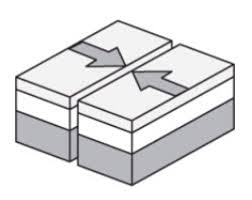
Name the boundary
a)
convergent boundary
b)
divergent boundary
c)
transform boundary
d)
sergent boundary
15.

Name the boundary
a)
convergent boundary
b)
divergent boundary
c)
transform boundary
d)
sergent boundary
16.
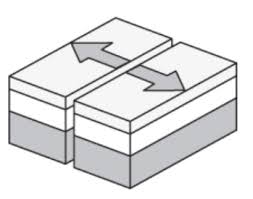
Name the boundary
a)
convergent boundary
b)
divergent boundary
c)
transform boundary
d)
sergent boundary
17.
Plate movement is caused by ______________.
a)
the rotation of the Earth
b)
ocean tides
c)
convection currents in the mantle
d)
the moon's gravity
18.
Whenever a subduction zone is formed a ______ is formed.
a)
Mountain
b)
Island Arc
c)
Rift
d)
Volcano
19.
Flood water pounding against a canyon wall and wearing it down
a)
Weathering
b)
Erosion
c)
Deposition
20.
Rain washing away soil from a hillside
a)
Weathering
b)
Erosion
c)
Deposition
21.
Rain washing away soil from a hillside
a)
Weathering
b)
Erosion
c)
Deposition
22.
Layers of sediment forming at the bottom of the ocean floor
a)
Weathering
b)
Erosion
c)
Deposition
23.
Caves being formed by acid rain dissolving underground limestone
a)
Weathering
b)
Erosion
c)
Deposition
24.
Deltas forming at the mouths of rivers
a)
Weathering
b)
Erosion
c)
Deposition
25.

What part of the water cycle does this picture show?
a)
condensation
b)
precipitation
c)
evaporation
26.
Which of these is an example of precipitation?
a)
snow
b)
air
c)
clouds
d)
vapor
27.
Snow, sleet, hail, and rain are all examples of ________________.
a)
evaporation
b)
condensation
c)
accumulation
d)
precipitation
28.
which answer best defines condensation?
a)
the process of changing from a liquid to a gas, usually caused by energy from the sun
b)
the process in which animals release water vapor
c)
the process of changing from a gas to a liquid, such as water vapor changing into water
d)
water falling to the surface of the Earth in the form of rain, hail, sleet, or snow
29.
Which answer best defines precipitation?
a)
the process of changing from a liquid to a gas, usually caused by energy from the sun
b)
the process in which animals release water vapor
c)
the process of changing from a gas to a liquid, such as water vapor changing into water
d)
water falling to the surface of the Earth in the form of rain, hail, sleet, or snow
30.
Which answer best defines groundwater?
a)
the process of changing from a gas to a liquid, such as water vapor changing into water
b)
Water below Earth's surface
c)
water falling to the surface of the Earth in the form of rain, hail, sleet, or snow
d)
water on top of Earth's surface
31.
Which answer best defines evaporation?
a)
the process of changing from a liquid to a gas, usually caused by energy from the sun
b)
the process in which animals release water vapor
c)
the process of changing from a gas to a liquid, such as water vapor changing into water
d)
water falling to the surface of the Earth in the form of rain, hail, sleet, or snow
32.

This rock was formed when magma cooled very slowly inside the Earth. What specific type of rock is it?
a)
Intrusive Igneous Rock
b)
Extrusive Igneous Rock
c)
Foliated Metamorphic Rock
d)
Clastic Sedimentary Rock
33.
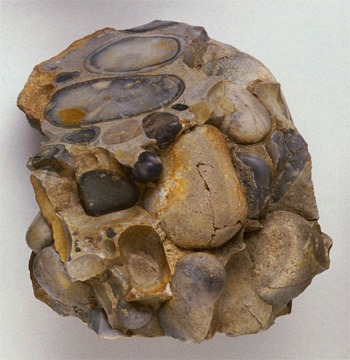
This rock was formed by smaller pieces of rock that settled at the bottom of a lake millions of years ago. What type of rock is this?
a)
Sedimentary
b)
Igneous
c)
Metamorphic
34.
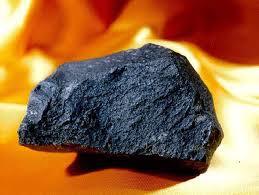
This rock was found near the mouth of a volcano. What type of rock is this?
a)
Sedimentary
b)
Igneous
c)
Metamorphic
35.
Sedimentary rock is formed through the process of
a)
Cementation
b)
Stratification
c)
Erosion
d)
Foliation
36.

Identify layer #20.
a)
mantle
b)
asthenosphere
c)
inner core
d)
outer core
37.

Identify the letter in the diagram. Identify letter A
a)
Lithosphere
b)
Asthenosphere
c)
Mantle
d)
Outer Core
38.
The lithosphere combines what two layers?
a)
Athenosphere & Crust
b)
Crust & Upper Mantel
c)
Mantel & Athenosphere
39.
The thinnest layer of the Earth is?
a)
Mantle
b)
Lithosphere
c)
Athenosphere
d)
Crust
40.
Which is deeper, a land valley or an ocean trench?
a)
Trench
b)
Valley
41.

When we go to beach, we are allowed to go on ____________
a)
continental slope
b)
continental shelf
c)
abyssal plain
d)
sea mount
42.
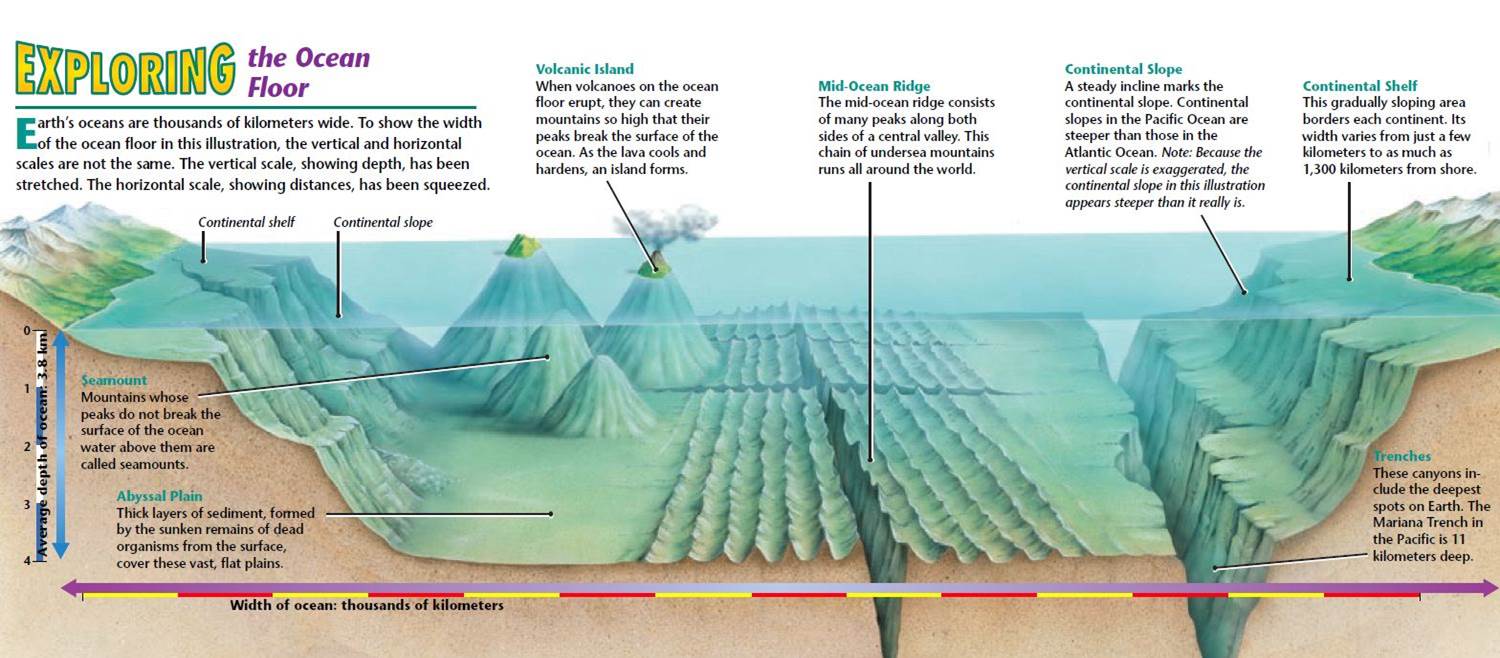
The ocean is salty mainly due to the weathering & erosion that takes place on igneous rocks found in Earth’s crust and on the mountains. It is also salty due to the dead ocean animals whose bodies sink to the ocean floor.
a)
True
b)
False
43.

This image shows
a)
sea floor is spreading
b)
continental shelf
c)
continental slope
d)
sea mount
44.

The __________ has planets, moons, comets, and asteroids.
a)
solar system
b)
earth
c)
rotation
d)
United States
45.
The Gulf stream carries _____________ water from the east coast of The United States to the West coast of Europe.
a)
Cold
b)
Warm
c)
Freezing
d)
Fresh
46.

What does label C represent in the picture?
a)
continental slope
b)
continental shelf
c)
abyssal plain
d)
sea mount
47.

What does label D represent on the picture?
a)
continental slope
b)
continental shelf
c)
abyssal plain
d)
mid ocean ridge
48.
What is a smooth, nearly flat region of the deep ocean floor called?
a)
continental shelf
b)
deep ocean basin
c)
abyssal plain
d)
trench
49.

An instrument that records vibrations in the ground and determines the location and strength of an earthquake.
a)
seismograph
b)
seismogram
c)
seismic wave
d)
vibrato
50.
Which layer of Earth is the source of lava that erupts from volcanoes?
a)
inner core
b)
outer core
c)
asthenosphere
d)
lithosphere
100 %

