
NEW
Font size
S
M
L
XL
 Worksheets
Great Depression
Total questions: 44
Worksheet time: 2hrs 48mins
Name
Class
Date
1.

How did Hoovervilles get their name?
a)
President Franklin Roosevelt named them after his dog, Hoover.
b)
Hoovervilles were named after President Hoover.
c)
Hoovervilles tended to hover over cities
d)
Hoovervilles needed hoover vacuum cleaners
2.

What is a breadline?
a)
A breadline is a line of bread.
b)
A breadline is a line where people lined up to get money.
c)
A breadline is a line of people waiting to receive food.
d)
A breadline is a line of people making bread.
3.

Which U.S. president was blamed for the Great Depression?
a)
President Roosevelt
b)
President Washington
c)
President Lincoln
d)
President Hoover
4.

When did the stock market crash?
a)
October 29, 1939
b)
October 29, 1919
c)
October 29, 1949
d)
October 29, 1929
5.

Who created the New Deal?
a)
Franklin D. Roosevelt
b)
Woodrow Wilson
c)
Herbert Hoover
d)
Calvin Coolidge
6.

What year did the Great Depression start?
a)
1921
b)
1927
c)
1929
d)
1930
7.

Where did the Dust Bowl happen?
a)
Great Plains
b)
Europe
c)
New York
d)
East Coast
8.

On Black Tuesday, the stock market __________.
a)
Crashed
b)
Opened
c)
Increased
d)
Dashed
9.

Farmers and families that decided to move because of the Dust Bowl were called....
a)
Hoovervilles
b)
Shanties
c)
Okies
d)
Yankees
10.

How many terms did Franklin D. Roosevelt serve as president?
a)
One
b)
Two
c)
Four
d)
Three
11.

President Franklin Roosevelt won the election of 1932. The country was in the Great Depression, and Roosevelt introduced the New Deal. Which was the MOST important goal of President Franklin Roosevelt's New Deal programs?
a)
to strengthen the economy
b)
to avoid going to war
c)
to improve public education
d)
to end racial discrimination
12.

What was the "New Deal" of the 1930s?
a)
a government program that gave free land to homesteaders
b)
a government program that helped women get the vote
c)
a government program that spread civil rights throughout the country
d)
a government program designed to help people during the depression
13.

President Franklin Roosevelt asked Congress to pass a series of acts called the New Deal. Which is one way the New Deal helped people during the Great Depression?
a)
It gave all people the right to vote.
b)
It created programs to put people back to work.
c)
It let all new immigrants become American citizens.
d)
It let people travel around the country freely.
14.

The Great Depression was an economic slowdown in the 1920s and 1930s. Which of the following was one cause of the Great Depression in the United States?
a)
the end of the gold rush
b)
the crash of the stock exchange
c)
the ending of World War II
d)
the high price of oil
15.

The Great Depression that began in 1929 hit farmers especially hard. Farmers had not been doing well in the 1920s and several years of severe drought turned the land into a "dust bowl." What was an immediate result of this?
a)
Many farmers decided to grow crops that did not use as much water.
b)
The government built large dams in the West for irrigation.
c)
Many farmers and their families lost their farms and moved west.
d)
The government helped farmers by buying their land and equipment.
16.

Many people lost their jobs during the Great Depression. People did not have money to pay for necessities, such as shelter, food, and clothing. The national government responded with President Franklin Roosevelt's "New Deal," a program that
a)
provided programs to help people make money to provide for their needs.
b)
provided new ways for people to apply for unemployment insurance.
c)
forced people to join the military forces to make money for their needs.
d)
forced people to use charities to help them provide for their needs.
17.

a)
The Great Recession
b)
Dust Bowl
c)
New Deal
d)
Great Depression
18.

The Great Depression was a very difficult time period for most Americans, including farmers. People looked for ways to forget their troubles. Which of the following is NOT a way people tried to escape their troubles?
a)
Going to the movies
b)
Running track and field
c)
Listening to popular music
d)
Reading books
19.

What caused millions to lose their family wealth during The Depression?
a)
Bank closures
b)
Foreclosures on their farms and homes
c)
Stockmarket
d)
All of the above
20.

Songs such as "Brother, Can you spare a dime" which tell an important story are called
a)
Sad and depressing
b)
Oral History
c)
Boring
d)
Old fashion
21.
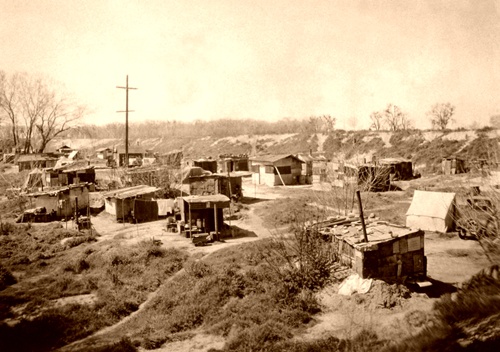
What were the villages full of shacks located in cities filled with unemployed Americans called?
a)
Hoovervilles
b)
Okies
c)
Bonus Army Bases
d)
Rooseveltowns
22.

What was one EFFECT of dust storms that occurred during "the Dust Bowl"?
a)
loss of farms and livestock
b)
homes were destroyed
c)
Texans moved to other states
d)
ALL of these are effects of the dust storms
23.

The major difference between President Hoover and President Roosevelt in how they dealt with the Depression. Roosevelt was....
a)
unwilling to allow government agencies to establish jobs programs
b)
unable to win congressional support for his economic program
c)
able to ignore economic issues for most of his first term in office
d)
more willing to use government intervention to solve economic problems
24.

FDR addressed the American public in weekly broadcasts known as:
a)
FDR Hour
b)
Hangin' With Franklin
c)
Fireside Chats
d)
Around the Fire
25.

What were the major goals of the New Deal?
a)
no gold standard and free coinage of silver
b)
abolition and suffrage
c)
relief, recovery, and reform
d)
expanding the size and economic influence of the United States
26.

What protects one's money in the bank?
a)
CCC
b)
NRA
c)
FDIC
d)
FBLA
27.

CCC and WPA were primarily intended to help
a)
Homeowners
b)
Unemployed
c)
Failing Banks
d)
Businesses
28.

Tennessee Valley Authority (TVA)
a)
Set-up work camps for millions of employed young men. the men received pay and housing and planted trees on public land
b)
built 50 dams along rivers in the South to prevent flooding. Built 13 power plants to provide people with electricity for the first time
c)
employed people to build roads, schools, bridges, parks, and airports. Employed artists to work on murals.
d)
provides monthly payments to the elderly, the disabled,and the unemployed
29.

Because of the Dust Bowl, many farmers moved to California
a)
True
b)
False
30.

An effect of the Great Depression was...
a)
A large number of people were admitted to the hospital.
b)
A large number of banks and businesses excelled.
c)
A large number of banks and businesses failed.
d)
A large number of banks and businesses moved to Canada.
31.

In the 1930’s, the enactment of New Deal programs demonstrated a belief that
a)
corporations were best left to operate without government interference
b)
state governments should give up control over commerce inside their states
c)
The government should be more involved in regulating economy
32.
When the Great Depression began in 1929, the most common economic belief supported by the President Hoover was that
a)
the government should assume control of industry
b)
the economy would recover on its own
c)
an increase in defense spending would stimulate the economy
33.

After the Supreme Court ruled that several New Deal programs were unconstitutional, how did FDR try to influence future decisions of the Court?
a)
by asking important congressmen to start impeachement charges against several court justices
b)
by appointing a new chief to the Supreme Court
c)
by paying bribes to several justices
d)
by trying to increase the number of justices
34.
FDR's New Deal was based on the three Rs. Which of the following is not one of the three Rs?
a)
Relief
b)
Recovery
c)
Reform
d)
Restitution
35.

Unemployment in the US was at its highest in 1933. The rate was
a)
5%
b)
10%
c)
20%
d)
25%
36.

This law gave FDR the power to close all banks. He used it for the bank holiday & then reopened stable banks. It was the
a)
Federal Emergency Relief Act
b)
Emergency Banking Relief Act
c)
National Recovery Administration
d)
Civilian Conservation Corps
37.

What does this picture tell you about the mindset of many Americans during the Great Depression?
a)
People were going hungry
b)
A political revolution was about to start
c)
Many Americans were desperate for work, not a handout
d)
Farmers suffered more than any other group during the G.D.
38.

What happened on this day?
a)
Black Tuesday
b)
World War I ended
c)
President Hoover was elected
d)
Federal Home Bank Loan Act was created
39.

What is the message of this political cartoon?
a)
Everyone blamed President Hoover for the Great Depression
b)
President Hoover was overwhelmed by the Great Depression
c)
When Hoover Vacuums went bankrupt, thousands of Americans lost their jobs
d)
Hoover didn't care about the welfare of the American people
40.

What is the message of this cartoon?
a)
The government was taking too long to help people during the G.D.
b)
People needed to work harder and stop standing around
c)
The government should put people to work by building cemetaries
d)
Homelessness was the greatest problem of the G.D.
41.

What is the message of this cartoon?
a)
To stimulate the economy, the US govt needed to build more amusement parks
b)
People found fun things to do to keep their mind off the hardships of the G.D.
c)
Government funded construction jobs were never finished
d)
The stock market rose quickly and then fell off a cliff
42.

What is the message of this cartoon?
a)
Automobile production decreased during the 1930s
b)
The G.D. affected all social classes, from the wealthy to the poor
c)
People become more concerned about the effect of the automobile on the environment during the G.D.
d)
Bicycling became a popular leisure activity during the G.D.
43.

Which of the following conclusions can be drawn by examining the map?
a)
The Dust Bowl extended to 9 states
b)
The most severe damage of the Dust Bowl reached five states
c)
Dust storms were limited only to the area of the Dust Bowl
d)
The Dust Bowl caused people to move east
44.

What are the people in the photograph doing?
a)
Withdrawing their money before the bank fails and their money is gone forever
b)
Depositing money so homeless thieves did not steal it
c)
Waiting to apply for one of the few jobs offered during the G.D.
d)
Waiting for food, as many banks were transformed into soup kitchens on the weekend
Reset

