wayground logo

Free Printable Worksheets

Font size

S
M
L
XL
Worksheets

AQA GCSE Organic Chemistry

Total questions: 78

Worksheet time: 57mins

Name
Class
Date
1.
Alcohols contain which functional group?
a)
-OH
b)
-COOH
c)
-COOCH3
2.
Carboxylic acid contain which functional group?
a)
-OH
b)
-COOH
c)
-COOCH3
3.
Name this diagram: (click to hide text)
a)
Ethanol
b)
Methanol
c)
Propanol
d)
Butanol
4.
What functional group does this have?
CH3OH
a)
Alcohol
b)
Carboxylic acid
c)
Ester
5.
What functional group does this have?
CH3CH2OH
a)
Alcohol
b)
Carboxylic acid
c)
Ester
6.
What functional group does this have?
CH3CH2CH2OH
a)
Alcohol
b)
Carboxylic acid
c)
Ester
7.
Name this diagram
a)
Ethanol
b)
Methanol
c)
Propanol
d)
Butanol
8.

Name this display structure

a)

Ethanol

b)

Methanol

c)

Propanol

d)

Butanol

9.
Alcohols dissolve in water
a)
True
b)
False
10.
Alcohol solutions are...
a)
Acidic
b)
Alkaline
c)
Neutral
11.

3 uses of alcohol are...

a)

Fuel

b)

Solvent

c)

Drinking

d)

Cleaning product

e)

Fertiliser

12.
Alcohols react with sodium metal and make which gas...
a)
hydrogen
b)
carbon dioxide
c)
oxygen
13.
methanol + sodium →
a)
 sodium methoxide + hydrogen
b)
 sodium ethoxide + carbon dioxide
14.
ethanol + sodium →
a)
 sodium ethoxide + hydrogen
b)
 sodium ethoxide + carbon dioxide
15.
propanol + sodium →
a)
 sodium propoxide + hydrogen
b)
 sodium propoxide + carbon dioxide
16.
Name the chemicals
2CH3OH + 2Na → 2Na(CH3O) + H2
a)
Ethanol, sodium, sodium alkane, hydrogen
b)
Ethanol, sodium, sodium alkane, carbon dioxide
c)
Ethanol, sodium, sodium ethoxide, hydrogen
17.

ethanol can be made by fermentation. What are chemicals and conditions for this?

a)

4500C, 200 atm, iron cat.

b)

Hydrogen, nickel, 60oC

c)

Glucose (sugar), yeast, 37oC

d)

Bromine water

18.

ethanol can be made by hydration . What are chemicals and conditions for this?

a)

4500C, 200 atm, iron cat.

b)

Ethene, Steam and hot catalyst

c)

glucose (sugar), yeast, 37oC

d)

Bromine water

19.

name this structural formula:

HCOOH

a)

methanol

b)

methanoic acid

c)

methyl methanoate

20.

Name this chemical

a)

ethanol

b)

ethanoic acid

c)

methyl methanoate

d)

Carboxylic acid

21.
name this diagram:
a)
propanol
b)
propanoic acid
c)
propyl methanoate
22.
What does the C=O represent in the diagram
a)
Single bond
b)
double bond
23.
name this:
CH3COOH
a)
ethanol
b)
ethanoic acid
c)
ethyl ethanoate
24.
name this:
CH3COOH
a)
ethanol
b)
ethanoic acid
c)
ethyl ethanoate
25.

What is the general formula for an alcohol

a)

CnH2n

b)

CnH2nO

c)

CnH2n+1O

d)

CnH2n+2O

26.
carboxylic acid solutions are
a)
Acid
b)
Alkaline
c)
neutral
27.
Carboxylic acids react with carbonates and produce ...
a)
salt + hydrogen
b)
salt + hydrogen + water
c)
salt + carbon dioxide + water
d)
salt + carbon dioxide
28.
When Carboxylic acids react with carbonates you will see ...
a)
fizzing because carbon dioxide is made
b)
fizzing because hydrogen is produced
29.
Carboxylic acid is a weak acid because....
a)
it fully ionises in solution
b)
it partially ionises in solution
30.
Labortory acids are strong acids because ....
a)
it fully ionises in solution
b)
it partially ionises in solution
31.
Test for Carbon dioxide is ....
a)
bubble through limewater and get a cloudy solution because calcium carbonate is made
b)
Put in a lit splint and get a squeaky pop 
32.
To make an ester you need....
a)
an alcohol, carboxylic acid
b)
an alcohol, carboxylic acid and acid catalyst
33.

What the reaction:

Ethanol + __________→ _____________ + Water

a)

Ethanoic acid → ethyl ethanoate

b)

ethyl ethanoate → ethanoic acid

34.
Ethyl Ethanoate has what function group 
a)
alcohol
b)
carboxylic acid
c)
ester
35.

propy octanoate has what function group

a)

alcohol

b)

carboxylic acid

c)

ester

36.
Alcohol turning to a carboxylic acid by bacterial respiration is know as a ....
a)
reduction reaction
b)
oxidation reaction
37.
Esters are volatile - what does this mean  
a)
explosive
b)
Flammable 
c)
turns into a vapour easily
38.

Which of the following is not a use of the products from the fractional distillation of crude oil?

a)

a) Iron ore

b)

b) Petrol

c)

c) Asphalt (road tarmac)

d)

d) Motor fuel

39.
Which key term is described as the attractive force BETWEEN molecules?
a)
a) Inner molecular forces
b)
b) Outer molecular forces
c)
c) Intermolecular forces
d)
d) Intramolecular forces
40.
What physical property allows Distillation to separate different molecules?
a)
a) Melting point
b)
b) Boiling point
c)
c) Diffusion rate
d)
d) Condensation rate
41.
What is the general formula of an alkane
a)
2n+2
b)
CnH2n+2
c)
CnH2n
d)
CnHn
42.
If an alkane has 20 carbon atoms, how many hydrogen atoms will it have?
a)
20
b)
22
c)
40
d)
42
43.
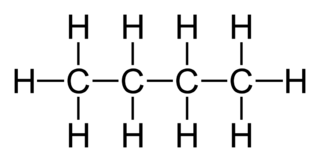
Name this alkane
a)
Methane
b)
Ethane
c)
Propane
d)
Butane
44.
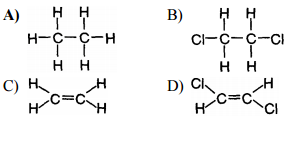
Which formula represents a saturated hydrocarbon?
a)
A
b)
B
c)
C
d)
D
45.
What is a homologous series?
a)
Chemicals which have similar numbers of atoms
b)
Chemicals with same functional group
c)
Chemicals with identical properties
d)
Alkenes
46.
What is the structure that gives a homologous series similar properties?
a)
Functional group
b)
Double bond
c)
C=C bond
d)
Alcohol (-OH)
47.
What chemical is this? (C5H10)
a)
Pentene
b)
Pentane
c)
Hexane
d)
Heptene
48.
What is the formula of ethene?
a)
C2H4
b)
CnH2n
c)
C2H6
d)
CH4
49.

Describe the polymer of DNA? (2 marks)

a)

glycerols

b)

amino acids

c)

fatty acids

d)

nucleotides

e)

Double helix

50.
Proteins are composed of what smaller subunits?
a)
amino acids
b)
nucleic acids
c)
fatty acids
d)
nucleotides
51.
Small molecules that make up larger molecules.
a)
monomer
b)
polymer
c)
synthetic
d)
plastic
52.
Cracking.....
a)
Breaks larger hydrocarbons into smaller hydrocarbons
b)
Separates hydrocarbons based on their length
c)
Detects alkenes
53.

Conditions for cracking is...

a)

High temperature

b)

Low temperature

c)

Catalyst and steam

d)

catalyst or steam

54.

Name the the functional group in this diagram: (click to hide text)

a)

Alcohol

b)

Carboxylic acid

c)

Ester

d)

Alkane

55.

Starch is composed of what smaller monomer?

a)

amino acids

b)

nucleic acids

c)

fatty acids

d)

nucleotides

e)

Glucose

56.

Cellulose is composed of what smaller monomer?

a)

amino acids

b)

nucleic acids

c)

fatty acids

d)

nucleotides

e)

Glucose

57.

name the functional group in this diagram:

a)

Alcohol

b)

ester

c)

carboxylic acid

d)

Alkene

58.

Test for alkenes is

a)

add acid

b)

add water

c)

Add bromine water

d)

burn it

59.

Bromine water with an alkene will

a)

have no change

b)

go clear

c)

go orange to clear

d)

go orange to colourless

e)

fizz

60.

Bromine water with an alkane will....

a)

have no change/stay orange

b)

go clear

c)

go orange to clear

d)

go orange to colourless

e)

fizz

61.

Carboxylic acid with calcium carbonate will ....

a)

Fizz

b)

Go orange to colourless

c)

go cloudy

d)

turn red

62.

pH of a carboxylic acid is around

a)

1

b)

5

c)

7

d)

10

e)

14

63.

pH of a alcohol is

a)

1

b)

5

c)

7

d)

10

e)

14

64.

What are the conditions to turn alkenes in to alkanes (Hydrogenation)

a)

Hydrogen

b)

Nickel catalyst

c)

600C

d)

Steam

e)

Very hot

65.

Carboxylic acids are weak acid compare to strong acids like sulfuric acid because .....

a)

They full ionise

b)

Partially ionise

c)

Have a higher concentration of H+ ions

d)

Have a lower concentration of H+ ions

e)

have a higher pH than strong acids

66.

Butene is made into a polymer. the polymers name would be....

a)

Poly(butane)

b)

Poly(butene)

c)

Poly(pocket)

d)

Poly(putakettleon)

67.

Polymerisation of alkenes is classed as a .....

a)

condensation polymerisation

b)

addition polymerisation

68.

Polymerisation to form poly(esters) is classed as a .....

a)

condensation polymerisation

b)

addition polymerisation

69.

Polymerisation to form poly(amides) are classed as a .....

a)

condensation polymerisation

b)

addition polymerisation

70.

Poly(esters) are formed from .....

a)

carboxylic acids

b)

alcohols

c)

water

d)

dicarboxylic acids

e)

diols

71.

Poly(amides) are formed from .....

a)

carboxylic acids

b)

alcohols

c)

diamine

d)

dicarboxylic acids

e)

diols

72.

What is the charge of CH3O ion in Na(CH3O)

(Na = Sodium, Group 1)

a)

+1

b)

-1

c)

0

d)

+2

e)

-2

73.

What is the name of the monomer used in DNA?

a)

glycerols

b)

amino acids

c)

fatty acids

d)

nucleotides

74.

The fraction at the top of a fractional distillation would have the properties..

a)

High boiling point, low viscosity,

b)

Low boiling point, low flammability

c)

Low boiling point, smaller molecules

d)

High boiling point, high flammablity

75.

Advantages of making ethanol from fermentation are...

a)

Low temperature, less energy needed

b)

Require less people to make the ethanol

c)

Batch process

d)

Has a renewable feedstock

e)

Make pure ethanol

76.

Disadvantages of making ethanol from fermentation are...

a)

Low temperature, less energy needed

b)

Require less people to make the ethanol

c)

Batch process

d)

Has a renewable feedstock

e)

Needs distillation to purify

77.

Disadvantages of making ethanol from hyration of ethene are...

a)

Higher temperatures needed

b)

Require less people to make the ethanol

c)

Continuous process

d)

Has a non-renewable feedstock

e)

Needs distillation to purify

78.

Advantages of making ethanol from hyration of ethene are...

a)

Higher temperatures needed

b)

Require less people to make the ethanol

c)

Continuous process

d)

Has a non-renewable feedstock

e)

Pure ethanol