wayground logo

Free Printable Worksheets

Font size

S
M
L
XL
Worksheets

Chemistry Test #2 Review

Total questions: 80

Worksheet time: 1hrs 20mins

Name
Class
Date
1.

How many d orbitals make up the d subshell?

a)

1

b)

5

c)

3

d)

7

2.

What is the difference in a 1s orbital and a 2s orbital?

a)

The shape of the orbital

b)

The size of the orbital

c)

The number of electrons it can hold

d)

None of the above

3.

When atoms _____________ energy, their electrons move to higher energy levels. These electrons _____________ energy by emitting light when they return to lower energy levels.

a)

lose, absorb

b)

absorb, lose

c)

lose, lose

d)

absorb, absorb

4.

What atom matches this electron configuration?

1s22s22p63s23p64s23d10

a)

Zinc

b)

Copper

c)

Nickel

d)

Germanium

5.

What is the noble gas electron configuration for sulfur?

a)

[Ar] 3p4

b)

[He] 3s23p4

c)

[Ne] 3s23p4

d)

[Na] 3s23p4

6.
How many electrons can the first energy level hold?
a)
1
b)
2
c)
8
d)
0
7.
What is the maximum number of electrons that can be on the p sublevel?
a)
6
b)
3
c)
2
d)
4
8.
How many orbitals are there in the "p" sublevel?
a)
1
b)
3
c)
5
d)
7
9.
The quantum number "n" represents:
a)
electron spin
b)
orbital
c)
sublevel
d)
energy level
10.

Which of the following colors of visible light has the highest frequency?

a)

Blue

b)

Green

c)

Orange

d)

Red

e)

Violet

11.

Which of the following colors of visible light has the lowest frequency?

a)

blue

b)

green

c)

yellow

d)

red

e)

violet

12.
If an electron moves from n=2 to n=4 ...
a)
it absorbs light
b)
it releases light
13.
For an electron to change from ground state to an excited stated it must...
a)
Absorb energy
b)
Release energy
14.

who discovered the first scientific and systematic periodic table

a)

Henry Mosley

b)

Dmitri Mendeleev

c)

John Dalton

d)

sir Isaac Newton

15.

choose the correct statement

a)

the vertical column in the periodic table is called period

b)

the vertical column in the periodic table is called group

c)

the horizontal row in the periodic table is not called period

d)

none of the above

16.

how many groups are there in modern periodic table

a)

8

b)

9

c)

18

d)

17

17.

alkali metals are kept in ........

a)

IIA

b)

IIIA

c)

IA

d)

0

18.

Number of valence electrons in halogens is ..........

a)

1

b)

4

c)

3

d)

7

19.

D block elements are known as .............

a)

Actinides

b)

Transition elements

c)

Lanthanides

d)

Noble gases

20.

In which block, does the element Iron stand?

a)

d block

b)

p block

c)

s block

d)

f block

21.

how many electrons can d orbital accommodate? (keep)

a)

2

b)

6

c)

10

d)

14

22.

Electronic configuration of phosphorus is ........

a)

1s22s22p53s23p4

b)

1s22s22p53s23p3

c)

1s22s22p63s23p3

d)

1s22s22p63s23p4

23.

Which element has following electronic configuration. 1s22s22p63s23p5

a)

Sulphur

b)

Chlorine

c)

Argon

d)

Potassium

24.

choose the metalloid element

a)

Alumunium

b)

Germanium

c)

Silver

d)

Helium

25.

Sulphur is........

a)

Non metal

b)

Metal

c)

Metalloid

d)

Inert gases

26.

What is the name of group number 2?

a)

transition metals

b)

halogens

c)

metaloids

d)

alkaline earth metals

27.

where are the metaloids found

a)

far left, vertical

b)

stair step/diagonal

c)

far right horizontal

d)

at the bottom

28.

What group number are the halogens found?

a)

18 (8A)

b)

1

c)

2

d)

17 (7A)

29.

Periodic law states that the elements are arranged according to their atomic ________ so that elements with similar chemical properties are in the same ________ and properties repeat periodically.

a)

numbers, rows

b)

masses, rows

c)

masses, column

d)

numbers, column

30.

A row on the Periodic Table of Elements

a)

family

b)

period

c)

row

d)

isotope

31.

___________ is a metal that is a liquid at room temperature.

a)

Platinum

b)

Water

c)

Tin

d)

Mercury

32.
__________ would have some characteristics of metals and some characteristics of nonmetals.
a)
Gold
b)
Sodium
c)
Arsenic
d)
Bismuth
33.

Which element is found in group 2, period 6?

a)

Oxygen (O)

b)

Barium (Ba)

c)

Selenium (Se)

d)

Carbon (C)

34.

Which halogen is found in period 4?

a)

Krypton (Kr)

b)

Xenon (Xe)

c)

Bromine (Br)

d)

Iodine (I)

35.

Which element has similar chemical properties as sodium but has 7 energy levels?

a)

Francium (Fr)

b)

Cesium (Cs)

c)

Rubidium (Rb)

d)

Potassium (K)

36.

Elements that have the same number of energy levels are said to be in the same ______.

a)

group

b)

period

c)

family

d)

classification

37.

Name this group: These metals contain familiar metals such as gold, iron, and copper.

a)
b)
c)
d)
38.
How many electrons can the first energy level hold?
a)
1
b)
2
c)
8
d)
0
39.
Which element is pictured?
a)
neon
b)
fluorine
c)
magnesium
d)
argon
40.
What do you start electron configuration with?
a)
1s2
b)
1d10
c)
1f14
d)
1p6
41.
There are 4 different types of subshells s,p,d,f
a)
true
b)
false
42.
Electrons occupy orbitals of lowest energy first is part of what electron configuration rule?
a)
Hund’s Rule
b)
Aufbau Principle
c)
Pauli Exclusion Principle
43.
What does Pauli exclusion principle state ?
a)
states that each electron occupies the lowest energy orbital available
b)
states that a maximum of two electrons can occupy a single atomic orbital, but if only if the electros have opposite spins
c)
states that single electrons electrons with the same spin must occupy each-energy orbital before additional electrons with opposite spins can occupy the same orbitals
44.
What does Hund's rule states ?
a)
states that single electrons electrons with the same spin must occupy each-energy orbital before additional electrons with opposite spins can occupy the same orbitals
b)
states that each electron occupies the lowest energy orbital available
c)
states that a maximum of two electrons can occupy a single atomic orbital, but if only if the electros have opposite spins
45.
If an atom has 12 protons, how many valence electrons will that atom have? 
a)
2
b)
10
c)
8
d)
6
46.
Which atom is it who has 3 energy levels and 4 valence electrons? 
a)
Carbon
b)
Lithium
c)
Silicon
d)
Aluminum
47.
How many energy levels does Hafnium have?
a)
4
b)
72
c)
6
d)
cannot determine
48.
How can you tell how many energy levels an atom has? 
a)
APE MAN
b)
By the Group
c)
By the Period
d)
By the atomic mass
49.
What atom matches this electron configuration?
1s22s22p63s23p64s23d10
a)
Zinc
b)
Copper
c)
Nickel
d)
Germanium
50.
What electron configuration matches an oxygen atom?
a)
1s22s22p63s2, 3p64s23d104p5
b)
1s22s22p4
c)
1s22s22p6
d)
1s22s22p63s23p64s23d1
51.
The electron configuration of an atom is 1s22s22p6.  The number of electrons in the atom is 
a)
3
b)
6
c)
8
d)
10
52.
Which electron configuration belongs to Chlorine (Cl)?
a)
1s2s2p3s3p5
b)
1s2s2p3s3p6
c)
1s2s2p3s3p7
53.

Choose the correct shortcut configuration for iodine.

a)

[Ar]4s24d104p5

b)

[Kr]5s24d105p5

c)

[Xe]5s25d105p5

d)

none of the above

54.

Which of the following is not a correct designation for a sublevel?

a)

zz

b)

p

c)

d

d)

f

55.
Which element is depicted from this orbital diagram
a)
Fluorine
b)
Neon
c)
Chlorine
d)
Argon
56.

What is incorrect about this orbital diagram?

a)

Both arrows in the 2p box should be pointing up

b)

There is nothing incorrect with this diagram

c)

There should only be 1 arrow in the first 2p box and one in the second 2p box

d)

All the arrows should be pointing up.

57.

What is incorrect about this orbital diagram?

a)

Only the arrows in the 2p box should be pointing up

b)

There is nothing incorrect with this diagram

c)

All the arrows should be pointing down

d)

The arrows should rotate up down, up down

58.

True or False: The ground state is the highest energy state of an atom.

a)

True

b)

False

59.

What is the light that you can see called?

a)

observatory light

b)

ultraviolet light

c)

visible light

d)

infrared light

60.
For an electron to change from ground state to an excited stated it must...
a)
Absorb energy
b)
Release energy
61.
Line emission spectrum shown below happens when
a)
Electron transition from lower to higher energy level.
b)
Electron transition from higher to lower energy level.
c)
Electron exist in fixed energy states
d)
Electron transition between different energy levels.
62.
Emission of light from an atom occurs when an electron
a)
drops from a higher to a lower energy level.
b)
   jumps from a lower to a higher energy level.   
c)
   moves within its atomic orbital.
d)
falls into the nucleus.
63.
Why are line emission spectra of elements called "atomic fingerprints"?
a)
They are all the same
b)
They are all unique
c)
They are all similar
d)
They all contain colored light
64.
The parallel lines represents...
a)
energy levels of the atom
b)
energy levels of the electrons
c)
energy levels of the photons
d)
energy levels of the nucleus
65.

If an electron moves from n=4 to n=2 it ____

a)

absorbs energy

b)

releases energy

66.
A wave with a large wavelength will have a ______ frequency and _____ energy
a)
high, low
b)
high, high
c)
low, high
d)
low, low
67.
Select the correct order of waves on the EMS 
a)
Radio, Micro, Infra, Visible, Ultra, X-ray, Gamma
b)
Gamma, X-ray, Ultra, Vis, Infra, Micro, Radio
c)
Vis, Micro, Infra, Ultra, X-ray, Gamma, Radio
d)
Micro, Radio, Vis, Infra, Ultra, X-ray, Gamma
68.
Which has the LONGEST wavelength and, therefore, the lowest frequency/energy
a)
Gamma Rays
b)
Radio Waves
c)
Visible Light
d)
Infrared rays
69.
Which has the SHORTEST wavelength and, therefore, the highest frequency/most energy
a)
Radio waves
b)
Ultraviolet Rays
c)
Gamma Rays
d)
X-rays
70.
Which section of the spectrum is the ONLY one we can see?
a)
X-rays
b)
Visible Light
c)
Gamma Rays
d)
Ultraviolet Rays
71.
As the frequency of an electromagnetic wave increases, the amount of energy in that wave...
a)
increases.
b)
decreases.
c)
stays the same.
72.
The blue section of the wave is measuring _________________.
a)
wavelength
b)
crest
c)
trough
d)
amplitude 
73.
Light behaves like both a particle and a ______.
a)
Mass
b)
Wave
c)
Current
74.
What happens to the energy of a photon as the frequency of the wave increases? 
a)
The energy increases
b)
The energy decreases
c)
The energy stays the same 
75.

If short wavelength has more ENERGY than long wavelength, which color Lightsaber is the most dangerous, or powerful?

a)

Red

b)

Orange

c)

Blue

d)

Green

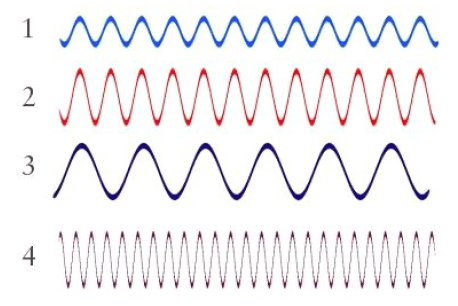
76.
Which wave in the diagram has the greatest wavelength?
a)
1
b)
2
c)
3
d)
4
77.

The color with the longest wavelength is...

a)

Blue

b)

Red

c)

Green

d)

Yellow

78.

If short wavelength has more ENERGY than long wavelength, which color Lightsaber is the least dangerous, or powerful?

a)

Red

b)

Orange

c)

Blue

d)

Green

79.

When an electron moves from n=4 to n=1, what wavelength of energy is emitted?

a)

97 nm

b)

410 nm

c)

434 nm

d)

1282 nm

80.

The line with the shortest wavelength is produced in the hydrogen spectrum when electron moves

a)

from n=2 to n=1

b)

rom n=4 to n=1

c)

from n=3 to n=1

d)

from n=4 to n=3