
 Worksheets
Periodic table groups
Total questions: 75
Worksheet time: 43mins

Name group 1A/1 on the periodic table.
alkali metals
alkaline earth metals
noble gases
noble gases
halogens

Name group 2A/2 on the periodic table.
alkali metals
alkaline earth metals
noble gases
transition metals

Name group 8A/18 on the periodic table.
alkali metals
alkaline earth metals
transition metals
noble gases

Name groups 3B - 12B (3-12) on the periodic table.
noble gases
halogens
metalloids
transition metals

Name group 7A/17 on the periodic table.
transition metals
metalloids
halogens
alkali metals



Group 1/1A
Group 17/7A
Group 2/2A
Group 18/8A
Which of the following are physical properties of metal? Choose all that apply.
Luster
Conductivity
Malleability
Ductility
True or False: The reactivity of metals tends to decrease as you move from left to right across the periodic table.
True
False
Name this group: These metals are the most reactive.


Name this group: These metals are the second most reactive.


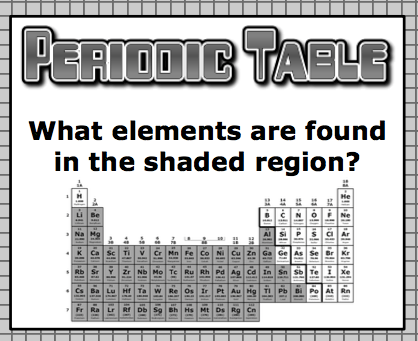
Find these groups: Locate Lanthanides and Actinides. Choose all that apply.


True or False: Synthetic elements are not made by forcing nuclear particles to crash into one another.
True
False
Which of the following could be properties of nonmetals? Choose all that apply.
Poor electrical conductivity
Poor thermal conductivity
Dullness
Brittleness
Name this family: This family contains an element known for its role in the chemistry of life.
Nitrogen family
Carbon family
Halogen family
Noble gases
Find this family: This family contains nitrogen and phosphorus.


Name this group: These elements, also known as inert gases, tend to be nonreactive.
Halogen family
Noble gases
Carbon family
Nitrogen family
True or False: The most useful property of the semimetals is their varying ability to conduct electric currents.
True
False
What do the vertical columns on the periodic table tell us?
The number of orbitals
The number of valence electrons (electrons on the outer most shell)
What does the number of proton tell us if the atom is neutral? Choose all that apply.
electrons
atomic number
atomic mass
neutrons

What is the name of the element? (Periodic table will be needed)
sodium
magnesium
vanadium

What group and period does this element belong in? *
period 1 and group 3
period 3 and group 1
period 2 and group 3
period 3 and group 2

How many valence electrons does the element have?
1
2
3
4

How many protons and electrons does nickel have?
28
58.69

How many orbitals does Nickel have?
3
4
5
10

What is the atomic mass?
58.693
28
This element has two valence electrons and two energy levels?
Beryllium (Be)
Lithium (Li)
Zinc (Zn)
How many valence electrons and energy levels does (Pb) lead have?
4 valence electrons and 6 energy levels (orbitals)
6 valence electrons and 4 energy levels (orbitals)
5 valence electrons and 5 energy levels (orbitals)
5 valence electrons and 10 energy levels (orbitals)


What element will have the most similar physical and chemical properties to the element Sulfur (S)?
Carbon (C)
Phosphorous (P)
Oxygen (O)
Neon (Ne

What element will have the most similar physical and chemical properties to the element Lithium (Li)?
Sodium (Na)
Magnesium (Mg)
Beryllium (Be)
Calcium (Ca)

What element will have the most similar physical and chemical properties to the element Bromine (Br)?
Fluorine (F)
Carbon (C)
Krypton (Kr)
Selenium (Se)

What element will have the most similar physical and chemical properties to the element Nitrogen (N)?
Phosphorous (P)
Carbon (C)
Oxygen (O)
Sulfur (S)
These elements are really bad at conducting heat/electricity.
Non-metals
Transition Metals
Metals
Metalloids
These are normally gases at room temperature.
Metals
Alkali Metals
Non-metals
Transition Metals
These are normally solid at room temperature.
Metals
Halogens
Noble Gases
Non-metals
An element is silver, solid at room temperature, and very reactive. Which group is it most likely to be from?
Alkaline Earth Metals
Transition Metals
Halogens
Noble Gases
If you were told an element was a colorless, odorless, unreactive gas, which group could you assume it belonged to?
Alkali metals
Chalcogens
Halogens
Noble Gases


What is this element?
Beryllium (atomic #4)
Boron (atomic #5)
Carbon (atomic #6)
Nitrogen (atomic #7)

How many valence electrons?
2
4
6
8


What is the mass number of this atom of Chlorine?
17
18
35
35.453

Which element does this Bohr model represent?
Aluminum
Silicon
Magnesium
Cobalt
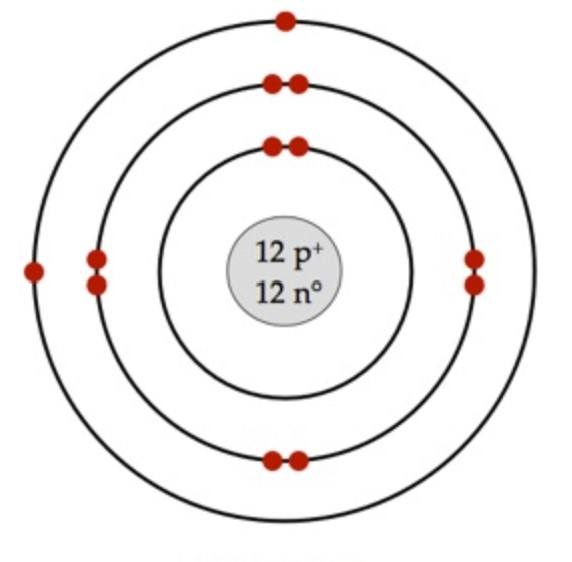
What element does this Bohr model represent?
Chromium
Magnesium
Carbon
Krypton
Anions
Gain electrons, has an overall positive charge
Lose electrons, has an overall positive charge
Lose electrons, has an overall negative charge
Gain electrons, has an overall negative charge
Cations
Gain electrons, has an overall positive charge
Lose electrons, has an overall positive charge
Lose electrons, has an overall negative charge
Gain electrons, has an overall negative charge
A Beryllium atom that has lost 2 electrons would look like
Be2+
B2-
B2+
Be2-
The cation Rb+ has
Had nothing happen to it
Gained 1 electron
Lost 1 electron
Become negative
An atom is ______________ where the protons equal the electrons.
charged
neutral
An ION is ____________ where the electrons DO NOT equal the protons.
charged
neutral

This group usually has a +1 charge in order to get to an octet. They lose one electron.
Group 1
Group 2
Group 3
Group 17
This group usually has a +2 charge because they lose two electrons to get to an octet.
Group 1
Group 2
Group 3
Group 16
Group 17
This group usually has a -1 charge as they gain one electron to get to the octet.
Group 1
Group 2
Group 3
Group 17
Group 16
This group usually has a -2 charge as it gains 2 electrons to get to an octet.
Group 1
Group 2
Group 3
Group 16
Group 17

