
 Worksheets
AP Chemistry Unit 3 Mega Revu
Total questions: 71
Worksheet time: 2hrs 29mins
According to kinetic molecular theory, in which of the following gases will the root mean square speed of the molecules be the highest at 200ºC?
SF6
H2O
HCl
Cl2
None, the molecules of all gases have the same root mean square speed at any given temperature.
A sample of a gas (5.0 mol) at 1.0 atm is expanded at constant temperature from 10.0 L to 15.0 L. The final pressure is ___ atm.
1.5 atm
15 atm
0.67 atm
3.3 atm
7.5 atm
A sample of He gas (2.35 mol) occupies 57.9 L at 300.0 K and 1.00 atm. The volume of this sample is ___L at 423 K and 1.00 atm.
0.709 L
57.9 L
41.1 L
81.6 L
1.41 L
The volume of a sample of gas (2.49 g) is 752 mL at 1.98 atm and 62ºC. What is the gas?
NO2
SO3
SO2
Ne
NH3
Gases generally have
low density
high density
closely packed particles
no increase in volume when temperature is increased
no decrease in volume when pressure is increased
What is the pressure in a container that has 3 atm H2, 2 atm of N2 and 5 atm of F2?
2 atm
3 atm
5 atm
10 atm
How are pressure and temperature related?
Directly
Indirectly
They aren't related
At 333 K, which of the pairs of gases below would have the most nearly identical rates of effusion?
CO and CO2
CO and N2
NO2 and N2O4
N2O and NO2
N2 and O2
Which substance would have the weakest intermolecular forces of attraction?
CH4
NaCl
H2O
MgF2
Which substance has the weakest intermolecular forces?
Substance A, boiling point of 75 °C
Substance B, boiling point of 105 °C
Substance C, boiling point of 25 °C
Substance d, boiling point of 45 °C
The shape of a liquid's meniscus is determined by ____.
the viscosity of the liquid
the type of material the container is made of
the relative magnitudes of cohesive forces in the liquid and adhesive forces between the liquid and its container
the amount of hydrogen bonding in the liquid
Which type of solid typically has the lowest melting point of the four types of crystals?
Ionic
Molecular
Metallic
Covalent Network
Chromatography separates solutions on the basis of _____ while distillation separates solutions on the basis of ______.
IMFs; solubility
solubility; conductivity
IMFs; boiling point
boiling point; solubility
A dissolved solute that does not form ions is
a nonelectroyte
a weak electrolyte
a strong electrolyte
insoluble
Which does not affect the rate at which a solid solute dissolves?
the vapor pressure of the solvent
the temperature of the solvent
the surface area of the solid
the speed at which the solution is stirred
Which of the following occurs as temperature increases?
solubility decreases
solubility increases
solubility remains the same
molarity doubles
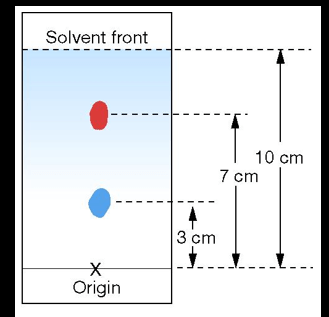
the yellow is more strongly adsorbed onto the stationary phase and is less soluble in the mobile phase.
the blue is more strongly adsorbed onto the stationary phase and is less soluble in the mobile phase.
the blue is more strongly adsorbed onto the stationary phase and is less soluble in the mobile phase.
Which of the following will be the least soluble in water?
CH3CH2CH2OH
CH3OH
CH3CH2OH
None of them are soluble in water.
They are all equally soluble in water.
How can you increase the solubility of a gas in a liquid?
Decrease the IMFs between the gas the and the liquid.
Increase the temperature of the solution.
Increase the pressure of the solution.
All of these would work.
In general, how could you increase the solubility of a solid in a liquid?
Increase the pressure.
Decrease the pressure.
Increase the temperature.
Decrease the temperature.


Which type of spectrum is this?
Emission Spectrum
Absorption Spectrum
Continuous Spectrum
A photon is a (a) of light
If the frequency of electromagnetic radiation is high, then the wavelength will be (a)

How many valence electrons does the element pictured in the PES spectrum below have?
1
2
3
4

Which peak (or peaks) correspond to the valence electrons?
The peak at 1
The peaks at 1 and 2.05
The peak at 239
The peaks at 239 and 22.7

The PES spectrum below is for the element _______________.
O
Ne
N
F
How many peaks would be expected for a PES spectum for Calcium?
2
3
4
5

Particle Z will experience the most attractive force when touching which particle? Think about Coulomb's Law and the fact that it depends on charge and distance
Particle A
Particle B
Particle C
Particle D
covalent bond
London forces
hydrogen bond
dipole-dipole attraction
Samples of F2 gas and Xe gas are mixed in a container of fixed volume. The initial partial pressure of the F2 gas is 8.0 atmospheres and that of the Xe gas is 1.7 atmospheres. When all of the Xe gas reacted, forming a solid compound, the pressure of the unreacted F2 gas was 4.6 atmospheres. The temperature remained constant. What is the formula of the compound?
XeF
XeF3
XeF4
XeF6
1. Under which conditions does a real gas behave very much like an ideal gas?
high temperature and low pressure
high temperature and high pressure
low temperature and high pressure
low temperature and low pressure

Molecules that absorb infrared radiation undergo…
bond vibrational movement.
rotational movement.
electron energy promotion (electron excitement).
Molecules that absorb microwaves undergo …
rotational movement.
electron energy promotion.
bond vibrational movement.
Molecules that absorb UV radiation ....
experience rotation or spin.
experience electron promotion (electron excitement).
experience bond vibration.

The diagrams above show the ultraviolet absorption spectra for two compounds. Diagram 1 is the absorption spectrum of pure acetone, a solvent used when preparing solutions for an experiment. Diagram 2 is the absorption spectrum of the solute for which the absorbance needs to be measured to determine its concentration. When the student reads the absorbance of the solution at 280 nm, the result is too high. Which of the following is most likely responsible for the error in the measured absorbance?
The student added too little solute to the acetone before measuring its absorbance
The student rinsed the cuvette with the solution before filling the cuvette with the solution
The student forgot to calibrate the spectrophotometer first by using a cuvette containing only acetone
The wavelength setting was accidentally changed from 280 nm to 300 nm before the student made the measurement
Infrared spectroscopy is a useful tool for scientists who want to investigate the structure of certain molecules. Which of the following best explains what can occur as the result of a molecule absorbing a photon of infrared radiation?
The energies of infrared photons are in the same range as the energies associated with changes between different electronic energy states in atoms and molecules. Molecules can absorb infrared photons of characteristic wavelengths, thus revealing the energies of electronic transitions within the molecules.
The energies of infrared photons are in the same range as the energies associated with different vibrational states of chemical bonds. Molecules can absorb infrared photons of characteristic wavelengths, thus revealing the types and strengths of different bonds in the molecules.
The energies of infrared photons are in the same range as the energies associated with different rotational states of molecules. Molecules can absorb infrared photons of characteristic wavelengths, thus revealing the energies of transition between different rotational energy states of the molecules.
The energies of infrared photons are in the same range as the total bond energies of bonds within molecules. Chemical bonds can be completely broken as they absorb infrared photons of characteristic wavelengths, thus revealing the energies of the bonds within the molecules.
Which statement correctly compares what occurs when molecules absorb photons in the microwave region with what occurs when molecules absorb photons in the infrared region?
Microwave photons cause the molecules to increase their rotational energy states, whereas infrared photons cause the molecules to increase their vibrational energy states.
Microwave photons cause electrons in the molecules to increase their electronic energy states, whereas infrared photons cause the molecules to increase their rotational energy states.
Microwave photons cause the molecules to increase their vibrational energy states, whereas infrared photons cause electrons in the molecules to increase their electronic energy states.
Microwave photons cause the molecules to increase their rotational energy states, whereas infrared photons cause electrons in the molecules to increase their electronic energy states.

Beta-carotene is an organic compound with an orange color. The diagram above shows the ultraviolet spectrum of beta-carotene. Which of the following statements is true about the absorption bands in the spectrum?
The absorption band between 250 and 320 nm is due to transitions in electronic energy levels, and the absorption band between 380 and 520 nm is due to transitions in molecular vibrational levels.
The absorption band between 250 and 320 nm is due to transitions in molecular vibrational levels, and the absorption band between 380 and 520 nm is due to transitions in molecular rotational levels.
The two main absorption bands are associated with transitions in electronic energy levels. The band in the region corresponding to shorter wavelengths shows a lower absorbance than the band in the region corresponding to longer wavelengths.
The two main absorption bands are associated with transitions in molecular vibrational levels. The band in the region corresponding to shorter wavelengths shows a lower absorbance than the band in the region corresponding to longer wavelengths.

The diagram above represents the photoelectric effect for a metal. When the metal surface is exposed to light with increasing frequency and energy of photons, electrons first begin to be ejected from the metal when the energy of the photons is 3.3×10⁻¹⁹ J.
Which of the following is closest to the frequency of the light with photon energy of 3.3×10⁻¹⁹ J ?
5.0x10−53 s−1
5.0x10⁻¹⁶ s−1
5.0x10¹⁴ s−1
5.0x1052 s−1

A beam of light has a frequency of 4.615E14 s-1. What is the color of this light?
orange
blue
green
purple
yellow
A student uses visible spectrophotometry to determine the concentration of CoCl2 (aq) in a sample solution. First the student prepares a set of CoCl2 (aq) solutions of known concentration. Then the student uses a spectrophotometer to determine the absorbance of each of the standard solutions at a wavelength of 510 nm and constructs a standard curve. Finally, the student determines the absorbance of the sample of unknown concentration.
A wavelength of 510 nm corresponds to an approximate frequency of 6×10¹⁴s−1. What is the approximate energy of one photon of this light?
9x1047 J
3x10¹⁷ J
5x10⁻⁷ J
4x10⁻¹⁹ J

The diagram above represents the photoelectric effect for a metal. When the metal surface is exposed to light with increasing frequency and energy of photons, electrons first begin to be ejected from the metal when the energy of the photons is 3.3×10⁻¹⁹ J
Using the wavelength information provided above, what is the color of the light?
RED
(647-760 nm)
ORANGE
(585-647 nm)
YELLOW
(575-585 nm )
BLUE
(424-491 nm)

A student prepared four solutions of known [Cu2+] and measured the absorbance of each solution using the same cuvette. The graph shows the data for two absorbance measurements done for each solution. Which of the following identifies the most likely error that affected the absorbance recorded for the solution with [Cu2+]≈7×10⁻³M in the second trial?
The cuvette was rinsed with water between measurements.
A fingerprint was left on the side of the cuvette facing the detector.
The absorbance was measured at a wavelength where Cu2+ has a lower molar absorptivity.
The cuvette was not filled with the same volume of solution.

A student uses visible spectrophotometry to determine the concentration of CoCl2(aq) in a sample solution. First the student prepares a set of CoCl2(aq) solutions of known concentration. Then the student uses a spectrophotometer to determine the absorbance of each of the standard solutions at a wavelength of 510 nm and constructs a standard curve. Finally, the student determines the absorbance of the sample of unknown concentration.
The student made the standard curve above. Which of the following most likely caused the error in the point the student plotted at 0.050 M Co2+ (aq) ?
There was distilled water in the cuvette when the student put the standard solution in it.
There was a few drops of 0.100M Co2+ (aq) standard solution in the cuvette when the student put the 0.050 M standard solution
The student used a cuvette with a longer path length than the cuvette used for the other standard solutions.
The student did not run a blank between the 0.050 M Co2+ (aq) solution and the one before it.

Using a spectrophotometer, a student measures the absorbance of four solutions of CuSO4 at a given wavelength. The collected data is given in the table above. Which of the following is the most likely explanation for the discrepant data in trial 4 ?
The solution was at a lower temperature than the solutions in the other trials
the measurement was made using a different spectrophotometer that uses a cell with a longer path length
the solution was saturated and the flow of light through the solution was restricted
the concentration of the solution was actually lower than 0.150M.

Cu(s) + 4 HNO3(aq) → Cu(NO3)2(aq) + 2 NO2(g) + 2 H2O(l)
Each student in a class placed a 2.00 g sample of a mixture of Cu and Al in a beaker and placed the beaker in a fume hood. The students slowly poured 15.0 mL of 15.8 M HNO3(aq) into their beakers. The reaction between the copper in the mixture and the HNO3(aq) is represented by the equation above. The students observed that a brown gas was released from the beakers and that the solutions turned blue, indicating the formation of Cu2+(aq). The solutions were then diluted with distilled water to known volumes.
To determine the number of moles of Cu in the sample of the mixture, the students measured the absorbance of known concentrations of Cu(NO3)2(aq) using a spectrophotometer. A cuvette filled with some of the solution produced from the sample of the mixture was also tested. The data recorded by one student are shown in the table above. On the basis of the data provided, which of the following is a possible error that the student made?
The Cu(NO3)2(aq) from the sample of the mixture was not diluted properly.
The spectrophotometer was calibrated with tap water instead of distilled water.
The student labeled the cuvettes incorrectly, reversing the labels on two of the solutions of known concentration.
The spectrophotometer was originally set to an inappropriate wavelength, causing the absorbance to vary unpredictably.
N2 molecules absorb ultraviolet light but not visible light. I2 molecules absorb both visible and ultraviolet light. Which of the following statements explains the observations?
More energy is required to make N2 molecules vibrate than is required to make I2 molecules vibrate.
More energy is required to remove an electron from an I2 molecule than is required to remove an electron from a N2 molecule.
Visible light does not produce transitions between electronic energy levels in the N2 molecule but does produce transitions in the I2 molecule.
The molecular mass of I2 is greater than the molecular mass of N2.

Arrange the following in order of increasing frequency:
radio waves
microwaves
yellow
purple
UV

Based on the spectrum, the ground state electron configuration is
(a)

What element does this PES spectrum represent?
(a)

Given the photoelectron spectra above for phosphorus, P, and sulfur, S, which of the following best explains why the 2p peak for S is further to the left than the 2p peak for P, but the 3p peak for S is further to the right than the 3p peak for P?
S has a greater effective nuclear charge than P, and the 3p sublevel in S has greater electron repulsions than in P.
S has a greater effective nuclear charge than P, and the 3p sublevel is more heavily shielded in S than in P.
S has a greater number of electrons than P, so the third energy level is further from the nucleus in S than in P.
S has a greater number of electrons than P, so the Coulombic attraction between the electron cloud and the nucleus is greater in S than in P.

