wayground logo

Free Printable Worksheets

Font size

S
M
L
XL
Worksheets

Atomic Theory/Structure

Total questions: 70

Worksheet time: 1hrs 10mins

Name
Class
Date
1.

JJ Thomson discovered what subatomic particle

a)

nucleus

b)

neutron

c)

proton

d)

electron

2.

Rutherford discovered what part of the atom

a)

nucleus

b)

neutron

c)

proton

d)

electron

3.

Who proposed the theory that atoms orbit the nucleus in specific orbits.

a)

Bohr

b)

Democritus

c)

Rutherford

d)

Chadwick

4.

These particles are found in the nucleus

a)

protons and electrons

b)

nucleus and neutrons

c)

protons and neutrons

d)

electrons and neutrons

5.

Thomson Experimented with ______

a)

Gold Foil

b)

alpha particles

c)

cathode rays

d)

protons

6.

Rutherford experimented with ____

a)

Gold foil and alpha particles

b)

Cathode rays and alpha particles

c)

electron and alpha particles

d)

gold foil and cathode rays

7.

Which Scientist created this model

a)

Democritus

b)

Chadwick

c)

Bohr

d)

Rutherford

8.
Which scientist developed the atomic theory?
a)
JJ Thomson
b)
Ernest Rutherford
c)
John Dalton
d)
James Chadwick
9.

Subatomic particles with a negative charge

a)

Electrons

b)

Neutrons

c)

Protons

d)

Quarks

10.
Subatomic particles with a positive charge
a)
neutrons
b)
atomic mass
c)
protons
d)
isotopes
11.
Subatomic particles that are neutral in charge
a)
Neutrons
b)
Protons
c)
Nucleus 
d)
Electrons
12.

John Dalton stated:

a)

Atoms are tiny, invisible particles.

b)

Atoms of one element are all the same.

c)

Atoms of different elements are different.

d)

Compounds form by combining atoms.

e)

All of the statements listed.

13.
The nucleus of an atom can be described as:
a)
spacious and negatively charged
b)
dense and positively charged
c)
spacious and positively charged
d)
dense and negatively charged
14.
Electrons are not factored into atomic mass because:
a)
They are so small their mass is negligible
b)
They're not in the nucleus
c)
They're too big
d)
They move so quickly their mass is zero
15.
True or False: The majority of an atom is made up of empty space
a)
True
b)
False
16.
Atoms are made up of three basic parts, which are -
a)
Protons, neutrons, electrons
b)
neutrinos, protons, neutrons
c)
quarks, protons, electrons
d)
electrons, neutrons, and quarks
17.
What scientist is best known for his "Plum Pudding" model of the atom?
a)
J.J. Tomson
b)
Ernest Rutherford
c)
John Dalton
d)
Democritus
18.
Place the following scientists in order, from earliest to latest: 
A) Ernest Rutherford
B) J.J. Thomson
C) John Dalton
a)
B,C,A
b)
C,A,B
c)
A,C,B
d)
C,B,A
19.

What is the atomic number?

a)

the number of protons in the nucleus

b)

the number of protons and neutrons in the nucleus

c)

the number of neutrons in the nucleus

d)

the number of protons in the energy levels

20.

What is the mass number?

a)

the number of protons in the nucleus

b)

the number of protons and neutrons in the nucleus

c)

the number of neutrons in the nucleus

d)

the number of protons and electrons in the atom
21.

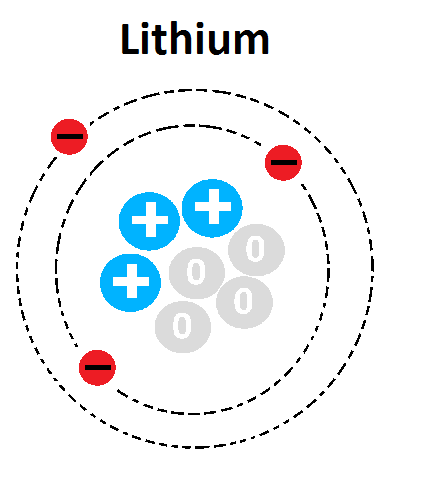
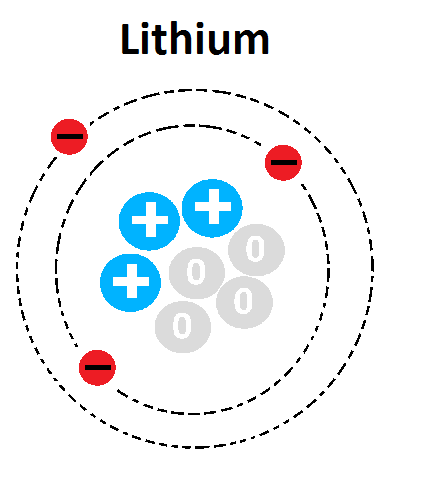
What is the atomic number of this atom?

a)

1

b)

3

c)

4

d)

7

22.

What is the mass number of this atom?

a)

1

b)

3

c)

4

d)

7

23.
In order for an atom to be neutral what has to be true?
a)
The atom has more protons than neutrons
b)
The atom has more neutrons than protons
c)
The atom has the same number of protons and neutrons
d)
The atom has the same number of protons and electrons
24.
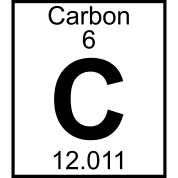
What does the C represent?
a)
atomic mass
b)
atomic number
c)
element name
d)
chemical symbol 
25.

What does the 6 represent?

a)

Atomic mass

b)

atomic number

c)

chemical symbol

d)

element name

26.
How is the number of neutrons in the nucleus of an atom calculated?
a)
Add the number of e- and p+ together
b)
Subtract the number of e- from p+
c)
Subtract the number of p+ from the mass number
d)
Add the mass number to the number of e-
27.
If an atom has 12 positively charged subatomic particles, which of the following must it also have to be considered a neutral atom?
a)
12 neutrons
b)
12 electrons
c)
12 protons
d)
24 protons and neutrons
28.

An atom has 10 protons, 15 neutrons and 10 electrons what is its mass number.

a)

20

b)

10

c)

35

d)

25

29.

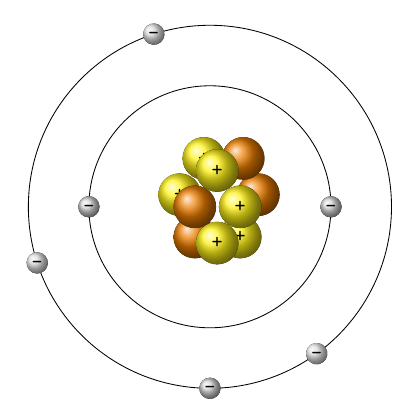
How many electrons does this atom have?

a)

2

b)

4

c)

6

d)

10

30.
The atomic number of an element that has 9 protons, 9 electrons, and 10 neutrons is _____.
a)
9
b)
10
c)
19
d)
28
31.
An element with a mass number of 11 and an atomic number of 5 has how many neutrons?
a)
11
b)
5
c)
6
d)
16
32.
An atom has an atomic number of 15 and a mass number of 31. How many protons are there in the atom?
a)
15
b)
31
c)
16
d)
47
33.
What is the atomic number of the atom pictured? 
a)
9
b)
10
c)
18
d)
19
34.

Which of the following determines the identity of an element?

a)

number of protons

b)

atomic mass

c)

number of neutrons

d)

number of shells

35.

Look at this picture of Argon off the periodic table. Which of the following is true for this element?

a)

18 protons

b)

40 protons

c)

22 protons

d)

21.9 protons

36.
What is an ion?
a)
A Charged Atom
b)
A Large Atom
c)
A Small Atom
d)
A Cute Atom
37.
An atom becomes _________ when it gains electrons.
a)
Positive
b)
Negative
c)
Neutral
d)
Invinsible
38.
Elements on the LEFT side of the periodic table will most likely form:
a)
Positive ions
b)
Negative ions
c)
Neutral Ions
d)
None of these
39.
Cations are...
a)
Positive
b)
Negative
c)
Neutral
d)
Purring
40.
Anions are...
a)
Positive
b)
Negative
c)
Neutral
d)
Crying
41.
An atom becomes _______ when it loses electrons.
a)
Positive
b)
Negative
c)
Neutral
d)
Invinsible
42.
What is the charge of an atom that has lost one electron?
a)
-1
b)
-2
c)
+1
d)
+2
43.
How many total electrons does O-2 (an oxide ion) have?
a)
8
b)
10
c)
6
d)
18
44.
How many total electrons does Na+1 (a sodium ion) have?
a)
10
b)
11
c)
12
d)
22
45.
If a sulfur atom has 16 protons, 16 electrons, and 16 neutrons, its atomic mass is:
a)
16
b)
32
c)
48
d)
64
46.
What do carbon-12 and carbon-14 have in common?
a)
they have same number of protons
b)
they have the same number of neutrons
c)
they have the same atomic mass
d)
they have the same atomic weight
47.
How is carbon-12 different from carbon-14?
a)
They have a different number of protons
b)
they have a different number of electrons
c)
they have a different number of neutrons
d)
they are different elements
48.
How many neutrons does the isotope of lithium have?
a)
8
b)
3
c)
4
d)
5
49.
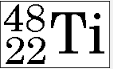
How many protons does this isotope of titanium have?
a)
48
b)
22
c)
26
d)
70
50.
In a correctly written symbol what would be located in the "A" position?
a)
number of neutrons
b)
atomic number
c)
number of electrons 
d)
mass number
51.
which atom has  4 neutrons?
a)
Li-6
b)
Li-7
c)
Li-8
d)
they have the same # of neutrons
52.
If X is the symbol for an element, which of the following two symbols represent    isotopes of the same element?     I. 7735X  II. 7733X  III. 8137X  IV. 8135 X
a)
I and II
b)
III and IV
c)
I and IV
d)
I and III
53.
Four isotopes of lead include lead-204, lead-206, lead-207, and lead-208.  The average atomic mass of lead is 207.2.  Which isotope of lead is likely to be the most abundant.
a)
204
b)
206
c)
207
d)
208
54.

Bromine-80 has how many neutrons?

a)

41

b)

42

c)

44

d)

45

55.
How many electrons can the first energy level hold?
a)
1
b)
2
c)
8
d)
0
56.
How many valence electrons does Chlorine have?
a)
5
b)
2
c)
7
d)
5
57.
What is the electron configuration of sodium?
a)
2.8
b)
2.8.2
c)
2.8.1
d)
11
58.
Which element has the electron configuration of 2.8.4?
a)
Neon
b)
Boron
c)
Gallium
d)
Silicon
59.

Valence electrons are located...

a)

inside the nucleus

b)

in outer space

c)

on the outermost energy level in an atom

d)

on the energy level closest to the nucleus.

60.
The energy of an electron __________ as it moves further away from the nucleus
a)
increases
b)
decreases
61.

Light is emitted when electrons

a)

move from one atom to another.

b)

collide with one another, releasing energy.

c)

move from a lower energy level to a higher energy level.

d)

move from a higher energy level to a lower energy level.

62.

In order to go from ground state to an excited state, an electron must

a)

emit energy

b)

absorb energy

c)

rotate

d)

wiggle

63.

When an electron returns to ground state from an excited state, the atom will

a)

emit energy

b)

absorb energy

c)

rotate

d)

wiggle

64.

Lewis Dot Structures provide information about an atom. It tells us...

a)

how many valence electrons it has

b)

how many total electrons it has

c)

how many protons it has

d)

the size of the atom

65.

Which of the following shows an excited state electron configuration?

a)

2-7-1

b)

2-4

c)

2-8-4

d)

2-8-1

66.

Which elements are present in the mixture?

SELECT ALL THAT APPLY

a)

Lithium

b)

Cadmium

c)

Strontium

d)

None

67.

What element is in the unknown?

a)

He

b)

O2

c)

Ne

d)

Ar

e)

Xe

68.

This could be the dot diagram of

a)

Mg

b)

Cl

c)

C

d)

O

69.

How would you draw a Lewis dot diagram for Magnesium?

a)
b)
c)
d)
70.
What is the name of this element?
a)
Lithium
b)
Boron
c)
Carbon
d)
Neon