
 Worksheets
Woleslagle - Honors Kinetics
Total questions: 70
Worksheet time: 3hrs 31mins
When you increase the temperature of a reaction, it increases the molecules __________
potential energy
kinetic energy
number of collisions
kinetic energy AND number of collisions
If activation energy is low, it is _____________ for a reaction to start.
easy
difficult
neither
The activated complex is also called the _________.
reaction rate
reaction mechanism
transition state
reaction order
What is the minimum amount of energy required to form the activated complex?
collision theory
rate constant
activation energy
catalyst
The ____________ states that atoms, ions, or molecules must collide in order to react.
transition state
activation energy
rate law
collision theory
The main reason an increase in temperature results in an increase of the reaction rate is that
the potential energy of the particles increases
the duration of the collisions between particles increases
the force of attraction between particles increases
the number of particles with the required activation energy increases
A catalyst which is in a different physical state from the reaction it catalyzes is a ___________ catalyst.
heterogeneous
homogeneous
inhibitor
transition
Yeast will decompose hydrogen peroxide because it contains enzymes that are
inhibitors
catalysts
transition state
emulsifier
A chemical applied to fruit to stop it from rotting is an example of a(n)
inhibitor
catalyst
transition state
emulsifier
5g of caffeine powder will take effect more quickly than a 5g caffeine pill because it has more __________.
concentration
potential energy
kinetic energy
surface area
What do you need to calculate the rate of a chemical reaction?
The change in enthalpy over time for the reaction
the time it takes for the reaction to go halfway to completion
the change in concentration of either the product or the reactant over time
the change in temperature for the reaction over time
How are the exponents n and m determined?


What is the rate law for this reaction?
rate = [A][B]
rate = k[A]2[B]2
rate = k[A]2[B]
rate = k[A][B]2

Ln[A]t - Ln[A]0 = -kt
1/[A]t - 1/[A]0 = kt

Which statement best explains why a 10°C increase in temperature can result in a substantial increase in reaction rate?
The collision geometry is more favorable at high temperatures.
The molecules are moving faster.
There are more frequent collisions.
The number of molecules that have the necessary activation energy increases.
The study of altering reaction rates by changing mechanisms and energy pathways is called
thermodynamics
catalysis
materials studies
kinetics
As the reaction proceeds at constant temperature, the rate of the reaction
remains the same unless a catalyst is added
remains the same because the temperature is constant
decreases because the concentration of reactant molecules decreases
decreases because the effectiveness of collisions between reactant molecules decreases
All of the following apply to the reaction
2 C(g) --> A(g) + 2 B(g)
as it is carried out in a sealed rigid container at constant temperature EXCEPT
The total pressure increases
The number of molecules of A decreases
The entropy of the system increases
The rate of the reaction decreases
Consider the reaction and its rate law given below.
2 A (g) + B(g) --> 2 C(g)
Rate = k[A][B]
At the beginning of one trial of this reaction, [A] = 3.0 M and [B] = 1.0 M. The observed rate for the formation of C is 0.36 mol L-1 s-1.
Determine the [A] when [B] drops to 0.50 M.
2.0 M
1.5 M
1.0 M
0.5 M
Consider the reaction and its rate law given below.
2 A (g) + B(g) --> 2 C(g)
Rate = k[A][B]
At the beginning of one trial of this reaction, [A] = 3.0 M and [B] = 1.0 M. The observed rate for the formation of C is 0.36 mol L-1 s-1.
The numerical value of k, the rate constant is closest to
0.040
0.12
108
6.0
Given the hypothetical reaction A + B --> AB, ΔH = -50 kJ
If the activation energy for the forward reaction is 75 kJ, the activation energy for the reverse reaction is
90 kJ
-75 kJ
25 kJ
125 kJ
For the reaction, 2 A + B2 --> C + D2, the rate law is rate = k[A]2[B]0.
What is a likely rate determining step?
A + B2 --X
A + B --> X
A + A --> X
2 A + B --> X

FLOW RATES of water through two systems of funnels. (Assume no overflow of any funnel occurs during flow rate studies.)
funnel A = 2.0 mL/s
funnel B = 4.0 mL/s
funnel C = 8.0 mL/s
What will be the overall output (flow rate) in System I?
2.0 mL/s
4.0 mL/s
8.0 mL/s
14.0 mL/s
For the reaction of N2(g) + 3 H2(g) --> 2 NH3(g), the rate expression for the appearance of NH3 in the forward reaction is: rate = k[N2]1[H2]2
If the volume of the container is halved, doubling the concentration of all ingredients, at constant temperature, the reaction rate will increase by a factor of
2
4
8
9
For the reaction of N2(g) + 3 H2(g) --> 2 NH3(g), the rate expression for the appearance of NH3 in the forward reaction is: rate = k[N2]1[H2]2
The rate law for the disappearance of H2 is
rate = 3k [N2]1[H2]2
rate = 3/2k [N2]1[H2]2
rate = 2k [N2]1[H2]2
rate = 2/3k [N2]1[H2]2

Which statement concerning the data table above is true?
Reactant Y is zero order
Reactant X2 is first order
The overall order is 2
If the [Y] triples, the reaction rate is 9 times faster
Which of the following plots will show a linear relationship for a second order reaction?
[A] vs time
1/[A] vs time
ln[A] vs time
[A]2 vs time

The iodide ion reacts with hypochlorite ion in the following way:
OCl- + I- ⟶ OI- + Cl-.
This rapid reaction gives the rate data shown. What is the rate law?
rate = [OCl-]2[I-]
rate = [OCl-][I-]2
rate = [OCl-][I-]
rate = [OCl-]

The following data were measured for the reaction
BF3(g) + NH3(g) ⟶ F3BNH3(g)
What is the rate when [BF3] = 0.100 M and [NH3] = 0.500 M ?
.01704 M/s
.0852 M/s
.1704 M/s
.852 M/s
The following data were measured for the reaction
BF3(g) + NH3(g) ⟶ F3BNH3(g)
What is the rate law for the reaction?
rate = k[NH3]
rate = k[BF3]2[NH3]
rate = k[BF3][NH3]
rate = k[BF3][NH3]2
A reaction is found to be second order with respect to carbon monoxide. If the concentration of carbon monoxide is doubled, the rate of reaction __________.
doubles
remains unchanged
increases by a factor of 4
is reduced by a factor of 2
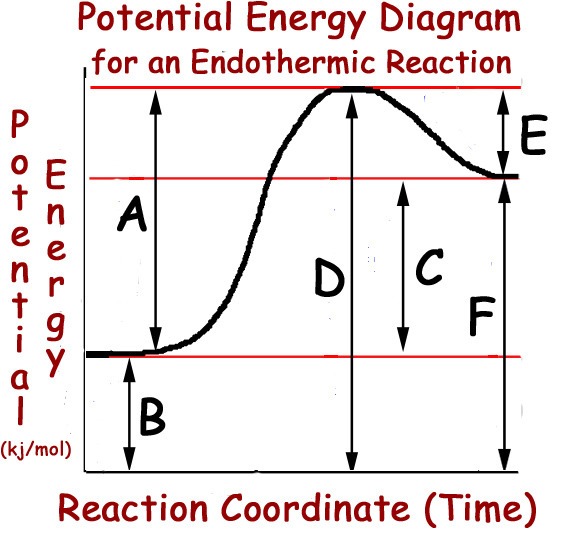
What letter represents the activation energy?
A
B
C
D
Given the following rate law,
rate = k[A]2[B]
if [A] were doubled, what must happen to [B] to keep the rate constant?
[B] must quadruple
[B] must double
[B] must be havled
[B] must be quartered

Which species is the catalyst in this reaction mechanism?
R
W
X
There is no catalyst.
rate = k[A]
The rate constant in the rate law above is 0.5 L/mol·s. If the initial concentration of A is 0.1 M, how long will it take for [A] to drop to 0.025 M?
0.7 s
1.4 s
2.8 s
There is not enough information given.

What is the rate law for this mechanism?
rate = k[A][B]2
rate = [B][X]
rate = [A]0.5[B]1.5
rate = [W][Y][Z]
2Mg(s) + O2 (g) −> 2MgO(s).
The reaction begins because the reactants

What rate law matches the graph?
rate= k [A]
rate= k [A]2
rate= k
rate= k [A]3

What rate law matches the graph?
rate= k [A]
rate= k [A]2
rate= k
rate= k [A]3

What rate law matches the graph?
rate= k [NO2]
rate= k [NO2]2
rate= k
rate= k [NO2]3
What would be my the overall order of this rate law?
Rate=[A]2[B]1
0 Order
1st Order
2nd Order
3rd Order
For second order reaction, the initial concentration of reactant A is 0.24 M. If the rate constant is 8.1 x 10⁻² M-1 s-1, what is the concentration of A after 29 seconds?
0.02 M
0.15 M
0.30 M
0.45 M
Given the following balanced equation :
2NO(g) + Cl2(g) → 2NOCl(g)
If the rate of disappearance of Cl2 is 4.84 x 10⁻² Ms-1, what is the rate of disappearance of NO?
1.45 x 10⁻² Ms-1
2.42 x 10⁻² Ms-1
3.67 x 10⁻² Ms-1
9.68 x 10⁻² Ms-1
The overall order for the reaction,
2A + B → C
is one and with respect to B the order is zero. Which of the following statements is true?
The rate law of the reaction is rate =k[A]2[B]
The formation of C is double the appearance of A
The rate of reaction would increase with increasing concentration B
The half-life of the reaction is independent on the concentration of the reactants
The rate constant for a second order reaction at 30oC is 2.0 x 10⁻⁶ M-1s-1. The activation energy for this is 108 kJ mol-1. By using Arrhenius equation, determine the collision frequency factor, A for the reaction.
5.0 x 10¹²
6.0 x 10¹²
8.0 x 10¹²
1.0 x 10¹³
The first order rate constant for the decomposition of 0.5 M compound A at 100oC is 0.03 min-1. Calculate the half-life of A.
1.5 min
8.3 min
23.1 min
66.7 min
Which of the following statements about catalyst is true?
It does not take part in the reaction
It increase the yield of the reaction
It provides an alternative mechanism for the reaction
It increases the number of collisions between reacting molecules per second
(A --> products)
with k = 123.4 s-1 initially has 3.0 M of A. How long will it take for the amount of reactant to be 0.75 M?

step 2: O3 + O -> 2 O2
The oxygen atom (O) is considered to be a(n)...

