wayground logo

Free Printable Worksheets

Font size

S
M
L
XL
Worksheets

Yr10 - Chemical Reactions - Revision

Total questions: 70

Worksheet time: 1hrs 9mins

Name
Class
Date
1.
4Si + S8 --> 2Si2S4
a)
Synthesis
b)
Decomposition
c)
Single displacement
d)
Double displacement
2.
3Ca + 2AlCl3 --> 3CaCl2 + 2Al
a)
Synthesis
b)
Decomposition
c)
Single diplacement
d)
Double displacement
3.
3KOH + H3PO4 --> K3PO4 + 3H2O
a)
Synthesis 
b)
Decomposition
c)
Single displacement
d)
Double displacement
4.
2Pb(NO3)2 --> 2PbO + 4NO2 + O2
a)
Synthesis 
b)
Decomposition
c)
Single displacement
d)
Combustion
5.
3Mg + N2 --> Mg3N2
a)
Synthesis 
b)
Decomposition
c)
Single displacement
d)
Combustion
6.
2NO2 --> N2 + 2O2
a)
Synthesis
b)
Decomposition
c)
Single displacement
d)
Combustion
7.
Which reaction type is the following: C5H10O4 + O2 --> CO2 + H2O
a)
Decomposition
b)
Single Replacement
c)
Combustion
d)
Double Replacement
8.
Which of the following is the general formula for a decomposition reaction?
a)
A + B  → AB
b)
AB → A + B
c)
AB + C → AC + B
d)
AB + CD → AC + BD
9.
H2SO4 + Fe -->H2 + FeSO4
a)
Synthesis
b)
Decomposition
c)
Single Replacement
d)
Double Replacement
10.
PbCl2 + AgNO3 ---> Pb(NO3)2 + AgCl 
a)
Synthesis
b)
Decomposition
c)
Single Replacement
d)
Double Replacement
11.
Which chemical reaction switches 2 elements?
a)
Double Replacement
b)
Single Replacement
c)
Combustion
d)
Decomposition
12.
What type a reaction is taking place in this picture?
a)
Synthesis
b)
Decomposition
c)
Single Replacement
d)
Double Replacement
13.
C4H12 + O2 → CO2 + H2O
a)
Synthesis
b)
Combustion
c)
Single Replacement
d)
Double Replacement
14.
4Si   + S8   -->   2Si2S4
a)
Synthesis
b)
Decomposition
c)
Single Displacement
d)
Double Displacement
15.
2Pb(NO3)2   -->   2PbO +  4NO2  +  O2
a)
Synthesis
b)
Decomposition
c)
Single Displacement
d)
Combustion
16.
Is this equation balanced?
a)
yes
b)
no
c)
Not enough information
d)
Left side is balanced
17.
Fill in the blanks with coefficient:
PCl5+_ H2O→_ HCl+H3PO4
a)
4, 5
b)
1, 6
c)
3, 8
d)
2,2
18.
Which side of a chemical equation is the product side?
a)
Left (before the yields sign)
b)
Right (after the yields sign)
19.
What is a coefficient?
a)
The small number on the right of the chemical symbol.
b)
The large number to the left of a formula.
20.
Balance this equation
_Zn+_HCl-->_ZnCl+_H2
a)
1,1,2,1
b)
1,1,1,2
c)
1,2,1,1
d)
2,1,1,1
21.
Balance this equation
_N+ _H--> _NH3
a)
1,2,3
b)
1,3,2
c)
1,1,2
d)
2,1,1
22.
How many atoms of aluminum are on each side of the following equation: 4Al + 3O--> 2AlO3
a)
2
b)
6
c)
1
d)
4
23.
The blue numbers in the image below represent ________
a)
Charges
b)
coefficients
c)
subscripts
d)
none of the answers are correct
24.
Number of H in 3(NH₄)₂CrO₄
a)
4
b)
6
c)
8
d)
24
25.
At the end of chemical reactions, what is the total mass of the reactants compared to the total mass of the products?
a)
the product is doubled
b)
the product is half the mass of the reactants
c)
the mass is the same
d)
the mass changes depending on the reaction
26.
Balance this equation,            
Al2O3 --> Al + O2 
a)
Cannot be balanced
b)
2Al2O3 --> 2Al+3O2 
c)
2Al2O3--> 4Al+3O2 
d)
3Al2O3--> 2Al+O2 
27.

__ Al + __ FeO → Al2O2 + __ Fe

a)

1, 1, 2

b)

2,1,2

c)

2, 2, 2

d)

2,4,2

28.
Which side of a chemical equation is the reactant side?
a)
Left (before the yields sign)
b)
Right (after the yields sign)
29.
When balancing equations a ____ can be placed to the left of a formula of a substance to make the equations balanced
a)
charge
b)
subscript
c)
random number
d)
coefficient
30.

What is the pH of a reaction between a strong acid and strong base?

a)

0

b)

5

c)

10

d)

7

31.

When dissolved in water, acids produce:

a)

bases

b)

salts

c)

hydrogen ions

d)

hydroxide ions

32.
Which of the following word pairs correctly completes the sentence below?
_______ are corrosive substances characterized as having a strong smell, a sour taste, and a _______.
a)
Acids; pH less than 7
b)
Acids; pH greater than 7
c)
Bases; pH greater than 7
d)
Bases; pH less than 7
33.

A substance is found to have the following characteristics:


Very bitter taste

Feels slippery to the touch

Produces OH- ions when dissolved in water


In what category would the substance be classified?

a)

acid

b)

base

c)

enzyme

d)

fatty acid

34.
Acids react with
a)
water to produce bases and salts
b)
salts to produce bases and water
c)
neither bases, salts nor water
d)
bases to produce salts and water
35.

Which of these pH values represent an acid?

a)

4

b)

8

c)

10

d)

12

36.

Which of the following pH values represents a base?

a)

2.1

b)

4.6

c)

6.8

d)

8.1

37.

The strongest bases have pH values close to

a)

0

b)

14

c)

7

d)

5

38.

Neutralisation reactions must make which two products?

a)

carbonate

b)

salt

c)

pepper

d)

water

39.

which of these general equations are correct?

a)

acid + base makes a salt + water

b)

acid + metal carbonate makes a salt + carbon dioxide + water

c)

acid + metal makes a salt + Hydrogen gas

d)

Acid + metal oxide makes a salt + water

e)

Acid + metal hydroxide makes a salt and water

40.
A neutralisation reaction produces 
a)
An acid 
b)
A neutral substance 
c)
Only water 
d)
Salt and water 
41.

List four factors that affects the rate of a reaction

a)

temperature

b)

concentration

c)

surface area

d)

volume

e)

catalysts

42.

A temperature increase causes the particles ......

a)

to slow down

b)

move faster

c)

collide higher

d)

in the right order

43.

How does a catalyst work in speeding up a reaction?

a)

By lowering the activation energy or reaction

b)

by giving them more energy

c)

by making them more available

44.
The following graph shows two different reaction pathways for the same overall reaction at the same temperature. Which pathway is slower and why?
a)
Red, because the activation energy is larger
b)
Blue, because the activation energy is lower
c)
both reaction progress at the same rate
45.
What does NOT happen when the temperature is increased?
a)
Particles collide more often
b)
Particles collide with more energy
c)
Particles move faster
d)
More particles collide in the correct orientation
46.

Why does a higher concentration increase the rate of reaction?

a)

it increases the amount of reactants

b)

it lowers the activation energy

c)

it increases the energy of particle collisions

d)

it increases the frequency of particle collisions

47.

Why does a higher temperature increase the rate of a reaction?

a)

it increases both the frequency and energy of particle collisions

b)

it only increases the frequency of particle collisions

c)

it only increases the energy of particle collisions

d)

it reduces the activation energy of the reaction
48.
What makes an effective collision?
a)
When molecules collide.
b)
When molecules collide with the proper orientation.
c)
When molecules collide with proper orientation and enough kinetic energy.
d)
High Temperature.
49.
Why don't all collisions between particles cause a reaction?
a)
the particles also need to collide with a catalyst
b)
not all the particles collide with enough energy
c)
not all the particles collide at a high enough temperature
d)
the particles need to collide with each other twice
50.
What is the rate of reaction?
a)
How fast a reaction is 
b)
How big a reaction is
c)
How loud a reaction is
d)
How much gas a reaction produces
51.
Grinding a seltzer tablet into powder increases the rate of reaction due to increased
a)
concentration
b)
surface area
c)
temperature
d)
reactants
52.

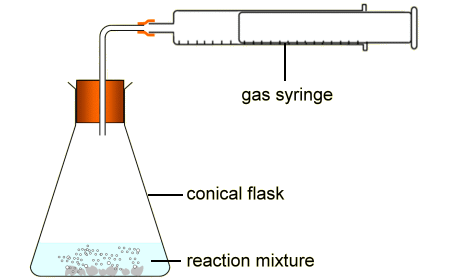
How is this equipment being used to measure the rate of reaction?

a)

The gas syringe measures how much gas is produced in a certain time

b)

The reaction mixture will increase in volume in a certain time

53.

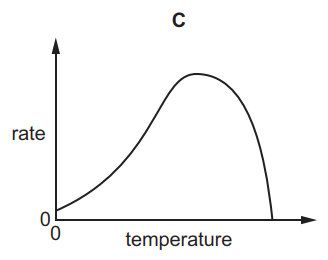
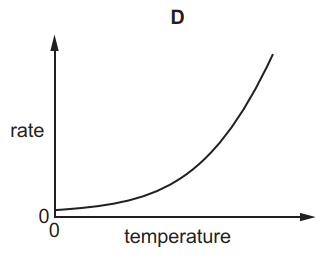
Which graph shows the effect of increasing temperature on the rate of reaction of calcium carbonate with dilute hydrochloric acid?
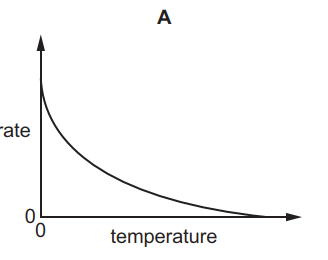
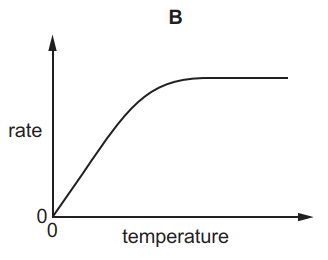
a)
b)
c)
d)
54.
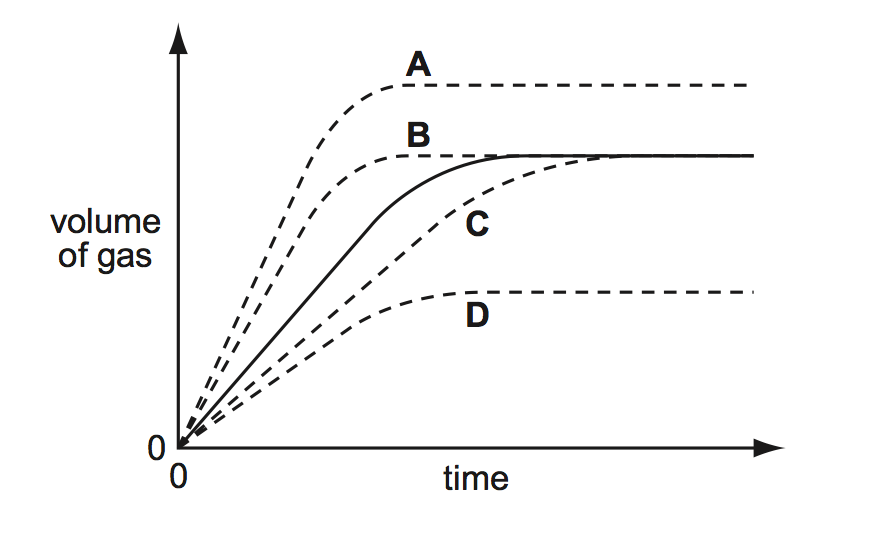
In an experiment, a 2 g lump of zinc and 2 g of powdered zinc are added separately to equal volumes of dilute sulphuric acid. The solid line on the graph shows the volume of gas given off when the 2 g lump is used. Which dotted line is obtained when the zinc is powdered? 
a)
A
b)
B
c)
C
d)
D
55.
A solution of hydrogen peroxide releases oxygen slowly at room temperature.
 hydrogen peroxide → water + oxygen
 The diagrams show the effect of adding blood to the solution. What could be the reason for the observed change? 
a)
Blood contains an enzyme. 
b)
Blood contains water. 
c)
The hydrogen peroxide becomes more concentrated. 
d)
The hydrogen peroxide is neutralised by blood. 
56.
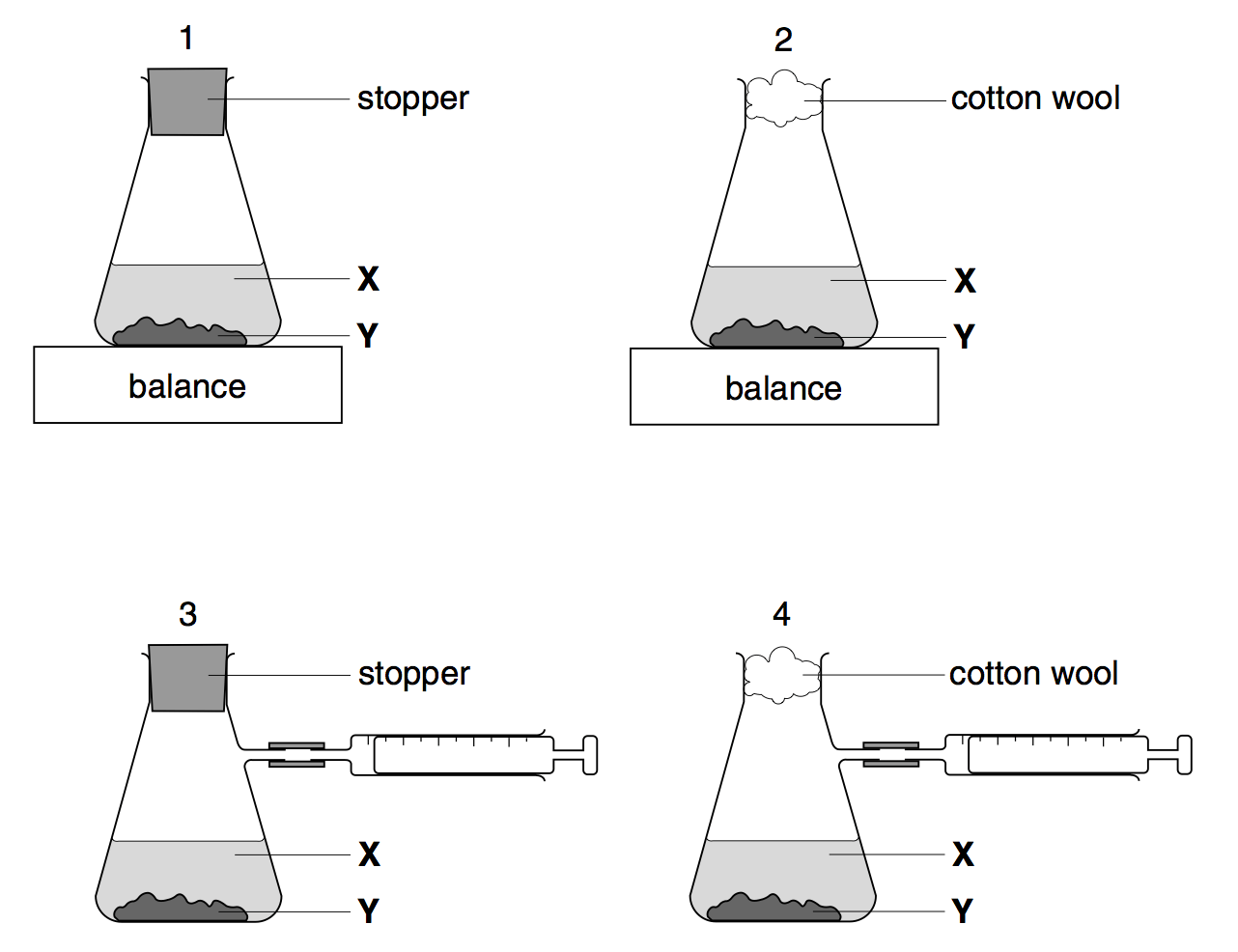
A liquid X reacts with solid Y to form a gas.
Which two diagrams show suitable methods for investigating the speed of the reaction? 
a)
1 and 3
b)
1 and 4
c)
2 and 3
d)
2 and 4
57.
In which experiment is the rate of reaction between hydrochloric acid and calcium carbonate slowest? 
a)
A
b)
B
c)
C
d)
D
58.
Identify where the reaction has finished
a)
A
b)
B
c)
C
d)
D
59.

Which of the following is a neutralization reaction?

a)

2Na + Cl2 → 2NaCl

b)

CH4 + 2O2 → CO2 + 2H2O

c)

HCl + KOH → KCl + H2O

d)

CaCO3 → CO2 + CaO

60.
An acid reacts with metal to produce 
a)
Carbon dioxide 
b)
Hydrogen gas
c)
Hydrogen gas and water 
d)
Salt and hydrogen gas 
61.
A neutralisation reaction produces 
a)
An acid 
b)
A neutral substance 
c)
Only water 
d)
Salt and water 
62.
An acid reacts with a metal carbonate to produce 
a)
Salt, water and hydrogen gas
b)
Salt, water and carbon dioxide
c)
Limewater
d)
Salt and water 
63.
What type of reaction is the following: 
HCl  + Zn --> ZnCl2 + H2
a)
Neutralisation
b)
Acid and a metal 
c)
Acid and a carbonate 
d)
Ionic 
64.
Acid + Metal --> ?
a)
Salt + Water
b)
Salt + Hydrogen
c)
Salt
d)
Hydrogen
65.
Iron + Hydrochloric acid --> ?
a)
iron sulfate + water
b)
iron + hydrogen
c)
iron chloride + hydrogen
d)
iron chloride + water
66.

Magnesium + hydrochloric acid-->

a)

Magnesium chloride + water

b)

Magnesium chloride + hydrogen

c)

Magnesium hydrochloride + hydrogen

d)

Magnesium chloride + water + carbon dioxide

67.

How do we test for hydrogen?

a)

Squeaky pop test

b)

Hydrogen extinguishes a lit splint

c)

Bubbling through lime water

d)

Hydrogen makes a glowing splint relight

68.

Metal carbonates react with acid to form....

a)

Salt, carboxylic acid and water

b)

Salt, carbon dioxide and water

c)

Salt and carbonated water

d)

Salt and hydrogen

69.

Calcium carbonate + hydrochloric acid -->

a)

Calcium chloride + hydrogen

b)

Calcium choride + water

c)

Calcium chloride + carbon dioxide + water

d)

Calcium sulfate + carbon dioxide + water

70.

Copper carbonate + hydrochloric acid -->

a)

Copper chloride + hydrogen

b)

Copper chloride + water

c)

Copper chloride + water + hydrogen

d)

Copper chloride + water + carbondioxide