
 Worksheets
Biology Mutations and Genetics Review
Total questions: 58
Worksheet time: 15hrs 30mins
Name
Class
Date
1.

Genotype refers to the ...
a)
physical expression of the genes
b)
the possible combination of alleles in a gene
c)
whether an allele is dominant or recessive
d)
how an organism will appear
2.

Squidward has light blue skin, and his genotype for this trait is Bb. Would Squidward be considered a purebred or hybrid for light blue skin?
a)
Purebred
b)
Hybrid
3.
The man who studied genetics and came up with genetics is
a)
Watson
b)
Crick
c)
Mendel
d)
Darwin
4.

An offspring will receive how many alleles from each parent to determine a specific trait?
a)
one
b)
two
c)
three
d)
five
5.
Which of the following is a phenotype?
a)
BB
b)
Bb
c)
bb
d)
Blue eyes
6.
What is a phenotype
a)
The genetic make up (code)
b)
The physical trait
7.
the passing of genetic traits from parent to offspring.
a)
heredity
b)
trait
c)
gene
d)
allele
8.
having two of the same genes for the trait (sometimes called purebred).
a)
homozygous
b)
hetrozygous
c)
protein
d)
chromosome
9.
Magda is a tall, 11 year old drummer. She has a scar on her right cheek. She is good at swimming. Which of her traits did Magda most likely inherit?
a)
height
b)
the scar
c)
ability to swim
d)
ability to play drums
10.
Two brown eyed parents (Bb) have a baby. What is the chance the baby is blue eyed?
a)
0 %
b)
25%
c)
50%
d)
75%
11.
G = green, g = yellow
The genotype for a yellow plant is...
The genotype for a yellow plant is...
a)
GG
b)
Gg
c)
gg
d)
all of the choices result in yellow
12.
An allele whose trait only shows up when no dominant allele is present.
a)
hidden allele
b)
dominant allele
c)
recessive allele
d)
present allele
13.
Two heterozygous (Tt) tall pea plants are crossed. Which describes their offspring?
a)
50% tall and 50% short
b)
75%tall and 25% short
c)
100%short
14.
A homozygous dominant dog with brown fur is crossed with a heterozygous dog with brown fur. What are the percentages of the possible genotypes?
a)
100% BB
b)
75% BB and 25%Bb
c)
50 % BB and 50% Bb
d)
50% Bb and 50% bb
15.

A heterozygous yellow pea plant's genotype would be:
a)
YY
b)
yy
c)
Yy
d)
Yg
16.
Snapdragon flowers come in red, pink and white. What type of inheritance is this?
a)
Complete Dominance
b)
Incomplete Dominance
c)
Codominance
d)
Polygenic Inheritance
17.

If a Homozygous red snapdragon and a Heterozygous pink snapdragon were crossed - what percentage of the offspring would be homozygous white?
a)
0%
b)
25%
c)
50%
d)
75%
18.

If T=Tall & t=short, what is the genotypic ratio?
a)
1:3
b)
3:1
c)
1:2:1
d)
2:2
19.

This is an example of what?
a)
Complete dominance
b)
Incomplete dominance
c)
Codominance
d)
None of the above
20.
What does heterozygous mean?
a)
An organism that has the same genes for a trait (TT or tt)
b)
An organism that has different genes for a trait (Tt)
c)
When neither gene is fully dominant; offspring is a mixture of both
d)
the different forms of a trait (hair color--> brown, blonde, red
21.
A dog gives birth to 5 puppies. What percentage of the chromosomes does each puppy share with the mother?
a)
25%
b)
50%
c)
75%
d)
100%
22.

The sex of an offspring is determined by ______________________.
a)
the mother
b)
the father
c)
the mother and the father
d)
by the environment
23.
Incomplete dominance means that the traits are
a)
expressed equally
b)
dominant
c)
recessive
d)
blended
24.

Red/green color blindness is a recessive trait. A woman who is a carrier for this allele marries a normal-vision male. What is the probability that they will have a child who is color blind?
a)
1/4
b)
1/2
c)
3/4
d)
1
25.
W=white hair
w= non-white hair
If you cross a horse with WW and a horse with ww what fraction of the offspring would be expected to have white hair?
w= non-white hair
If you cross a horse with WW and a horse with ww what fraction of the offspring would be expected to have white hair?
a)
none
b)
3/4
c)
1/2
d)
all
26.
What is a phenotype?
a)
The expression of a trait; what you see.
b)
refers to the genetic makeup of an individual
c)
An organism that has the same genes for a trait (ex. TT or tt)
d)
the passing of traits from parent to offspring
27.
The inherited combination of alleles is known as the offspring's
a)
heredity
b)
phenotype
c)
genotype
d)
redigree
28.
An organism's appearance is known as its
a)
heredity
b)
phenotype
c)
genotype
d)
pedigree
29.
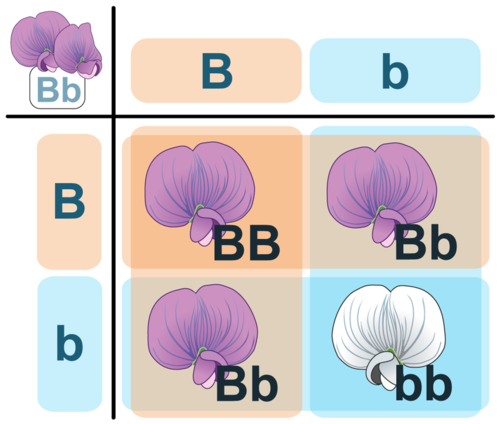
In this punnett square, which is the dominant trait?
The B stands for bud.
The B stands for bud.
a)
purple flower bud
b)
white flower bud
c)
dominant
d)
recessive
30.
One form of a gene is called_______________
a)
a DNA
b)
a Phenotype
c)
a trait
d)
an allele
31.
What is the definition of genotype?
a)
The physical expression of a trait
b)
The genetic combination of alleles
c)
the genes on a DNA strand
32.
What is the definition of phenotype?
a)
The physical expression of a trait
b)
The genetic combination of alleles
c)
A gene on the DNA strand
33.
the condensed form of DNA is called________________
a)
an allele
b)
a gene
c)
a chromosome
d)
a phenotype
34.
Where, in the eukaryotic cell, is DNA located?
a)
ribosomes
b)
nucleus
c)
E.R.
d)
cytoplasm
35.
Which of the following will only show if two alleles are present?
a)
a dominant trait
b)
a recessive trait
36.
Which of the following genotypes would be considered heterozygous?
a)
BB
b)
gg
c)
Ff
d)
TT
37.
Which of the following is a phenotype?
a)
Bb
b)
Black fur
38.

This image shows a...
a)
Punnett Square
b)
Phenotype
c)
Genotype
d)
Dominant allele
39.
What does a Punnett Square help you do?
a)
Determine the ratio of phenotypes
b)
Determine the ratio of genotypes
c)
Predict possible traits the offspring will have
d)
All of the above
40.
Another word for homozygous is...
a)
purebred
b)
hybrid
c)
heterozygous
d)
dominant
41.
Dominant alleles are-
a)
capital
b)
lowercase
c)
both
d)
neither
42.
Recessive alleles are-
a)
capital
b)
lowercase
c)
both
d)
neither
43.
If the four existing children in a family are all sons, what chance would there be that the next child would also be a son?
a)
75%
b)
50%
c)
25%
d)
20%
44.

Which genetic abnormality is shown in this karyotype?
a)
Partial Addition
b)
Partial Deletion
c)
Trisonomy 21
d)
Monosomy
45.
Photograph of chromosomes grouped in ordered pairs
a)
pedigree
b)
Punnett Square
c)
Venn Diagram
d)
Karyotype
46.
Which sex chromosomes would indicate a typical human male?
a)
XX
b)
X
c)
XY
d)
XXY
47.
A characteristic of mutations is that they usuallu
a)
are caused only by the events of mitosis
b)
do not occur at random
c)
result in a different genetic sequences
d)
occur to meet the needs of a species
48.
A sudden change in the DNA of a chromosome can usually be passed on to future generations if the change occurs in a
a)
Brain cell
b)
Sex cell
c)
Liver cell
d)
Skin cell
49.
For those individuals who have an allergic reaction to cats, a company in Los Angeles promises relief. They offer a new line of cats genetically modified to eliminate or reduce their allergy-causing properties. The development of this new line of cats most likely involved
a)
manipulating the DNA of cats
b)
changing the behavior of cats
c)
altering the reproductive rate of cats
d)
using natural selection to produce a new variety of cat
50.
An organism gets to choose if the mutation is helpful, harmful or neutral.
a)
True
b)
False
51.
What do mutations change?
a)
DNA
b)
Chromosomes
c)
Genes
52.
Any permanent change in a gene or chromosome of a cell; may be beneficial, harmful, or have little effect on an organism
a)
Homozygous
b)
Selective Breeding
c)
Mutation
d)
Carrier
53.
A person who has one recessive allele for a trait, but does not have the trait
a)
Homozygous
b)
Selective Breeding
c)
Mutation
d)
Carrier
54.
Segment of DNA on a chromosome that contains instructions for protein synthesis and controls a particular inherited trait
a)
Gene
b)
Pedigree
c)
Punnett Square
d)
Dominant
55.
Scientific study of how traits are passed to offspring through genes
a)
Heredity
b)
Genetics
c)
Inheritance
d)
Allele
56.
Passing of traits from one generation to the next
a)
Heredity
b)
Genetics
c)
Inheritance
d)
Allele
57.
The genetic characters transmitted from parent to offspring, taken collectively
a)
Heredity
b)
Genetics
c)
Inheritance
d)
Allele
58.
rule where genes come in only dominant or recessive
a)
Regulatory Genes
b)
Mendelian Inheritance
c)
Incomplete Dominance
100 %

