wayground logo

Free Printable Worksheets

NEW

Font size

S
M
L
XL
Worksheets

Biomolecules and LOO (with enzymes and proteins)

Total questions: 53

Worksheet time: 53mins

Name
Class
Date
1.

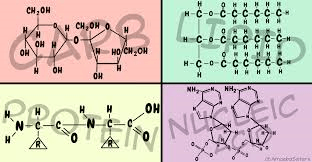
Which biomolecule do pastas and breads contain?

a)
Lipid
b)
Protein
c)
Nucleic Acid
d)
Carbohydrate
2.
Which biomolecule helps form muscles?
a)
Nucleic Acid
b)
Carbohydrate
c)
Protein
d)
Lipids
3.
Which biomolecule is responsible for insulation and energy storage?
a)
Protein
b)
Nucleic Acid
c)
Lipid
d)
Carbohydrate
4.

Which biomolecule are sugars and starches categorized as?

a)
Lipids
b)
Proteins
c)
Carbohydrates
d)
Nucleic Acid
5.
Which biomolecule is made of amino acids?
a)
Nucleic Acid
b)
Carbohydrate
c)
Protein
d)
Lipid
6.

Which biomolecule is your primary source of energy?

a)
Nucleic Acid
b)
Protein
c)
Lipid
d)
Carbohydrate
7.
Which biomolecule contains fats, oils, and waxes?
a)
Proteins
b)
Nucleic Acid
c)
Lipids
d)
Carbohydrate
8.
Building blocks of polymers.
a)
monomer
b)
polypeptide
c)
monosaccharide
d)
glycerol
9.
Which biomolecule is a main source of quick energy?
a)
Nucleic Acid
b)
Protein
c)
Lipid
d)
Carbohydrate
10.

What elements are common to all 3 biomolecules so far?

a)
Carbon, hydrogen, nitrogen
b)
Carbon, Nitrogen, Phosphorus
c)
Carbon, Hydrogen, Oxygen
d)
Carbon, Hydrogen, Phosphorus
11.

Which biomolecule makes up cell membranes?

a)

Protein

b)

Carbohydrate

c)

Lipid

d)

Nucleic acid

12.
What are the four biological molecules?
a)
proteins, carbohydrates, lipids, nucleic acids
b)

enzymes, carbohydrates, lipids, nucleic acids

c)

proteins, saccharides, lipids, nucleic acids

d)

proteins, carbohydrates, waxes, nucleic acids

13.
The conditions for an enzyme to work need to be ____________
a)
specific
b)

healthy

c)

acidic

d)

body temperature

14.
If you want a reaction to speed up you need an _________.
a)
nucleic acid
b)
enzyme
c)

carbohydrate

d)
carbohydrate
15.

Once an enzyme does its work, the enzyme is ___________.

a)
destroyed
b)
unchanged
c)

broken down

d)

denatured

16.

What is the function of proteins?

a)

provides quick energy

b)

stores energy

c)

helps with growth and repair of tissues

d)

stores genetic information

17.

What is the monomer for carbohydrates?

a)

Monosaccarides

b)

Fatty Acids

c)

Amino Acids

d)

Nucleotides

18.

Which are examples of proteins?

a)

glucose, pasta, bread

b)

fats, oils, waxes

c)

meats, enzyme, lactase, eggs

d)

DNA, RNA

19.
What do disaccharides, such as sucrose, and polysaccharides, such as starch, have in common?
a)
They are lipids made of fatty acids.
b)
They are proteins made of amino acids.
c)
They are nucleic acids made of nucleotides.
d)
They are carbohydrates made of simple sugars.
20.

Enzymes help reactions take place in our body, what are they best classified as?

a)

Lipid

b)

Carbohydrate

c)

Protein

d)

Nucleic Acid

21.

_________ are utilized as a form of fast energy source. ________ provide longer term energy and storage.

a)

carbohydrates, lipids

b)

lipids, carbohydrates

c)

protein, carbohydrates

22.

What is the monomer of Lipids?

a)

Monosaccharides

b)

Amino Acids

c)

Nucleotides

d)

Glycerol/Fatty Acids

23.

Many carbohydrates tend to end in—

a)

"ose"

b)

"ase"

c)

"ing"

d)

"ain"

24.

Glucose is a sugar that provides quick energy that would best be classified as...

a)

Carbohydrate

b)

Protein

c)

Nucleic Acid

d)

Lipids

25.

Plant cell walls consist of cellulose, what is it best classified as.

a)

Carbohydrate

b)

Protein

c)

Nucleic Acid

d)

Lipids

26.

Functions can include being long term energy, insulation, and component of the plasma membrane.

a)

Carbohydrates

b)

Proteins

c)

Nucleic Acid

d)

Lipids

27.

Monomers are....

a)

the smaller building blocks for biomolecules

b)

the complex components for biomolecules

c)

the finalizing step to building biomolecules

28.
With what 3 letters do enzymes typically end?
a)
-ose
b)
-ase
c)
-ese
d)
-tic
29.
What happens when enzymes are heated to a high temperature?
a)
The enzymes die.
b)

The shapes of the enzyme are altered.

c)
The enzymes' amino acid sequence changes.
d)
The enzymes remain the same
30.
Which of these is most likely an enzyme?  
a)
Sucrose
b)
Galactose
c)

Insulin

d)
Amylase
31.
Where do substrates bind on an enzyme?
a)
voltage-gated channels
b)
surface receptor
c)
calcium channels
d)
active site
32.
What is a substance called if it speeds up a chemical reaction?
a)

chemical

b)
catalyst
c)
specific
d)

molecule

33.

Can a change in pH alter the active site of an enzyme?

a)

yes

b)

no

34.
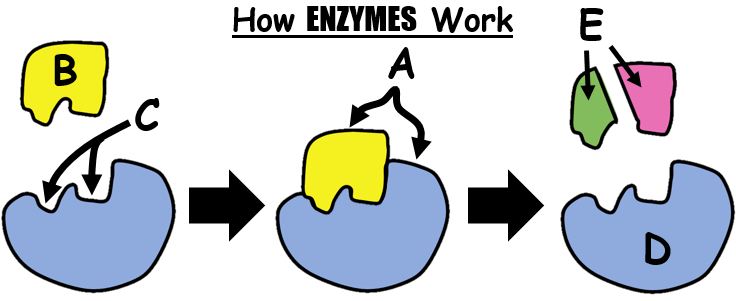
What is indicated by letter A?
a)
enzyme
b)
product
c)
substrate
d)
active site
35.

What is indicated by letter C?

a)

enzyme

b)

product

c)

substrate

d)

active site

36.

What is indicated by letter B?

a)

enzyme

b)

product

c)

substrate

d)

active site

37.

Enzymes are specific. This means that an enzyme only works with molecules that are...

a)

the right size and shape

b)

broken down already

c)

present in the body

d)

toxic to the body

38.
In the diagram, what is letter A? 
a)
product
b)
substrate
c)
enzyme-substrate complex
d)
active site
39.
An enzyme speeds up a chemical reaction in the cell but can only be used once.  True or False? 
a)
true
b)
false
40.

Enzymes are an example of

a)

Lipids

b)

Carbohydrate

c)

Protein

d)

Nucleic Acid

41.
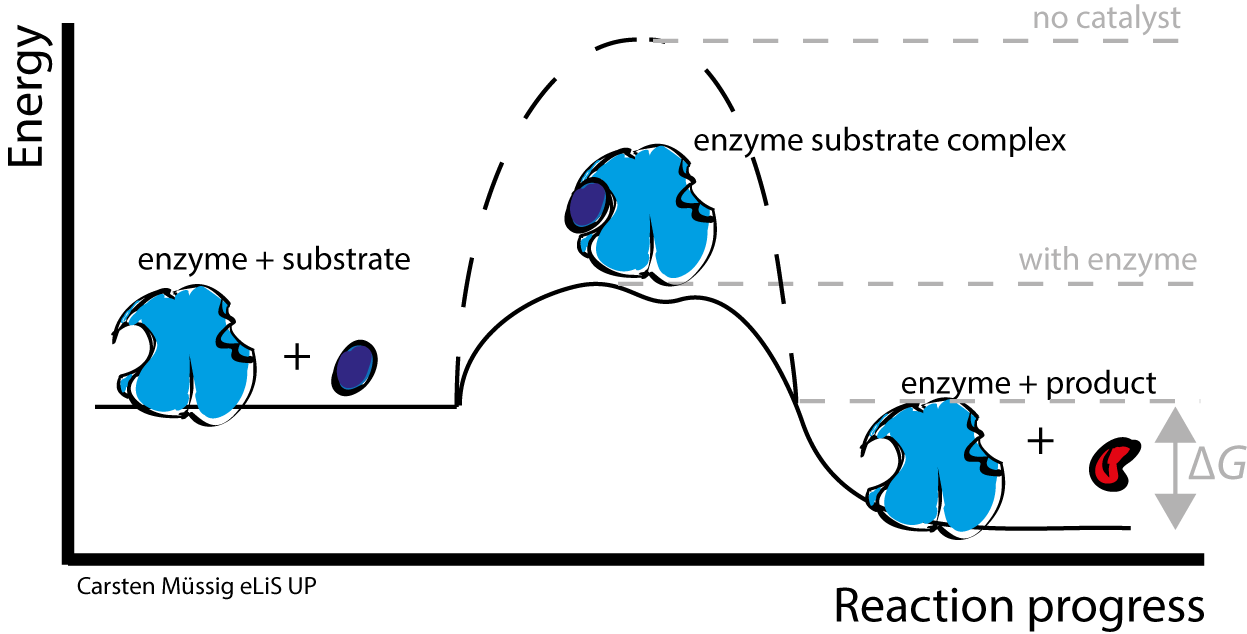
An enzyme speeds up a reaction by
a)
lowering the activation energy.
b)
raising the activation energy.
c)
releasing energy.
d)
absorbing energy.
42.
Which of these is NOT true?
a)
Enzymes can denature (change shape) when the temperature gets too high.
b)
Enzymes can only be used once in a chemical reaction. 
c)
Extreme pH can denature enzymes.
d)
Enzymes speed up chemical reactions. 
43.
What is the function of an enzyme?
a)
enzymes break themselves into small pieces
b)
enzymes slow down chemical reactions
c)
enzymes speed up chemical reactions
d)
enzymes combine products to form reactants 
44.
Enzymes will make a reaction go _______ and use ______ energy.
a)
faster, less
b)
faster, more
c)
slower, less
d)
slower, more
45.
What happens to an enzyme when it is denatured?
a)
Activation energy is lowered.
b)
It becomes stronger.
c)
It loses its shape.
d)
Activation energy is raised.
46.

What is an organ?

a)

Groups of similar types of cells that work together to carry out a specific task

b)

Groups of different tissues working together to perform a particular job

c)

Groups of different organs working together to complete a series of tasks

d)

The smallest unit of life

47.

What is the order of levels of organization of the body from SMALLEST to Largest

a)

cell, organ, tissue, organ system, organism

b)

organism, organ system, organ, tissue, cell

c)

cell, organ, tissue, organ system, organism

d)

cell, tissue, organ, organ systems, organism

48.
Multiple organisms of the same species describes a
a)
organism
b)
population
c)
community
d)
ecosystem
49.
Which level of organization is the most complex?
a)
organism
b)
population
c)
community
d)
ecosystem
50.
What do ecosystems have that the other three levels of organization do not have?
a)
living things
b)
biotic factors
c)
abiotic factors
d)
organisms
51.
A forest full of many kinds of trees and grasses is an example of a
a)
group
b)
organism
c)
population
d)
community
52.
which is the correct order of the levels of organization from simple to complex?
a)
organism, population, community, ecosystem
b)
ecosystem, community, population, organism
53.
Which is the definition of a community
a)
multiple organisms of the same species
b)
all the living and nonliving things in an area
c)
a living thing
d)
multiple organisms of different species