
 Worksheets
Unit 7 Test Review
Total questions: 60
Worksheet time: 1hrs 3mins
Name
Class
Date
1.
An object with which of the following densities will float on water?
a)
0.7 g/cm3
b)
1.2 g/cm3
c)
3.5 g/cm3
d)
11.4 g/cm3
2.
Mercury is a metal that is liquid at room temperature and has a density of 13.5 g/cm3. Which of these metals would sink below the mercury if dropped into a container of mercury?
a)
gold (density=19.3 g/cm3)
b)
lead (density=11.4 g/cm3)
c)
iron (density=7.9g/cm3)
d)
aluminum (density=2.7g/cm3)
3.
______________________ can be used to identify a substance and they are not affected by the amount of the substance.
a)
chemical properties
b)
characteristic properties
c)
physical properties
d)
elemental properties
4.

Which liquid has the least density?
a)
Water
b)
Glycerine
c)
Corn Oil
d)
Corn Syurp
5.

The amount of space an object takes up
a)
mass
b)
volume
c)
density
d)
gram
6.

What is the volume of this block
a)
168 cm3
b)
17 cm3
c)
10 cm3
d)
145 cm3
7.

What is the formula for density?
a)
density = mass x volume
b)
density = mass ÷ volume
c)
density = mass + volume
d)
density = mass - volume
8.

What is the density of an object with a mass of 30 grams and a volume of 6 cm3
a)
36 g/cm3
b)
5 g/cm3
c)
30 g/cm3
d)
5 g/cm2
9.
An irregularly shaped stone is lowered into a graduated cylinder holding a volume of water equal to 2 mL. The height of the water rises to 7 mL. If the mass of the stone is 25 g, what is its density?
a)
5 mL
b)
3.57 g/cm3
c)
0.20 g/cm3
d)
5 g/cm3
10.

The mass of an unknown object is 15 g and the volume of the object is 30 ml. What is the object?
a)
Air
b)
Ice
c)
Pine
d)
Brick
11.

What is the correct order of the objects from least dense to most dense?
a)
Solid - Liquid - Gas
b)
Gas - Solid - Liquid
c)
Gas - Liquid - Solid
d)
Liquid - Gas - Solid
12.

A rubber ball has a mass of 12 g and the volume is shown in the picture. What is its density?
a)
10 g/cm3
b)
2.4 g/cm3
c)
24 g/cm3
d)
1 g/cm3
13.
Elements which are shiny, conduct electricity and heat are called
a)
metal
b)
nonmetal
c)
metalloid
d)
nonexistent
14.

The atoms along the staircase (also known as the zig-zag line) are called
a)
metals
b)
nonmetals
c)
metalloids
d)
noble gases
15.
In the modern periodic table, elements are arranged by:
a)
atomic mass
b)
atomic number
c)
valence electrons
d)
number of isotopes
16.

The blue elements in the table pictured are called
a)
metals
b)
nonmetals
c)
metalloids
d)
noble gases
17.
If a material can easily be drawn into the shape of a wire, it is
a)
Ductile
b)
Magnetic
c)
Malleable
d)
Reactive
18.

Elements in Group 17 on the periodic table are known as the ________________.
a)
Alkali Metals
b)
Fluorine Group
c)
Halogens
d)
Noble Gases
19.

The yellow elements on the periodic table pictures are known as ___________________.
a)
metals
b)
nonmetals
c)
metalloids
d)
noble gases
20.

Most of the elements on the periodic table are classified as ______________.
a)
Metals
b)
Nonmetals
c)
Metalloids
d)
Periods
21.
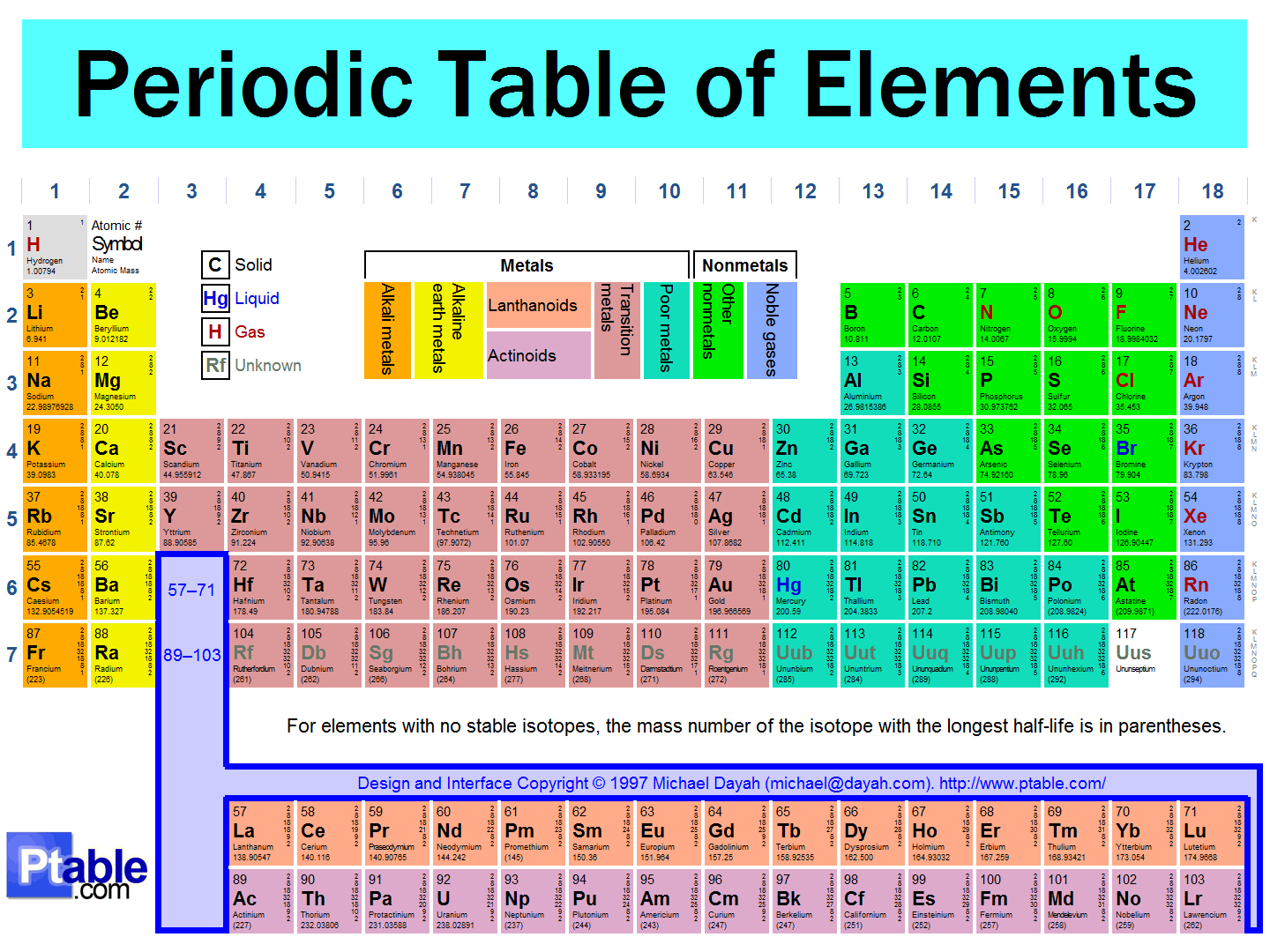
This class of elements are sometimes called "semiconductors."
a)
Metals
b)
Nonmetals
c)
Metalloids
d)
Groups
22.

How did Mendeleev arrange the elements?
a)
alphabetical
b)
density
c)
melting point
d)
atomic mass
23.

Elements in group 1 on the periodic table are known as ________________.
a)
Alkali Metals
b)
Alkaline-earth metals
c)
Halogens
d)
Noble Gases
24.

A horizontal row on the periodic table is called a?
a)
group
b)
period
c)
family
d)
actinides
25.

Each vertical column on the periodic table is called a?
a)
period
b)
group
c)
element
d)
row
26.

These contain only one kind of atom.
a)
element
b)
compound
c)
mixture
d)
water
27.
A compound consists of ________________.
a)
atoms of the same element
b)
two atoms
c)
atoms of two or more elements
d)
mixtures
28.
Carbon Dioxide (CO2) is a ______
a)
compound
b)
element
c)
mixture
d)
family
29.
Which of the following represents an element?
a)
H2O
b)
H2
c)
NaCl
d)
CaCO3
30.
Which of the following is not a compound?
a)
HCl
b)
Cl2
c)
NaCl
d)
CO2
31.

This picture represents which of the following?
a)
element
b)
compound
c)
mixture of elements
d)
mixture of compounds
32.

This picture represents which of the following?
a)
element
b)
compound
c)
mixture
33.

This picture represents which of the following?
a)
element
b)
compound
c)
mixture
34.

a)
1
b)
2
c)
3
d)
4
35.
How many elements are represented in the compound?
Na2CO3
Na2CO3
a)
1
b)
2
c)
3
d)
4
36.

Which of the following elements are required in an organic compound?
a)
nitrogen and carbon
b)
oxygen and nitrogen
c)
carbon and hydrogen
d)
sodium and hydrogen
37.
The compound PO4 is...
a)
inorganic
b)
organic
38.
Which compound is inorganic?
a)
Glucose (C₆H₁₂O₆)
b)
Ethane (C₂H₆)
c)
Carbon Dioxide (CO₂)
d)
Stearic Acid (C₁₈H₃₆O₂)
39.

Salt water can be separated into salt and water by boiling or evaporating the water. This makes salt water a(n) ____________________.
a)
Element
b)
Mixture
c)
Compound
d)
Organic compound
40.
How many Hydrogen atoms are in H2O?
a)
zero
b)
one
c)
two
d)
three
41.

The red numbers in the image below that are placed to the left of a chemical formula are known as ________
a)
subscripts
b)
coefficients
c)
multiples
d)
dividends
42.

The blue numbers in the image below represent ________
a)
multiples
b)
coefficients
c)
subscripts
d)
periodic numbers
43.
How many Hydrogen are in 4H2O?
a)
6
b)
8
c)
2
d)
4
44.
What is the left part of a chemical equation called...
H2 + O --> H2O
H2 + O --> H2O
a)
Reactants
b)
Products
c)
Yields
d)
Chemical Equation
45.
What does the arrow in a chemical equation stand for ?
H2 + O --> H2O
H2 + O --> H2O
a)
Reactants
b)
Products
c)
Yields
d)
Chemical Equation
46.
What is the right part of a chemical equation called...
H2 + O --> H2O
H2 + O --> H2O
a)
Reactants
b)
Products
c)
Yields
d)
Chemical Equation
47.
Is the following equation balanced or unbalanced ?
N2 +3 H2 --> 2NH3
N2 +3 H2 --> 2NH3
a)
Balanced
b)
Unbalanced
48.

How many oxygen atoms are in this chemical formula?
a)
6 oxygen atoms
b)
2 oxygen atoms
c)
3 oxygen atoms
d)
4 oxygen atoms
49.

The smallest unit of a substance that keeps all of the properties of that substance (a group of atoms bonded together)
a)
A Molecule
b)
A Coefficient
c)
A Mixture
d)
A Proton
50.

Green bananas turning yellow on their own as they ripen.
a)
Chemical Change
b)
Physical Change
51.

Baking a cake by mixing flour, sugar, chocolate powder, eggs, and milk, and then heating them in the oven.
a)
Chemical Change
b)
Physical Change
52.
Which of the following is NOT an example of chemical change?
a)
sour milk
b)
burning wood
c)
breaking a pencil
d)
rust
53.
Which of the following IS a physical change?
a)
Getting a haircut
b)
Rusty metal
c)
sour milk
d)
A compound
54.
Is melting butter for popcorn a chemical or physical change?
a)
chemical
b)
physical
55.

Is burning wood a chemical or physical change?
a)
chemical
b)
physical
56.
Is hammering wood together to build a house a chemical or physical change?
a)
chemical
b)
physical
57.
Which of the following characteristics is shared by all chemical reactions?
a)
Produce a precipitate
b)
Show a color change
c)
Release heat energy
d)
Form new substances
58.

A new solid that is produced as a result of a chemical reaction in solution is known as a ___________________________.
a)
reactant
b)
precipitate
c)
product
d)
solvent
59.
The ability to conduct electric current?
a)
Physical Change
b)
Conductivity
c)
Malleability
d)
Ductility
60.

The ability of a substance to be molded or flattened into thin sheets without breaking
a)
Density
b)
Solubility
c)
Physical Property
d)
Malleability
100 %

