
 Worksheets
Darwin Finches
Total questions: 20
Worksheet time: 19mins
Name
Class
Date
1.

what did Charles Darwin observe in finch populations of the Galapagos Islands off the coast of South America?
a)
different species on different islands
b)
all species on one of the islands
c)
identical species on all the islands
d)
the same species as North America
2.
Which statement best describes the process of evolution?
a)
Populations can survive in different locations on earth
b)
Environmental conditions limit the number of species on Earth
c)
Populations grow when resources are abundant
d)
The traits of a species can change over time
3.
Natural selection can also be referred to as:
a)
Survival of the weakest
b)
Survival
c)
Survival of the fittest
d)
Artificial selection
4.
The term that best describes "the better adapted organisms survive to pass traits along to offspring".
a)
Evolution
b)
Natural Selection
c)
Extinction
d)
Artifical Selection
5.
Why did the population of peppered moths in England change from light to dark after the Industrial Revolution?
a)
Light moths were easy to see against sooty trees and were eaten
b)
Light moths were killed by soot
c)
The birds that ate the dark moths were killed by soot
d)
Dark moths were produced by industrial processes
6.
Which is NOT a factor of Natural Selection?
a)
variation
b)
competition
c)
mutation
d)
acquired characteristics
7.

All of these finches have different shaped beaks, they are an adaptation to gain access of
a)
Water
b)
Food
c)
Shelter
8.
This finch is a descendant of birds released in NYC in 1940
a)
gold finch
b)
song finch
c)
house finch
d)
crossbill
9.
The finch is a _____
a)
bird of prey
b)
song bird
c)
wading bird
d)
woodpecking bird
10.
According to the theory of natural selection, why are some individuals more likely than others to survive and reproduce?
a)
Some individuals pass on to their offspring new characteristics they have acquired during their lifetimes.
b)
Some individuals are better adapted to exist in their environment than others are.
c)
Some individuals do not pass on to their offspring new characteristics they have acquired during their lifetimes.
d)
Some individuals tend to produce fewer offspring than others in the same environment.
11.
Base your answer(s) to the following question(s) on the diagram below that shows variations in the beaks of finches in the Galapagos Islands and on your knowledge of biology.
The diversity of species seen on the Galapagos Islands is mostly due to
The diversity of species seen on the Galapagos Islands is mostly due to
a)
gene manipulation by scientists
b)
gene changes resulting from mitotic cell division
c)
natural selection
d)
selective breeding
12.
Base your answer to the following question on the finch diversity diagram below and on your knowledge of biology. Warbler finches are classified as
a)
producers
b)
herbivores
c)
carnivores
d)
decomposers
13.
Base your answer(s) to the following question(s) on the information below and on your knowledge of biology. The diagram below represents the relationship between beak structure and food in several species of finches in the Galapagos Islands.
Which factor most directly influenced the evolution of the diverse types of beaks of these finches?
Which factor most directly influenced the evolution of the diverse types of beaks of these finches?
a)
predation by humans
b)
available food sources
c)
oceanic storms
d)
lack of available niches
14.
Base your answer(s) to the following question(s) on the diagram below and your knowledge of biology. Which species of finch has an edge-crushing bill that can also probe into plants for food?
a)
cactus finch
b)
sharp-billed ground finch
c)
warbler finch
d)
large ground finch
15.
Studies of the finches of the Galapagos Islands have shown that
a)
DNA will change to produce structures needed by birds to survive intense competition
b)
a bird’s beak changes annually in response to the type of food that is most abundant each year
c)
natural selection occurs when there are scarce resources and intense competition
d)
the beak of a finch will change if the environment of the bird remains stable
16.
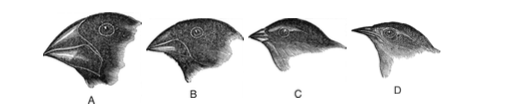
Base your answer(s) to question(s) on the diagram below and on your knowledge of biology. The diagram shows the heads of four different species of Galapagos Islands finches.
The four different types of beaks shown are most likely the result of
The four different types of beaks shown are most likely the result of
a)
gene manipulation
b)
natural selection
c)
unchanging environmental conditions
d)
patterns of behavior learned from parents
17.
This scientist developed the theory of evolution as he studied the finches.
a)
Charles Darwin
b)
Isaac Newton
c)
Albert Einstein
d)
Marie Curie
18.
Behavioral changes of individuals of a species that allow for better survival. (Acquired traits)
a)
Variation
b)
Adaptation
c)
Behavior
d)
Environment
19.
The differences among a species, like different bird beaks, are called
a)
genes.
b)
variations.
c)
traits.
d)
theories.
20.
People develop sickle-cell disease, a condition in which the red blood cells are abnormally shaped, if they inherit two faulty copies of the gene for the oxygen-carrying protein hemoglobin. If a person inherits only one faulty copy then they have a (an)
a)
increased risk of cancer
b)
increased risk of malaria
c)
increased protection from malaria
d)
decreased risk of cancer
100 %

