
 Worksheets
Chemical Reactions
Total questions: 54
Worksheet time: 58mins
Name
Class
Date
1.
Catalysts permit reactions to proceed by ___________ the activation energy.
a)
decreasing
b)
increasing
2.
In which of these compounds are there twice as many oxygen atoms as hydrogen atoms?
a)
H3PO4
b)
H2SO4
c)
HCIO3
d)
H20
3.

All of the following reactions are correctly balanced except-
a)
A
b)
B
c)
C
d)
D
4.

What is the mass of H2O in the reaction above?
a)
70.01
b)
24.11
c)
21.44
d)
48.22
5.
The substances at the beginning of a chemical equation are called the ____
a)
product
b)
yield
c)
chemical symbol
d)
reactants
6.
Mg + ___ HCl → MgCl2 + H2
a)
1
b)
2
c)
3
d)
4
7.

The red numbers in the image below represent ________
a)
subscripts
b)
coefficients
c)
I don't know, and don't want to try
d)
None of the answers are correct
8.

The blue numbers in the image below represent ________
a)
I don't know, and don't want to try
b)
coefficients
c)
subscripts
d)
none of the answers are correct
9.
The Law of Conservation of Mass states
a)
that matter exists in all states and reacts the same
b)
that matter can only be changed into new substances by introducing a catalyst
c)
that matter exists in the same state throughout any chemical change
d)
that matter cannot be created or destroyed and that the mass of the products must equal the mass of the reactants
10.
Compounds break down into simpler substances in this type of reaction.....
a)
Double Replacement
b)
Single Replacement
c)
Synthesis
d)
Decomposition
11.
Which type of reaction takes place in the presence of oxygen and produces carbon dioxide and water?
a)
double replacement
b)
decomposition
c)
combustion
d)
single replacement
12.
A compound is reacted and forms two new substances. What type of reaction is this?
a)
combustion
b)
synthesis
c)
decomposition
d)
single replacement
13.
What are the correct coefficients when this equation is balanced?
KClO3 --> KCl + O2
KClO3 --> KCl + O2
a)
2,2,2
b)
2,2,3
c)
1,2,3
d)
3,3,3
14.
A reaction that gives off heat to its surroundings is...
a)
exothermic
b)
endothermic
c)
endergonic
d)
none of these
15.
Which type of reaction will feel cold?
a)
exothermic
b)
exergonic
c)
endothermic
d)
none of these
16.
What must go in the blank space to balance the equation?
4Fe + ____O2 --> 2Fe2O3
a)
1
b)
2
c)
3
d)
4
17.
Why must chemical equations be balanced?
a)
So that the equation doesn't explode
b)
The reaction won't happen until it is balanced
c)
Based on the Law of Conservation of Matter, matter cannot be created or destroyed.
d)
Based on the Law of Conservation of Energy, energy cannot be created or destroyed.e
18.
A synthesis occurs when...
a)
Two simpler compounds combine to form a larger more complex compound
b)
a larger more complex compound breaks down into 2 or more simplier compounds
c)
An atom is replaced during a reaction.
19.
What type of chemical reaction is this one?
Ca + MgCl2 --> CaCl2 + Mg
Ca + MgCl2 --> CaCl2 + Mg
a)
Decomposition
b)
Combustion
c)
Synthesis
d)
Single Replacement
20.
In the reaction of K + AgNO3 what will the products be?
a)
K and AgNO3
b)
Ag and KNO3
c)
NO3 and AgK
d)
No reaction
21.
What will weigh more when a chemical change is complete? The reactants before the chemical reaction, or the product after the reaction is complete?
a)
They both will weigh the same
b)
The product always weighs more than the reactant
c)
The reactant will weigh more than the product
d)
They both will loose mass after the reaction
22.
A chemical reaction is balanced when
a)
both sides have the same elements
b)
Both sides have the same number of atoms
c)
Same subscripts
d)
Same coefficients
23.
For the equation:
2H2 + O2 --> 2H2O
How much H2O will be produced if we react 4g of H2 and 32g of O2?
2H2 + O2 --> 2H2O
How much H2O will be produced if we react 4g of H2 and 32g of O2?
a)
4g
b)
32g
c)
36g
d)
28g
24.
For the equation:
2H2 + O2 --> 2H2O
How much H2O will be produced using only one O2?
2H2 + O2 --> 2H2O
How much H2O will be produced using only one O2?
a)
1/2
b)
1
c)
2
d)
4
25.
Grinding a seltzer tablet into powder increases the rate of reaction due to increased
a)
concentration
b)
surface area
c)
temperature
d)
reactants
26.
What coefficients are needed to correctly balance the equation?
_Bi + _O2 → _Bi2O3
_Bi + _O2 → _Bi2O3
a)
3,2,3
b)
2,3,2
c)
4,3,2
d)
none of these
27.
A 5.0-gram sample of Fe(s) is to be placed in 100. milliliters of HCl(aq). Which changes will result in the fastest rate of reaction?
a)
(1) increasing the surface area of Fe(s) and increasing the concentration of HCl(aq)
b)
(2) increasing the surface area of Fe(s) and decreasing the concentration of HCl(aq)
c)
(3) decreasing the surface area of Fe(s) and increasing the concentration of HCl(aq)
d)
(4) decreasing the surface area of Fe(s) and decreasing the concentration of HCl(aq)
28.
The collision theory states that a reaction is most likely to occur when the reactant particles collide with the proper
a)
(1) formula masses
b)
(2) molecular masses
c)
(3) density and volume
d)
(4) energy and orientation
29.

Given the equation representing a system at equilibrium: (see pic)
Which change causes the equilibrium to shift?
Which change causes the equilibrium to shift?
a)
(1) increasing pressure
b)
(2) increasing temperature
c)
(3) adding a noble gas
d)
(4) adding a catalyst
30.
Which mathematical expression represents the heat of reaction for a chemical reaction?
a)
(1) (the heat of fusion) – (the heat of vaporization)
b)
(2) (the heat of vaporization) – (the heat of fusion)
c)
(3) (the potential energy of the products) – (the potential energy of the reactants)
d)
(4) (the potential energy of the reactants) – (the potential energy of the products)
31.
For a reaction at equilibrium, which change can increase the rates of the forward and reverse reactions?
a)
(1) a decrease in the concentration of the reactants
b)
(2) a decrease in the surface area of the products
c)
(3) an increase in the temperature of the system
d)
(4) an increase in the activation energy of the forward reaction
32.
Determine the mass of CO2 produced when 9.0 grams of glucose completely reacts with 9.6 grams of oxygen to produce 5.4 grams of water.
a)
12.4 g
b)
12.2 g
c)
13.2 g
d)
16.4 g
33.
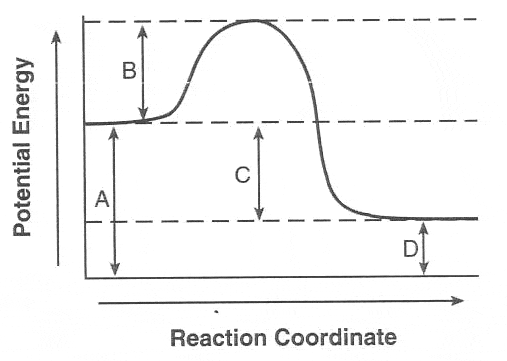
What type of reaction is this?
a)
Endothermic
b)
Exothermic
34.
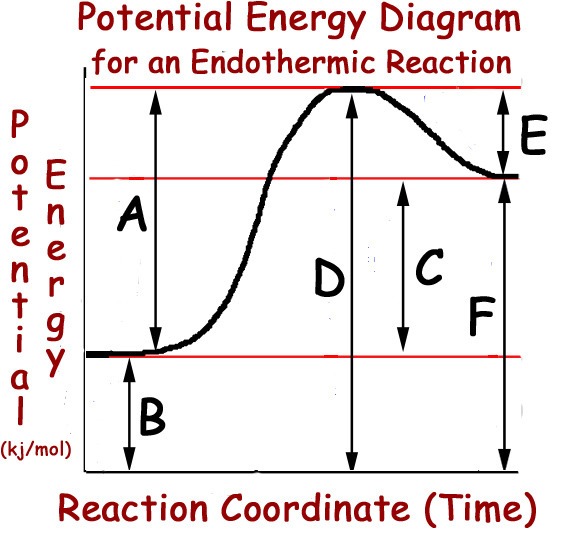
Is this reaction endothermic or exothermic?
a)
endothermic
b)
exothermic
35.
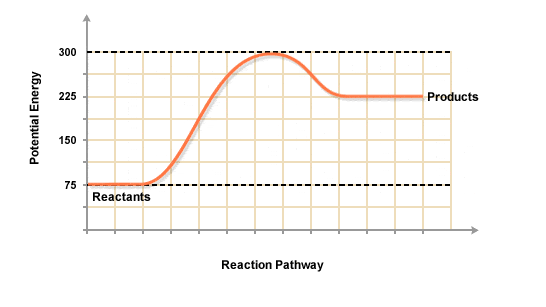
What is the activation energy of the reverse reaction?
a)
75 kJ
b)
300 kJ
c)
150 kJ
d)
225 kJ
36.
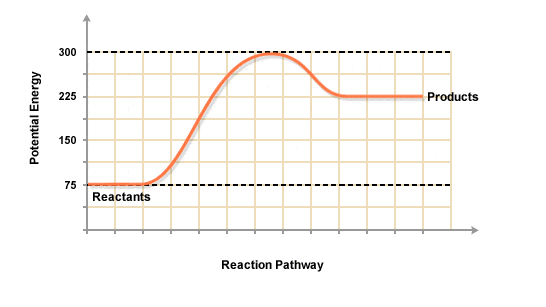
How much potential energy do the products of the reverse reaction have?
a)
225 kJ
b)
300 kJ
c)
75 kJ
d)
250 kJ
37.
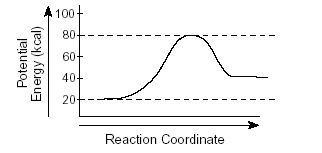
What is the ΔH of this reaction?
a)
40 kJ
b)
20 kJ
c)
80 kJ
d)
60 kJ
38.
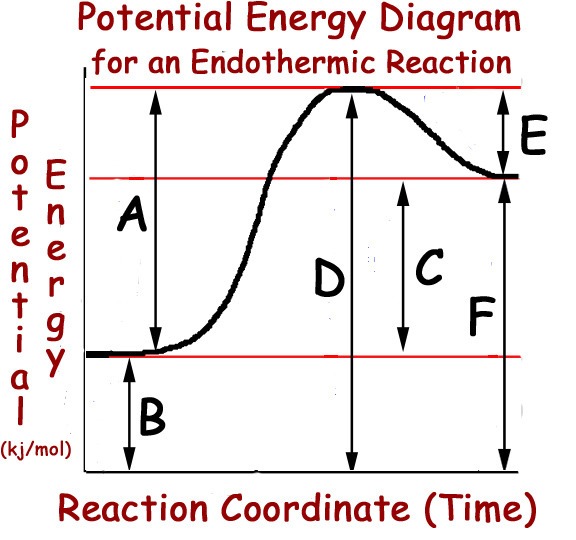
What letter represents ΔH?
a)
A
b)
B
c)
C
d)
D
39.

Exothermic reactions...
a)
Absorb energy
b)
Release energy
c)
Release Color
d)
Absorb Color
40.
Adding a catalyst to a chemical reaction changes the rate of reaction by causing
a)
a decrease in the activation energy
b)
an increase in the activation energy
c)
a decrease in the heat of reaction
d)
an increase in the heat of reaction
41.

Which interval represents the activation energy of the forward reaction?
a)
A
b)
B
c)
C
d)
E
42.
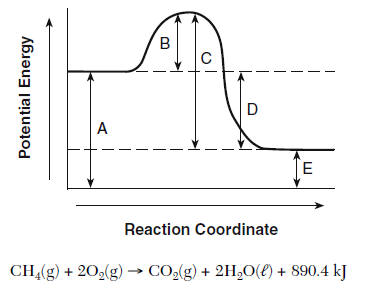
Which interval represents the heat of reaction for the reaction?
a)
A
b)
B
c)
D
d)
E
43.
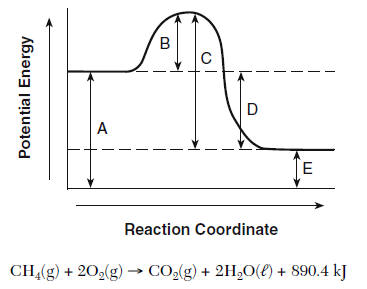
Interval C in this potential energy diagram could be changed by adding a ________?
a)
Cookies
b)
More energy
c)
Catalyst
d)
Changing the temperature
44.
In table I the reaction of hydrogen and oxygen to form water is best described as
a)
exothermic, because energy is released
b)
endothermic, because energy is released
c)
exothermic, because energy is absorbed
d)
endothermic, because energy is absorbed
45.
Which term refers to the difference between thepotential energy of the products and the potential energy ofthe reactants for any chemical change?
a)
heat of deposition
b)
heat of fusion
c)
heat of reaction
d)
heat of vaporization
46.
The SI unit of heat and energy is the __________.
a)
calorie
b)
heat
c)
joule
d)
watt
47.
ΔH value in an endothermic reaction is a positive number.
a)
True
b)
False
48.
How much potential energy do the products of the reverse reaction have?
a)
225 kJ
b)
300 kJ
c)
75 kJ
d)
250 kJ
49.
What is the activation energy of the reverse reaction?
a)
75 kJ
b)
300 kJ
c)
150 kJ
d)
225 kJ
50.
What letter represents ΔH?
a)
A
b)
B
c)
C
d)
D
51.
In a balanced chemical reaction,each side of the equation has the same n
a)
Moles
b)
Coeffici
c)
Atoms
d)
Subscripts
52.
The point in a chemical reaction where the rate at which reactants and products are being produced is equal is
a)
completion
b)
not possible
c)
equilibrium
d)
catalysis
53.
According to Le Chatlier's Principle, decreasing the temperature favors the
a)
endothermic reaction
b)
exothermic reaction
54.
According to Le Chatlier's Principle, increasing the concentration of the products favors the
a)
forward reaction
b)
the reverse reaction
100 %

