
 Worksheets
Oceanography Quiz Review
Total questions: 54
Worksheet time: 44mins
Name
Class
Date
1.
Which is the primary cause of surface winds on Earth?
a)
Unequal heating of the Earth
b)
Deflection in prevailing winds caused by the coriolis effect.
c)
Rotational speeds of Earth's surface at various latitudes.
2.
Where is ocean water the densest.
a)
The surface
b)
The middle
c)
The bottom
d)
Lake Michigan
3.
Tides occur because of
a)
the pull of gravity between two bodies
b)
the blowing of wind across the oceans
c)
the friction generated by waves moving along coastlines
d)
the diffences in temperature throughout the oceans
4.
Wave height is a measure of the distance between
a)
two wave crests
b)
wavelength and wave period
c)
a wave's crest and the ocean surface
d)
a wave's crest and trough
5.
What is the primary cause of deep currents in the ocean?
a)
the Coriolis effect
b)
winds
c)
density differences in ocean water
d)
upwellings
6.
Wave speed is calculated by dividing
a)
wave height by wavelength
b)
wavelength by wave height
c)
wave period by wavelength
d)
wavelength by wave period
7.
Wavelength is a measure of the horizontal distance between
a)
two wave crests
b)
a wave's crest and trough
c)
a wave's crest and the ocean surface
d)
any two water molecules in the same wave
8.
What is the primary cause of ocean waves?
a)
upwellings
b)
wind
c)
density differences in ocean water
d)
temperature differences in ocean water
9.
Which of the following statements is true about ocean water temperature and depth?
a)
As depth increases, temperature increases.
b)
As depth increases, temperature decreases.
c)
As depth increases, temperature decreases, then increases.
d)
Temperature and depth are not related in ocean water.
10.
Spring tides occur when which of the following bodies form a straight line with Earth?
a)
the sun and the moon
b)
the moon and Venus
c)
the sun and Mars
d)
Venus and Mars
11.
What term describes the longest underwater mountain range?
a)
Mid-Ocean Ridge
b)
Trench
c)
Seamount
d)
Volcanic Island
12.
Which term describes why wind and currents curve due to the Earth's rotation?
a)
Currents
b)
Wind
c)
The Coriolis Effect
d)
Tides
13.
How much time passes between high tide and low tide?
a)
6 Hours and 10 Minutes
b)
24 Hours
c)
12 Hours and 25 Minutes
d)
12 Hours and 10 Minutes
14.
What term is the measure of dissolved salts in water?
a)
Thermocline
b)
Salinity
c)
Saltiness
d)
Tides
15.
What is the most abundant salt in seawater?
a)
Magnesium Chloride
b)
Calcium Chloride
c)
Potassium Chloride
d)
Sodium Chloride
16.
Why is the Dead Sea so salty?
a)
Water evaporates quickly in the hot, arid climate
b)
Fresh water is being added often
c)
Lots of fish have died in there
d)
People visit and pour salt into it
17.
Which of the following would have the lowest salinity?
a)
Middle of the Ocean
b)
Mouth of a river
c)
Dead Sea
d)
Bottom of a trench
18.
Why can people float in the Dead Sea?
a)
Very salty water is more dense
b)
There is no salt in the water
c)
Lowest point on Earth
d)
Very shallow
19.
Spring Tides do NOT occur during which of the following moon phases?
a)
New Moon
b)
1st Quarter Moon
c)
Full Moon
d)
Spring Tides occur during all of these moon phases
20.

a)
Neap Tide
b)
High Tide
c)
Low Tide
d)
Spring Tide
21.

a)
Neap Tide
b)
High Tide
c)
Low Tide
d)
Spring Tide
22.

a)
Continental Slope
b)
Continental Shelf
c)
Seamount
d)
Abyssal Plain
23.

a)
Seamount
b)
Trench
c)
Abyssal Plain
d)
Volcanic Island
24.

a)
Trough
b)
Peak
c)
Valley
d)
Crest
25.
Neap Tides do NOT occur during which of the following moon phases?
a)
Full Moon
b)
1st Quarter
c)
3rd Quarter
d)
Neap Tides occur during all of these moon phases
26.
An Abyssal Plain is similiar to...
a)
Cont. Shelf
b)
The Grand Canyon
c)
The Great Plains
d)
Hidden Valley
27.
A __________ is the area in an ocean basin where new ocean floor is formed
a)
sea mount
b)
continental shelf
c)
mid ocean ridge
d)
continental slope
28.
Scientists use ______ to determine the oceans depth.
a)
Submarine
b)
Sonar
c)
Helicopter
d)
Light
29.

Label E
a)
continental slope
b)
volcanic island
c)
abyssal plain
d)
sea mount
30.

Label C
a)
continental slope
b)
continental shelf
c)
abyssal plain
d)
sea mount
31.
Seamount is similiar to...
a)
an atoll reef
b)
a small mountain or volcano
c)
The Great Plains
d)
The Grand Canyon
32.
An __________ on the ocean floor causes a tsunami.
a)
tidal wave
b)
earthquake
c)
aftershock
d)
underquake
33.
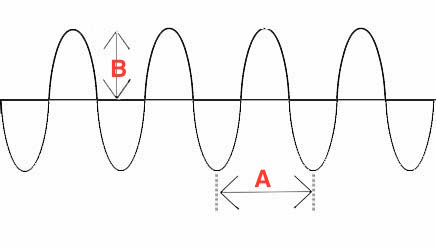
What property of this wave is represented by the letter "A"
a)
amplitude
b)
crest
c)
trough
d)
wavelength
34.
In general, low tides occur...
a)
each hour
b)
2 times a day
c)
each month
d)
twice a month
35.
The large, circular surface-current pattern found in each ocean.
a)
California Current
b)
Surface Current
c)
Gyre
d)
Global Conveyor Belt
36.

Which letter indicates the continental shelf?
a)
A
b)
B
c)
C
d)
D
37.

Which feature is indicated by the letter K?
a)
guyot
b)
continental slope
c)
continental rise
d)
trench
38.
Which feature is indicated by the letter F?
a)
guyot
b)
continental slope
c)
continental rise
d)
trench
39.

Which features of the seafloor represent the flattest part of the Earth's surface?
a)
deep-sea trenches
b)
continental margins
c)
mid-ocean ridges
d)
abyssal plains
40.
Which features of the seafloor are cut by turbidity currents?
a)
longshore bars
b)
submarine canyons
c)
abyssal plains
d)
baymouth bars
41.

What percentage of Earth's surface is covered by oceans?
a)
97 percent
b)
30 percent
c)
50 percent
d)
70 percent
42.
About how much of Earth's surface is covered by land?
a)
30%
b)
50%
c)
60%
d)
70%
43.
The largest of Earth's oceans is the ___.
a)
Pacific
b)
Atlantic
c)
Indian
d)
Arctic
44.
The rising of cold water from deeper layers to replace warmer surface water is called ___.
a)
the Coriolis effect
b)
a surface current
c)
upwelling
d)
reflection
45.
The smallest daily tidal range occurs during which type of tide?
a)
spring tide
b)
flood tide
c)
neap tide
d)
ebb tide
46.
When is the daily tidal range greatest?
a)
spring tide
b)
neap tide
c)
ebb tide
d)
flood tide
47.

_______________ are caused by earthquakes on the ocean floor, volcanic eruptions, or underwater landslides.
a)
tides
b)
waves
c)
tsunamis
d)
surface currents
48.
If 10,000 kilograms of seawater evaporates, how many kg. of salt would be left behind
a)
3.5 kg
b)
35 kg
c)
350 kg
d)
3500 kg
49.
What is the average salt percentage of ocean water?
a)
3.5%
b)
.35%
c)
35%
d)
97%
50.
How do salinity and temperature affect the density of ocean water?
a)
salinity increase = density increase, temp decrease = density increase
b)
salinity decrease = density increase, temp. decrease = density decrease
c)
salinity increase = density increase, temp increase = density increase
d)
salinity decrease = density increase, temp increase = density increase
51.
What causes vertical ocean currents?
a)
The phase of the moon.
b)
The gravitational attraction of the sun
c)
Commercial boating activities.
d)
The temperature and salinity of ocean water
52.

According to the graph below, what happens to the density of a substance as its temperature increases (as you move up on the y-axis)? (Helpful tip: pick at least 2 temperatures and find their densities on the graph. Compare.)
a)
As temperature increases, density stays the same.
b)
As temperature increases, density decreases.
c)
As temperature increases, density increases.
53.

The two factors that effect the density of the ocean are
a)
temperature and winds
b)
winds and salinity
c)
temperature and salinity
d)
Coriolis effect and winds
54.

This is an image of how upwelling occurs. Upwelling is important to organisms because...
a)
when local wind patterns blow along the north west coast, they cause local surface currents to move away from the shore.
b)
upwelling causes warm water to flow to the British Isles and creates a mild climate there.
c)
upwelling brings nutrients to the surface of the ocean to support the growth of phytoplankton and zooplankton.
100 %

