
 Worksheets
Test Review for Unit 2, Solar System
Total questions: 50
Worksheet time: 25mins
Name
Class
Date
1.
Which best describes a solar eclipse?
a)
moon's shadow falls on the Earth
b)
Earth's shadow falls on the moon
c)
Sun's shadow falls on the Earth
d)
Earth's shadow falls on the sun
2.
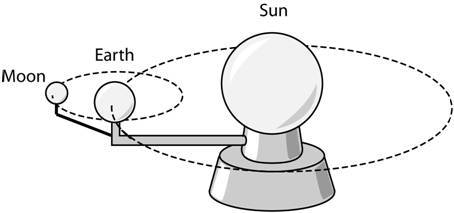
This model can be used to show some relationships between the Earth, Sun, and Moon.
The model shows all of the following EXCEPT –
The model shows all of the following EXCEPT –
a)
the relative sizes of the Moon and Earth
b)
the way the Moon revolves around the Earth
c)
the composition of the Moon, Earth, and Sun
d)
how the Moon and the Earth revolve around the Sun
3.
The time it takes the Moon to go from a new moon to a full moon and back to a new moon is about
a)
1 day
b)
14 days
c)
28 days
d)
365 days
4.
Earth has water in all three states (solid, liquid, and gas). This water is transported via the water cycle through Earth's hydrosphere, atmosphere, biosphere, and lithosphere. What allows Earth to be unique in this way?
a)
the length of its rotation
b)
the tilt of its axis
c)
its distance from the Sun
d)
the presence of oxygen in its atmosphere
5.

What moon phase is at position 7?
a)
1st quarter
b)
3rd quarter
c)
waning gibbous
d)
waning crescent
6.

What moon phase is at position 5?
a)
waxing crescent
b)
waxing gibbous
c)
full moon
d)
waning crescent
7.
What is the correct order of the moon phases?
a)
new, full, 1st quarter, 3rd quarter
b)
new moon, 1st quarter, full moon, 3rd quarter
c)
1st quarter, 3rd quarter, new moon, full moon
d)
new, 1st quarter, 3rd quarter, full
8.

Which type of eclipse is shown in this picture?
a)
Solar Eclipse
b)
Orbit
c)
Lunar Eclipse
d)
Total Eclipse
9.

We do not have a solar or lunar eclipse each month because...
a)
The tilt of the moon's orbit is at 5 degrees
b)
The moon is too small
c)
The moon's orbital distance changes
d)
All choices
10.
The outer planets are largely composed of
a)
magnesium and iron
b)
hydrogen and helium
c)
oxygen and carbon dioxide
d)
nitrogen and oxygen
11.
What caused inner planets to lose hydrogen and helium as they formed?
a)
hydrogen and helium were not in the solar nebula
b)
hydrogen and helium sank to the core of inner planets
c)
fusion of hydrogen to form helium
d)
energy from the sun blew the lighter gases to space
12.
What caused inner planets to lose hydrogen and helium as they formed?
a)
hydrogen and helium were not in the solar nebula
b)
hydrogen and helium sank to the core of inner planets
c)
fusion of hydrogen to form helium
d)
energy from the sun blew the lighter gases to space
13.
99% of Earth's atmosphere is composed of which two gases?
a)
nitrogen and oxygen
b)
hydrogen and helium
c)
oxygen and carbon dioxide
d)
hydrogen and oxygen
14.
Which planet spins backward and is the slowest of all the planets?
a)
Mars
b)
Neptune
c)
Venus
d)
Earth
15.
The right combination of temperature, water, and oxygen
a)
affects Neptune’s orbit.
b)
supports life on Earth.
c)
causes gas giants to form.
d)
results in storms on Jupiter.
16.
Which are the inner planets?
a)
Mercury, Mars, Earth, and Venus
b)
Earth, the Moon, Mars
c)
Neptune, Pluto, Earth
d)
:)
17.

How many planets are there all together in our solar system?
a)
10
b)
9
c)
8
d)
7
18.
Which are the outer planets?
a)
Jupiter, Saturn, Uranus, and Neptune
b)
Venus, Mercury, Earth, Neptune
c)
Saturn, Jupiter, and Neptune
19.
Almost Earth’s twin in size and mass, this planet has very thick atmosphere.
a)
Venus
b)
Mars
c)
Mercury
d)
Neptune
20.
What are the reasons for the seasons?
a)
Earth's tilt and rotation.
b)
Earth's rotation and revolution.
c)
Earth's tilt and revolution.
d)
Earth's tilt and resolution
21.

In this diagram, the motion of the Earth can best be described as -
a)
Rotation
b)
Revolution
22.

In this diagram, the motion of the EARTH can best be described as -
a)
Rotation
b)
Revolution
23.
Day and night are caused by -
a)
Rotation
b)
Revolution
24.
The outermost planets have what type of physical composition?
a)
gaseous
b)
terrestrial
c)
liquid
d)
plasma
25.
Earth and Mars have similar seasons because their axis is tilted to nearly the same degree. What can be inferred about a planet without a tilted axis?
a)
Its temperatures are more extreme throughout the year.
b)
It has more seasons than Earth.
c)
It does not revolve around the Sun.
d)
It does not have seasons.
26.
Which of the following is true about the way planets in our solar system revolve around the sun?
a)
all are revolving clockwise around the sun
b)
all are revolving counterclockwise around the sun
c)
there is no pattern to the direction planets revolve
d)
we cannot determine the direction of revolution for some planets
27.
Which of the following correctly lists objects of our solar system in order from the sun?
a)
Earth, Venus, Mars, Mercury, Asteroid Belt, Jupiter, Saturn, Neptune Uranus,Kuiper Belt
b)
Asteroid Belt, Kuiper Belt, Mercury, Venus, Earth, Mars, Jupiter, Saturn, Uranus, Neptune, Kuiper Belt
c)
Mercury, Venus Earth, Mars, Asteroid Belt, Jupiter, Saturn, Uranus, Neptune, Kuiper Belt
d)
Mercury, Venus, Earth, Mars, Asteroid Belt, Jupiter, Saturn, Uranus, Neptune, Asteroid Belt, Kuiper Belt
28.
Which of these satellites first orbited Earth?
a)
Voyager
b)
Mercury
c)
Skylab
d)
Sputnik
29.
Which of these satellites orbited Earth most recently?
a)
Voyager
b)
Mercury
c)
Sputnik
d)
Skylab
30.
The timelines below list several events in space exploration. Which order is correct?
a)
Apollo 11 lands on Moon - Sputnik launch - Mercury orbits Earth - Viking I lands on Mars
b)
Mercury orbits Earth - Sputnik launch - Apollo 11 lands on Moon - Viking I lands on Mars
c)
Sputnik launch - Mercury orbits Earth - Apollo 11 on the Moon - Viking I lands on Mars
d)
Sputnik launch - Apollo 11 - Mercury orbits Earth - Viking I lands on Mars
31.
Which of these is a list of technologies that developed through our research designed to help us explore space?
a)
freeze-dried food, lightweight fabrics, medical monitoring devices
b)
adjustable beds, GPS, better rockets
c)
radio communication, reflective material, plastic
d)
plastic, compact disks, Bluetooth
32.
A newly discovered planet is found to have liquid water, temperatures between 5 and 35 degrees Celsius, and a mountainous landscape. What else must it have in order to support life as we know it?
a)
a flat landscape in some locations
b)
distinct seasons
c)
warmer temperature
d)
oxygen in its atmosphere
33.
Venus is the only planet in the solar system that rotates clockwise. This is called
a)
prograde motion
b)
retrograde motion
c)
altered spin
d)
reverse revolution
34.
Select the pair of bodies which are LEAST alike in composition and size
a)
asteroid and meteor
b)
moon and comet
c)
earth and venus
d)
uranus and neptune
35.
Which of the following bodies are MOST alike in composition and size?
a)
Earth and Venus
b)
Uranus and Neptune
c)
asteroid and comet
d)
meteor and asteroid
36.
We are composed mainly of rock and metal.
a)
comets and stars
b)
stars and meteors
c)
asteroid and meteors
d)
comets and asteroid
37.
One similarity between asteroids, comets and meteoroids is that they all:
a)
are made of rock
b)
come from the Asteroid Belt
c)
come from the Oort Cloud
d)
orbit the sun
38.
Describe a comets origin and orbit
a)
Between Mars and Jupiter, long-elliptical orbit
b)
Oort cloud or Kuiper belt, circular orbit similar to a planet
c)
Another galaxy, long-elliptical orbit
d)
Oort cloud or Kuiper belt, long-elliptical orbit
39.
All of these objects have a nearly circular orbit except
a)
moons
b)
comets
c)
planets
40.
The solar wind causes comets to develop a "tail" as they approach the sun in their orbit. How does this tail point?
a)
toward the sun
b)
away from the sun
c)
parallel to the sun
d)
perpendicular to the sun
41.
Which of the following is not a unique characteristic of Pluto that contributed to its reclassification as a dwarf planet?
a)
its composition is icy, like a comet, rather than gaseous like its neighboring planets
b)
its orbit is oval (elliptical) rather than being nearly circular like other planets
c)
it is too small to have enough gravity to clear its path around the Sun of other objects
d)
its shape is more like that of an egg than a sphere
42.

Which type of eclipse has the Earth casting a shadow on the Moon?
a)
Solar Eclipse
b)
Lunar Eclipse
c)
Total Eclipse
d)
Partial Eclipse
43.
Which planet rotates on its side?
a)
Uranus
b)
Jupiter
c)
Saturn
d)
Neptune
44.

A student created a diagram to compare the characteristics of the Earth and the Moon.
Which of the following characteristics could be placed in the center part of the diagram?
Which of the following characteristics could be placed in the center part of the diagram?
a)
orbits another object
b)
strong gravitational pull
c)
rotates every 24 hours
d)
has an atmosphere
45.
A solar eclipse can only occur during .....
a)
Full Moon
b)
New Moon
c)
Quarter Moon
d)
Equinox
46.
The majority of Jupiter is made up of
a)
nitrogen and oxygen.
b)
helium and oxygen.
c)
rock and water.
d)
hydrogen and helium.
47.
Which of the following planets experiences a runaway greenhouse effect?
a)
Venus
b)
Mars
c)
Mercury
d)
Earth
48.
How long ago was the solar system formed
a)
5.6 Billion years ago
b)
3.5 Trillion years ago
c)
3 days ago
d)
4.6 Billion years ago
49.
A nebula is:
a)
A cloud of ice
b)
A cloud of dust and gas
c)
A cloud of just gas
d)
A cloud of just dust
50.
Our solar system began as a -
a)
nebula
b)
quasar
c)
prototype
d)
neutron star
100 %

