
 Worksheets
Earthquakes, Seismic Waves, Boundaries and Volcanoes Review
Total questions: 84
Worksheet time: 1hrs 14mins
Name
Class
Date
1.

When two tectonic plates slide past each other, neither crashing together, nor pulling apart, the boundary between them is called...
a)
Divergent boundary
b)
Convergent boundary
c)
Transform boundary
d)
Subduction
2.

Sometimes, when two tectonic plates collide, one is pushed below the other; this action at the convergent boundary is called...
a)
Divergent boundary
b)
Convergent boundary
c)
Transform boundary
d)
Subduction
3.

When an oceanic plate is subducted under a continental plate, a deep valley is formed in the ocean. What is this valley called?
a)
a trench
b)
a rift zone
c)
ocean spreading ridge
d)
Continental crust
4.

When a continental plate is pulled away from another continental plate, the area of crust that is thinned and pulled apart is called.
a)
a trench
b)
a rift zone or rift valley
c)
ocean spreading ridge
d)
Continental crust
5.

When an oceanic plate is pulled away from another oceanic plate,, magma spews from below the crust and this is formed.
a)
a trench
b)
a rift zone or rift valley
c)
ocean spreading ridge
d)
continental crust
6.
When convergent plates collide, if both plates are pushed upward, this forms.
a)
Fissures
b)
Mountain Ranges
c)
Volcanoes
d)
Rock Cycle
7.
When fissures form, magma is pushed to the surface forming...
a)
Fissures
b)
Mountain Ranges
c)
Volcanoes
d)
Rock Cycle
8.
The movement of the tectonic plates continually creates new rock on the surface of the earth and pulls old rock back into the mantle and recycles it. This process is called...
a)
Fissures
b)
Mountain Ranges
c)
Volcanoes
d)
Rock Cycle
9.

When two tectonic plates are moving away from each other, the boundary between them is called...
a)
Divergent boundary
b)
Convergent boundary
c)
Transform boundary
d)
Subduction
10.

When two tectonic plates are moving toward each other, the boundary between them is called...
a)
Divergent boundary
b)
Convergent boundary
c)
Transform boundary
d)
Subduction
11.

What type of plate boundary is occurring between the Eurasian Plate and the Indian Plate?
a)
Divergent Boundary
b)
Convergent Boundary
c)
Transform Boundary
12.

Using the plate boundaries map to help you, why do you think there are so many earthquakes in California?
a)
Along divergent boundary which cause MAJOR earthquakes
b)
Along convergent boundary which cause MAJOR earthquakes
c)
Along transform boundary which cause MAJOR earthquakes
13.

What type of plate boundary is occurring between the Cocos Plate and the Caribbean Plate?
a)
Divergent Boundary
b)
Convergent Boundary
c)
Transform Boundary
14.

What type of plate boundary is occurring between the Pacific Plate and the Nazca Plate?
a)
Divergent Boundary
b)
Convergent Boundary
c)
Transform Boundary
15.

What type of stress is this?
a)
compression
b)
shearing
c)
tension
16.

a)
normal fault
b)
reverse fault
c)
strike-slip fault
17.

What type of stress causes these folds?
a)
compression
b)
shearing
c)
tension
18.

a)
normal fault
b)
reverse fault
c)
strike-slip fault
19.

a)
normal fault
b)
reverse fault
c)
strike-slip fault
20.

a)
normal fault
b)
reverse fault
c)
strike-slip fault
21.

a)
normal fault
b)
reverse fault
c)
strike-slip fault
22.

When two oceanic plates converge what landform is produced?
a)
A lake
b)
A river
c)
A mountain range
d)
A trench
23.
When two landmass plates collide the crust crumples what is produced?
a)
A river
b)
A trench
c)
A lake
d)
A mountain range
24.

The San Andreas Fault is an example of a transform boundary. What is produced in this area?
a)
Trenches
b)
Tornadoes
c)
Earthquakes
d)
Rivers
25.

What process taking place in the asthensophere enables the plates to move?
a)
radiation
b)
subvection
c)
conduction
d)
convection
26.
A force that acts on rock to change its shape or volume?
a)
stress
b)
focus
c)
friction
d)
fracture
27.

Stress that stretches rock so that it becomes thinner in the middle!
a)
tension
b)
compression
c)
sheear
d)
rubber-binder
28.

Stress that pushes masses of rock in opposite directions, in a sideways movement?
a)
shear
b)
compression
c)
tension
d)
constriction
29.
A type of fault where the hanging wall slides down...caused by tension.
a)
normal fault
b)
strike-slip fault
c)
reversynclinese fault
30.
The stress force that pushes the crust where two plates are moving together
a)
tension
b)
compression
c)
shear
31.
The stress force that pulls plates past one another sideways is called
a)
shear
b)
compression
c)
tension
32.
A fault caused by rocks moving together
a)
normal fault
b)
reverse fault
c)
slip strike fault
33.

Name the boundary
a)
convergent boundary
b)
divergent boundary
c)
transform boundary
d)
sergent boundary
34.

Name the boundary
a)
convergent boundary
b)
divergent boundary
c)
transform boundary
d)
sergent boundary
35.
The theory that pieces of Earth's lithosphere are in constant motion, driven by convection currents in the mantle.
a)
Plate tectonics
b)
Continental drift
c)
convection currents
d)
subduction zone
36.

What type of stress is this?
a)
compression
b)
shearing
c)
tension
37.

Name the boundary
a)
convergent boundary
b)
divergent boundary
c)
transform boundary
d)
sergent boundary
38.
A deep valley that forms along a divergent boundary.
a)
rift valley
b)
canyon
c)
mid-ocean ridge
d)
ocean valley
39.

In the diagram of the planet, what do we know about the layers, based on the S waves?
a)
1 and 2 are both solids
b)
1 and 2 are both liquids
c)
1 is a solid and 2 is a liquid
d)
1 is a liquid and 2 is a solid
40.
P Waves travel through...
a)
Solids
b)
Liquids
c)
Both
41.
We know there are two layers to the Earth’s core because...
a)
S Waves stop at the outer core
b)
P Waves bend as they reach inner core
c)
P Waves bend as they outer core
d)
All of the above
42.

Which term provides the most accurate classification of the geologic structure shown?
a)
Anticline Fold
b)
Reverse fault
c)
Normal fault
d)
Strike slip fault
43.

Which set of waves are the P waves?
a)
A
b)
B
c)
C
d)
They are all P waves
44.
A
place above a mantle plume where melted rock can form a volcano is a
a)
fissure
b)
mantle plume
c)
hotspot
d)
volcano
45.

The diagram represents the Hawaiian island volcanoes- some of which are extinct because the Pacific Plate has continued moving over the hot spot. Identify which island is most likely to have an active volcano.
a)
A
b)
B
c)
C
d)
D
46.
What is the fewest number of seismographic stations that must record the arrival time of P and S waves in order for the epicenter of an earthquake to be located?
a)
2
b)
3
c)
5
d)
10
47.
Where do the majority of the Earth's volcanoes and earthquakes occur?
a)
Around the Atlantic Ocean
b)
Around the Pacific Ocean
c)
Around Iceland
48.

What does letter "a" represent?
a)
amplitude
b)
wavelength
c)
crest
d)
trough
49.
What does letter "b" represent?
a)
amplitude
b)
wavelength
c)
crest
d)
trough
50.
What does letter "c" represent?
a)
amplitude
b)
wavelength
c)
crest
d)
trough
51.
What does letter "d" represent?
a)
amplitude
b)
wavelength
c)
crest
d)
trough
52.
Which type of wave arrives to a point first?
a)
Primary Waves (P-Waves)
b)
Secondary Waves (S-Waves)
c)
Rayleigh Waves
d)
Love Waves
53.
Which classification of wave does the most damage?
a)
Body Waves
b)
Mega Waves
c)
Surface Waves
d)
Love Waves
54.
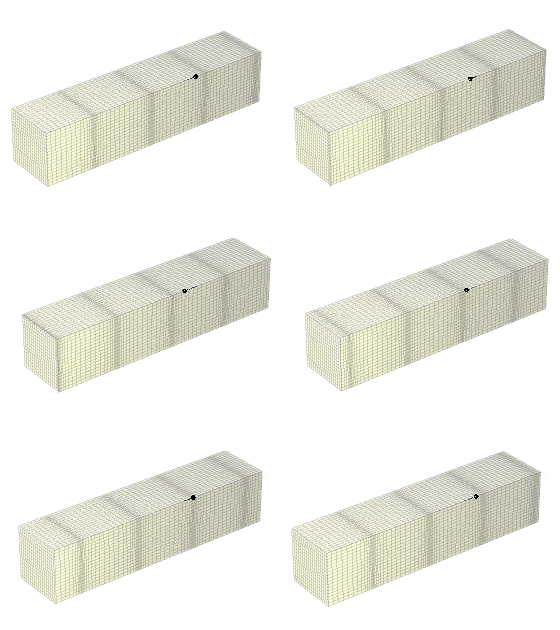
Which body wave is pictured?
a)
P-Wave
b)
S-Wave
c)
Rayleigh Wave
d)
Love Wave
55.

When plates break or slip past each other they form these
a)
mountains
b)
tectonic plates
c)
Fault lines
d)
earthquakes
56.
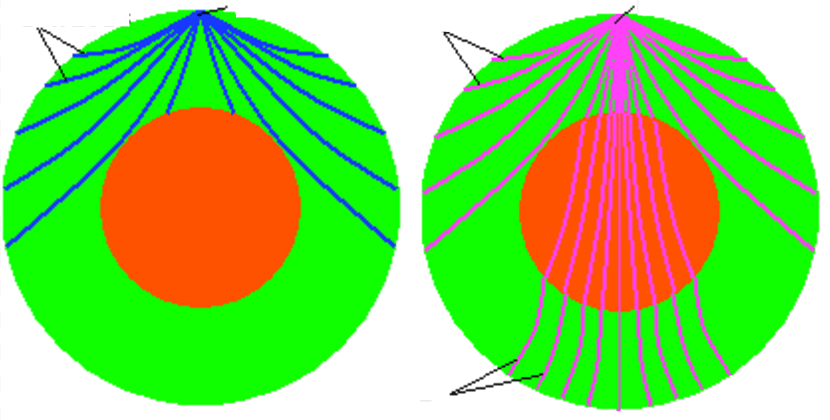
What type of wave are the BLUE waves? (orange circle is the core)
a)
P-waves
b)
S-waves
c)
Love waves
d)
Raleigh waves
57.

Where is the epicenter for this earthquake located based on triangulation?
a)
A
b)
B
c)
C
d)
D
58.

Where is the epicenter located?
a)
A
b)
B
c)
C
d)
There is no epicenter
59.
Which type of seismic waves are the quickest?
a)
S-waves
b)
P-waves
c)
Surface waves
d)
Love waves
60.
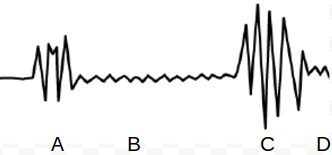
Where are the P-waves located on this seismogram?
a)
A
b)
B
c)
C
d)
D
61.
Which kind of waves canNOT travel through a liquid?
a)
P waves
b)
S waves
62.
The epicenter of an earthquake is
a)
The point below the surface where rock begins to break and the first motion occurs
b)
The seismic station closest to the earthquake
c)
The place where the greatest damage occurs
d)
The point on the surface directly above the focus
63.
Which travels fastest, always being the first detected by seismic stations?
a)
P waves
b)
S waves
64.
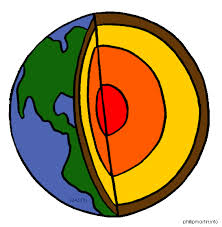
Which layer is made up of iron and nickel?
a)
Crust
b)
Mantle
c)
Inner Core
d)
Lithosphere
65.
A transverse and a longitudinal wave that combine at or near the boundary between two media
a)
A. surface wave
b)
B. mechanical wave
c)
C. wave
d)
D. electromagnetic wave
66.

What are the "waves" called that come from an earthquake?
a)
Thunder
b)
Seismic
c)
Hang 10
d)
Lava
67.
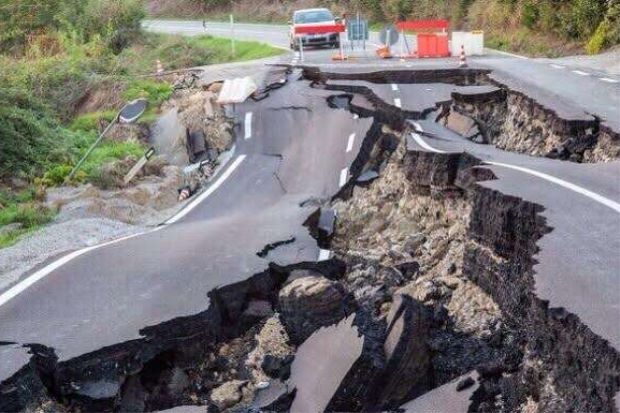
What are earthquakes?
a)
rolling, shaking, moving or shocking of the Earth's surface
b)
a giant tidal wave
c)
an eruption
d)
a super storm
68.
If you traveled from the center of Earth to the surface, the pressure would...
a)
increase
b)
decrease
c)
stay the same
d)
unsure
69.
Density ____ as the molecules in the layer get closer together.
a)
Increases
b)
Decreases
70.
Density ____ as waves travel deeper into the earth.
a)
Increases
b)
Decreases
71.
Pressure ____ as waves travel deeper into the earth.
a)
Increases
b)
Decreases
72.
Temperature ____ as waves travel deeper into the earth.
a)
Increases
b)
Decreases
73.
The Mantle is ____ dense than the core.
a)
More
b)
Less
74.
The Mantle is ____ dense than the crust.
a)
More
b)
Less
75.
The Outer Core is a___
a)
Solid
b)
Liquid
76.
The Inner Core is a____
a)
Solid
b)
Liquid
77.

What do we know about the materials that make up the two layers by looking at the s waves?
a)
Both layers are made of the same material
b)
Each layer is made of a different kind of material
78.

What do we know about the material in each layer by looking at the S waves?
a)
Both layers are made of the same material
b)
Each layer is made of a different kind of material
79.
An instrument that records vibrations in the ground and determines the location and strength of an earthquake.
a)
Seismograph
b)
Shakeograph
c)
Seismogram
d)
Epicenter
80.
The point on Earth's surface directly above an earthquake's starting point or focus.
a)
Hot spot
b)
Focus
c)
Moho point
d)
Epicenter
81.
A tracing of earthquake motion created by a seismograph.
a)
P-wave
b)
Seismograph
c)
S-wave
d)
Seismogram
82.
Which of the following is true?
a)
Charleston,SC is at risk for a major earthquake, but not a tsunami.
b)
Charleston, SC is at risk for a major earthquake and a tsunami.
c)
Charleston, SC is at risk for a tsunami, but not an earthquake.
d)
Charleston, SC has nothing to worry about. We are not over any active fault lines.
83.

What type of fault is the San Andreas?
a)
Convergent
b)
Transform
c)
Optimus Prime
d)
Divergent
84.
The most destructive type of wave is a
a)
P-wave
b)
S-wave
c)
Surface wave
d)
transverse wave
100 %

