
 Worksheets
Weather, Climate and Ocean Currents
Total questions: 41
Worksheet time: 38mins
Name
Class
Date
1.
If the Earth did not rotate on its axis, there would be no
a)
Greenhouse effect
b)
Coriolis effect
c)
Global warming
d)
Convection
2.
What causes vertical ocean currents?
a)
The phase of the moon.
b)
The gravitational attraction of the sun
c)
Commercial boating activities.
d)
The temperature and salinity of ocean water
3.
Which is the primary cause of surface winds on Earth?
a)
Unequal heating of the Earth
b)
Deflection in prevailing winds caused by the coriolis effect.
c)
Rotational speeds of Earth's surface at various latitudes.
4.
How does climate generally change with elevation?
a)
Cooler with higher altitude
b)
Warmer with higher altitude
5.
The climate in cities that are close to a large body of water tends to be:
a)
Cooler in the summer and warmer in the winter than inland cities
b)
Cooler in the winter and warmer in the summer than inland cities
c)
Cooler in the winter and the summer than inland cities
d)
Warmer in the winter and the summer than inland cities
6.
Deep Ocean currents are a result of
a)
Global Wind Patterns
b)
Earth's Rotation
c)
Density
d)
All of the above
7.
The Gulf stream carries _____________ water from the east coast of The United States to the West coast of Europe.
a)
Cold
b)
Warm
c)
Freezing
d)
Fresh
8.
Constantly moving system of deep-ocean circulation driven by temperature and salinity. It moves water around the globe.
a)
California Current
b)
Global Conveyor Belt
c)
Surface Currents
d)
Gulf Stream
9.
A horizontal movement of ocean water that is caused by wind and that occurs at or near the ocean's surface.
a)
Gulf Stream
b)
Global Conveyor Belt
c)
Surface Current
d)
Gyre
10.
The large, circular surface-current pattern found in each ocean.
a)
California Current
b)
Surface Current
c)
Gyre
d)
Global Conveyor Belt
11.
Warm air sinks, and cold air rises.
a)
True
b)
False
12.
Winds are moving air.
a)
True
b)
False
13.
What type of winds blow constantly, predictably, and over long distances?
a)
land breezes
b)
mountain breezes
c)
global winds
d)
sea breezes
14.

What kind of breeze is this & what time of day/night would it form?
a)
Land breeze - daytime
b)
Land breeze - nighttime
c)
Sea breeze - daytime
d)
Sea breeze - nighttime
15.
Where does the initial source of energy come from that creates winds?
a)
the moon
b)
the Sun
c)
the Earth's surface
d)
the rotation of the Earth
16.
Why is it warmer at the equator than at the poles?
a)
a. The sun strikes at a very slanted angle at the equator.
b)
b. The sun strikes the Earth at a 90 degree angle at the equator.
c)
c. The sun strikes at the most direct angle at both poles.
d)
d. The sun strikes the Earth at a 90 degree angle at the poles.
17.
Near the top of the troposphere is a narrow band of high speed winds called the______.
a)
westerlies
b)
jet stream
c)
trade winds
d)
local winds
18.
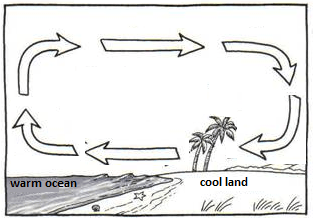
What kind of breeze is this and when would it form?
a)
Land breeze - daytime
b)
Land breeze - nighttime
c)
Sea breeze - daytime
d)
Sea breeze - nighttime
19.
Which global winds have the greatest impact on the weather in the US?
a)
trade winds
b)
prevailing westerlies
c)
doldrums
d)
polar easterlies
20.
A severe storm which involves a funnel cloud forming over land is:
a)
hurricane
b)
tornado
c)
thunderstorm
d)
blizzard
21.
A severe storm that involves winds over 119mph and forms over water is:
a)
tornado
b)
thunderstorm
c)
hurricane
d)
blizzard
22.
Why do hurricanes inflict more damage than tornadoes?
a)
they are larger
b)
longer duration
c)
also associated with flooding and strong rains
d)
all of the rest
23.
Air pressure is greatest:
a)
closer to Earth
b)
farther from Earth
24.

Which number illustrates Condensation?
a)
1
b)
2
c)
3
d)
4
25.
Rain, snow, sleet, and hail are all forms of _____.
a)
precipitation
b)
condensation
c)
evaporation
d)
climate
26.

What part of the water cycle does this picture show?
a)
condensation
b)
precipitation
c)
evaporation
27.
Which of these is an example of precipitation?
a)
snow
b)
air
c)
clouds
d)
vapor
28.
Which is the opposite of condensation?
a)
runoff
b)
evaporation
c)
precipitation
d)
transpiration
29.
Which best explains why runoff is important?
a)
It returns water to other locations on Earth
b)
It increases the chance of flooding
c)
It makes evaporation occur faster
d)
It increases condensation
30.

What is it called when plants give off water vapor as a waste product?
a)
condensation
b)
evaporation
c)
sublimation
d)
transpiration
31.
What is the water cycle?
a)
the 3 forms of water
b)
the movement of water on, above, or below the surface of the Earth
c)
when water melts
d)
when clouds form
32.
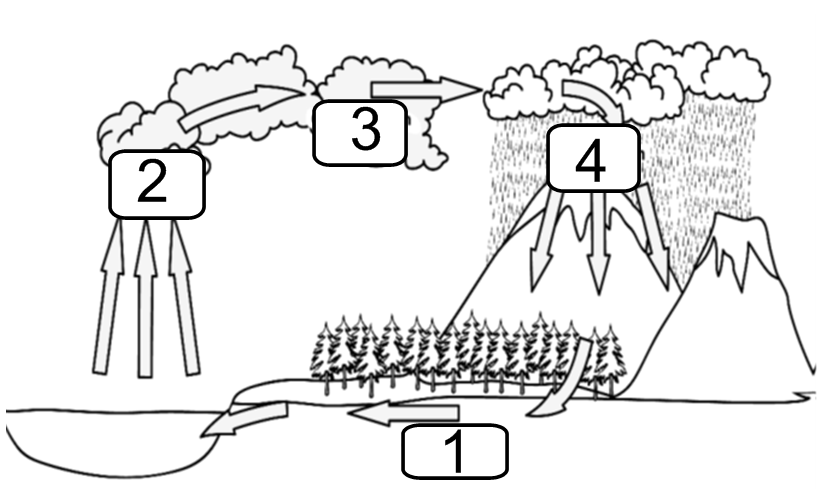
Which stage does the #2 show in the diagram?
a)
condensation
b)
evaporation
c)
precipitation
d)
run off
33.

what does the #4 show in the diagram?
a)
condensation
b)
evaporation
c)
precipitation
d)
run off
34.
Which is not a factor that affects climate?
a)
altitude
b)
latitude
c)
lakes and oceans
d)
living organisms
35.

The numbers in this image refer to_____.
a)
latitude
b)
longitude
c)
temperature
d)
angle of the Sun's rays hitting Earth
36.

The rain shadow is shown at ____
a)
A
b)
B
c)
C
d)
D
37.
What is the condition of the Earth's atmosphere at a certain time and place?
a)
climate
b)
temperature
c)
weather
d)
air pressure
38.
The sun's energy produces the
a)
Coriolis effect
b)
water cycle
c)
seasons
d)
tides
39.

A group of friends gather around a fire to stay warm.
a)
conduction
b)
convection
c)
radiation
40.

Walking on the warm sand sand with your bare feet.
a)
conduction
b)
convection
c)
radiation
41.

Blow drying your wet hair.
a)
conduction
b)
convection
c)
radiation
100 %

