wayground logo

Free Printable Worksheets

NEW

Font size

S
M
L
XL
Worksheets

Electrons and Chemical Bonds

Total questions: 59

Worksheet time: 58mins

Name
Class
Date
1.
Some coins are alloys of zinc and copper. Which type of bond forms in these coins?
a)
covalent  
b)
hydrogen
c)
ionic 
d)
metallic 
2.
How can two different nonmetals form a compound? 
a)
by sharing protons
b)
by sharing electrons
c)
by transferring protons
d)
by transferring electrons
3.
Compounds can be classified as covalent or ionic by noting the location on the periodic table for each atom in the compound. Which compound is covalently bonded? 
a)
sodium chloride (NaCl)
b)
sulfur dioxide (SO2)
c)
potassium bromide (KBr)
d)
 magnesium chloride (MgCl2)
4.
Based on its electron configuration, which element will most likely gain electrons from another element when forming an ionic compound?  
a)
potassium (K)
b)
vanadium (V)
c)
iodine (I)
d)
xenon (Xe) 
5.
Metal atoms will most likely form ions by  
a)
the loss of electrons.
b)
loss of protons.
c)
gain of electrons.
d)
gain of protons.
6.
Which compound results from covalent bonding?  
a)
NH4Cl
b)
K2SO4
c)
NaCl
d)
C6H12O6 
7.
Atoms of which two elements will form an ionic bond?  
a)
Mg and Cl 
b)
N and O
c)
Fe and Co
d)
Rb and Al
8.
An ionic bond is formed through the...  
a)
transfer of electrons
b)
sharing of electrons 
c)
sea of electrons 
d)
 decay of electrons 
9.
A covalent bond is formed through the... 
a)
gaining of electrons
b)
 loss of electrons
c)
 sharing of electrons
d)
transfer of electrons 
10.
Marcos and Helen study the electron configurations of neutral atoms. They draw the atomic models shown. Due to their electron structure, what do the two atoms have in common? 
a)
 family
b)
period
c)
mass number
d)
atomic number
11.
The diagrams show part of the Periodic Table of the Elements. The shaded areas represent a general trend in the number of valence electrons in the elements. The lighter shading indicates fewer valence electrons and the darker shading indicates more valence electrons. Which diagram best shows the relationship between the elements and the number of valence electrons? 
a)
A
b)
B
c)
C
d)
D
12.
Potassium is a very reactive metal and does not occur free in nature. A diagram of a potassium atom is shown.  Which of the following is the most likely to occur? 
a)
Gain seven electrons.
b)
Lose one electron. 
c)
The atom is stable and will note form an ion.
d)
Lose one proton. 
13.
The electron dot diagrams of calcium and magnesium are shown.  What do the two dots next to the symbol represent?  
a)
All electrons
b)
 Protons 
c)
Valence electrons
d)
Neutrons 
14.
Which element could have the following dot diagram?  
a)
helium
b)
magnesium
c)
oxygen
d)
potassium 
15.
As you move from left to right across a period, the number of valence electrons...
a)
 increases then decreases
b)
 decreases
c)
s stays the same
d)
increases 
16.

As you move from left to right across a period, the number of valence electrons...

a)

increases then decreases

b)

decreases

c)

stays the same

d)

increases

17.
Covalent bonds are between...
a)
two or more nonmetals
b)
sodium and chlorine
c)
metals and metals
d)
metals and nonmetals
18.
What is the name for an ion with a positive charge?
a)
cation
b)
anion
c)
onion
d)
union
19.
What is the name for an ion with a negative charge?
a)
cation
b)
anion
c)
onion
d)
union
20.
What kind of bond forms when atoms share electrons?
a)
ionic
b)
covalent
c)
artificial
d)
univalent
21.
What kind of bond forms when atoms exchange electrons?
a)
ionic
b)
covalent
c)
artificial
d)
univalent
22.
What are valence electrons?
a)
sum of the protons and neutrons
b)
protons minus electrons
c)
electrons in the inner shells
d)
electrons in the outer shell
23.
How many valence electrons does oxygen have?
a)
2
b)
4
c)
5
d)
6
24.
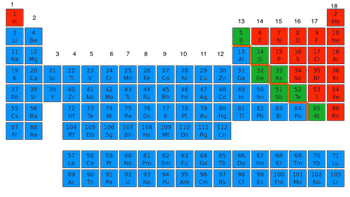
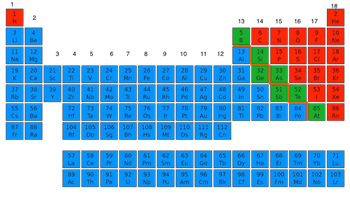
Where are metals located on the periodic table?
a)
Blue
b)
Green
c)
Red
25.
Where are the nonmetals located on the periodic table? 
a)
Blue
b)
Red
c)
Green
26.
Where are the metalloids located on the periodic table?
a)
Blue
b)
Red
c)
Green
27.
Which of these is not a real bond in chemistry?
a)
James
b)
Ionic
c)
Covalent
28.

All but Hydrogen and Helium want how many valence electrons?

a)

1

b)

2

c)

8

d)

0

29.

Why do atoms bond?

a)

to find a date

b)

to become bigger

c)

to go to dog jam

d)

to become stable

30.
What is the name of this element?
a)
Helium
b)
Hydrogen
c)
Argon
d)
Silver
31.

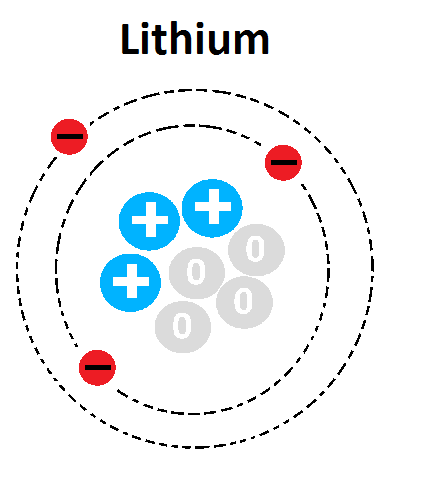
What element is represented in this Bohr Model?

a)

Carbon

b)

Hydrogen

c)

Aluminum

d)

Lithium

32.
What is the name of this element?
a)
Lithium
b)
Boron
c)
Carbon
d)
Neon
33.
What is the name of this element?
a)
Beryllium
b)
Boron
c)
Barium
d)
Bromine
34.
What is the mass number of this atom?
a)
1
b)
3
c)
4
d)
7
35.
What is the atomic number of this atom?
a)
2
b)
4
c)
6
d)
none of the above
36.
What group does this element belong to?
a)
Group 1: Alkali metals
b)
Group 18: Noble Gases
c)
Group 2: Alkaline-Earth Metals
d)
Group 17: Halogens
37.
How many valence electrons?
a)
2
b)
3
c)
5
d)
10
38.
What's a valence electron?
a)
electrons in the second energy level
b)
electrons in the outermost energy level
c)
the atomic number
d)
electrons in the first level
39.

On the periodic table, Groups are

a)

Horizontal rows

b)

Vertical columns

40.

On the periodic table, Periods are

a)

Horizontal rows

b)

Vertical columns

41.

The innermost energy level has a maximum of how many electrons?

a)

1

b)

2

c)

6

d)

8

42.

How many dots would you put around carbon, a group 14 element?

a)

4

b)

6

c)

8

d)

18

43.

This could be the dot diagram of

a)

Mg

b)

Cl

c)

C

d)

O

44.

This is a correct dot diagram for neon (Ne)

a)

true

b)

false

45.
This is the correct dot diagram for nitrogen, group 15.
a)
true
b)
false
46.
This could be the dot diagram of
a)
Mg
b)
Cl
c)
C
d)
O
47.

How many electrons should sodium, atomic number 11, have around its Lewis dot model?

a)

1

b)

2

c)

3

d)

4

48.

How would you draw a Lewis dot diagram for Magnesium?

a)
b)
c)
d)
49.
How many electrons should Lithium have around its Lewis dot model?
a)
1
b)
2
c)
3
d)
4
50.
How many electrons should Beryllium have around its Lewis dot model?
a)
1
b)
2
c)
3
d)
4
51.
How many electrons does Si contain? (click to see image)
a)
14
b)
28
c)
2
d)
None of these
52.
How many electrons does potassium K contain? (click to see image)
a)
19
b)
39
c)
20
d)
40
53.
How many electrons should Chlorine have around its Lewis dot model?
a)
5
b)
6
c)
7
d)
8
54.

In metallic bonds electrons are:

a)

shared

b)

move around the nuclei randomly

c)

transferred

55.

Which of the following lists of elements contain only metals?

a)

Li, Al, Te

b)

Ni, Pb, H

c)

Na, Os, Ga

d)

Ca, Zn, I

56.

Malleability and ductility are characteristics of compounds with

a)

covalent bonds

b)

metallic bonds

c)

ionic bonds

d)

alloy bonds

57.

In metals, the valence electrons are

a)

attached to the most positive ions

b)

shared by all of the atoms

c)

are bonded to the least electronegative element

d)

shiny

58.

Malleability means

a)

the ability to be drawn into a wire

b)

the electrons of metals are mobile

c)

the ability to be hammered into a shape

d)

the ability to be a conductor of electricity

59.

Metals are hard because metals have a

a)

sea of electrons that tightly hold the nuclei together

b)

they form triple bonds

c)

low melting point

d)

high luster