
 Worksheets
Breathing and respiration
Total questions: 50
Worksheet time: 31mins
Name
Class
Date
1.
What keeps mucus and dirt out of your lungs?
a)
Your diaphragm
b)
Your medula
c)
Your heart
d)
Cilia
2.

Alveoli has a mesh covering made of what?
a)
Cartilage
b)
Blood Vessles
c)
Bronchi
d)
Blue Alveoli
3.

What is the entrance to the lungs called?
a)
Lungs
b)
Bronchi
c)
Trachea
4.
The trachea leads to the...
a)
Bronchioles
b)
Bronchi
c)
Esophagus
d)
Pulmonary Vessel
5.
Oxygen from the air enters the blood stream at what location?
a)
Cardiac Notch
b)
Pulmonary Vein
c)
Alveoli
d)
Paranasal Sinuses
6.
Inhale!!!
My lungs ________
My lungs ________
a)
Got Smaller
b)
Got Bigger
7.
EXHALE!!!
My lungs are __________________ air.
My lungs are __________________ air.
a)
Taking in
b)
Letting out
8.
EXHALE!!
My lungs are getting _______________
My lungs are getting _______________
a)
smaller
b)
bigger
9.

Where is the bronchi?
a)
A
b)
B
c)
C
d)
D
10.
What does the lung send to blood cells
a)
Oxygen
b)
Nitrogen
c)
Carbon Dioxide
11.
The Bronchi extends to your right and left lung
a)
True
b)
False
12.

What is this?
a)
Trachea
b)
Vocal Cord
c)
Aveoli
d)
Pharynx
13.

When you breathe, your lungs take in ___ and remove ___.
a)
Air/Oxygen
b)
Oxygen/Carbon Dioxide
c)
Carbon Dioxide/Waste
d)
Waste/air
14.

The air sacs that are covered with capillaries where gas exchange takes place is _________?
a)
Bronchi
b)
Blue/Yellow Trachea
c)
Oxygen
d)
Alveoli
15.

What is the tube that is also known as your windpipe?
a)
Esophagus
b)
Bronchi
c)
Trachea
d)
Alveoli
16.
The larynx is also known as the ______.
a)
Voice box
b)
Passage to the lungs
c)
Throat
d)
Airway
17.
Which of the following does NOT make up part of the lungs?
a)
Alveoli
b)
Bronchioles
c)
Trachea
d)
Bronchi
18.

What is the function of the bronchi?
a)
Transport air from nose to lungs
b)
Transport air from trachea to lungs
c)
Transport air from lungs to alveoli
d)
Transport air from alveoli to blood
19.

What is the main function of the respiratory system?
a)
to provide oxygen and remove carbon dioxide from the body
b)
to bring oxygen to the body
c)
to break down food and absorb nutrients
d)
to remove oxygen from the body and deliver carbon dioxide
20.
What reactants are there in cellular respiration?
a)
Water and Glucose
b)
Oxygen and Glucose
c)
Carbon Dioxide and Water
d)
Twenty One Pilots
21.
What happens to your breathing rate when you exercise?
a)
It increases
b)
It decreases
c)
It stays the same
22.
Which organ excretes carbon dioxide?
a)
Lungs
b)
Liver
c)
Heart
d)
Kidney
23.
What are the products of aerobic respiration?
a)
Glucose and oxygen
b)
Carbon dioxide and water
c)
Lactic acid
d)
Carbon monoxide
24.
What type of respiration requires oxygen?
a)
Aerobic
b)
Anaerobic
25.
What happens to your pulse when you exercise?
a)
It increases
b)
It decreases
c)
It stays the same
26.
All living things do which of the following?
a)
Chemosynthesis
b)
Respiration
c)
photosynthesis
d)
all of the answers
27.
Which gas is a product released during photosynthesis that humans need for survival?
a)
Carbon dioxide
b)
neon
c)
nitrogen
d)
oxygen
28.
In which way are photosynthesis and cellular respiration different?
a)
Cellular respiration stores ATP, while photosynthesis releases ATP.
b)
Cellular respiration produces oxygen, while photosynthesis uses oxygen.
c)
Photosynthesis releases energy, while cellular respiration stores energy.
d)
Photosynthesis used carbon dioxide, while cellular respiration produces carbon dioxide.
29.

Which of the following structure is where cellular respiration occurs in the cell?
a)
nucleus
b)
cytoplasm
c)
mitochondria
d)
vacuoles
30.
What type of respiration does not require oxygen?
a)
Aerobic
b)
Anaerobic
31.
How do human beings get rid of carbon dioxide?
a)
it is excreted
b)
it is exhaled
32.
What is the equation for respiration?
a)
carbon dioxide + water --> oxygen + glucose
b)
food + energy --> oxygen + water
c)
oxygen + glucose --> carbon dioxide + water
d)
Carbon dioxide + glucose --> water + oxygen
33.
What is the equation for photosynthesis?
a)
carbon dioxide + water --> oxygen + glucose
b)
food + energy --> oxygen + water
c)
oxygen + glucose --> carbon dioxide + water
d)
Carbon dioxide + glucose --> water + oxygen
34.
Yeast undergoes anerobic respiration.
a)
True
b)
False
35.
Which statement is NOT correct?
a)
Red blood cells transport oxygen from the cappilaries surrounding the alveoli towards the heart
b)
Red blood cells transport carbon dioxide from the cappilaries surrounding the alveoli towards the heart
c)
Red blood cells transport carbon dioxide away from the heart towards the capillaries surrounding the alveoli
d)
The alveoli are very moist to allow gases to diffuse into the blood stream
36.
What does the Larynx hold ?
a)
The larynx holds the whole respitory system.
b)
The larynx holds the trachea.
c)
The larynx holds the vocal chords.
d)
The larynx hold the wind pipe.
37.
We receive oxygen and take out what from our bodies ?
a)
Our need to live
b)
Carbon Dioxide
c)
Molecules unneeded to the body.
d)
Chemicals needed to the body .
38.
The place in the lungs where oxygen and carbon dioxide are exchanged
a)
Diaphragm
b)
Alveolus
c)
Bronchi Tube
d)
Trachea
39.
Tubes that move air from the trachea to the lungs.
a)
Alveoli
b)
Bronchi
c)
Veins
d)
Arteries
40.
What is the main bone structure that protects the lungs?
a)
Vertebrae
b)
Rib cage
c)
Skull
d)
Pelvis
41.
Which part of the Respiratory System collects air from the environment & heats/moistens the air before entering the body?
a)
lungs
b)
nose
c)
heart
d)
brain
42.
Kim is studying certain blood vessels in the body. Blood vessels travel from the heart to the muscles in the upper arm. Which type of vessel is Kim studying?
a)
Veins
b)
arteries
c)
capillaries
d)
lymph ducts
43.
What is the main organ of the circulatory system?
a)
Bladder
b)
Heart
c)
Veins
d)
Arteries
44.
How many chambers does the heart have ?
a)
4
b)
6
c)
3
d)
1
45.
What is the main function of the heart ?
a)
The heart circulates blood and oxygen throughout the body.
b)
The heart is the control centers for all body activities.
c)
The heart gets rid of the wastes in your body produced by homeostasis.
d)
The heart transports , protection and regulation. Blood transports the following substances:
46.

What is the general path blood takes through the body?
a)
Body, lungs, body, heart
b)
Heart, body, heart, lungs
c)
Lungs, body, heart, lungs
d)
Heart, lungs, heart, body
47.
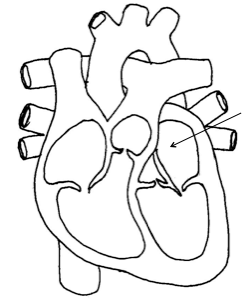
Name this part.
a)
Right atrium
b)
Left ventricle
c)
Right ventricle
d)
Left atrium
48.
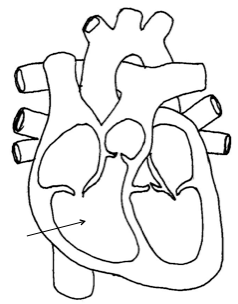
Name this part.
a)
Right ventricle
b)
Pulmonary artery
c)
Left ventricle
d)
Right atrium
49.
Which side of the heart pumps blood into the lungs?
a)
Right
b)
Left
50.
______ carry blood to the heart.
a)
Arteries
b)
Veins
c)
Capillaries
d)
Vena Cava
100 %

