wayground logo

Free Printable Worksheets

NEW

Font size

S
M
L
XL
Worksheets

Final Cell Unit Test Review

Total questions: 50

Worksheet time: 8hrs 7mins

Name
Class
Date
1.
a)
produces ribosomes
b)
contains genetic information
c)
stores food, water, wastes and other materials
2.
a)
controls what enters and exits the cell
b)
contains chlorophyll
c)
thick and rigid
3.
a)
where ribosomes are made
b)
receives proteins from ER and distributes them
c)
assembles amino acids into proteins
4.
a)
produces energy a cell needs
b)
where ribosomes are made
c)
packages amino acids and moves them out of the cell
5.
a)
control center of the cell
b)
captures energy from sunlight
c)
found in plant and animal cells
6.
a)
found only in plants
b)
contains chlorophyll
c)
produces energy
7.
Which 2 organelles are in plants and animals?
a)
cell wall and cytoplasm
b)
nucleaus and plastids
c)
cell membrane and cytoplasm
d)
cell membrane and chlorophast
8.
What is the gel-like substance inside of cells called?

a)
photoplasm
b)
photosynthesis
c)
cytoskeleton
d)
cytoplasm
9.
What is Osmosis?
a)
equal concentration
b)
diffusion of water through a selectively-permeable membrane
c)
high to low concentration
d)
non-polar tail
10.
Which is true about active transport?
a)
It requires energy
b)
it does not require energy
c)
It moves substances down the concentration gradient
d)
it moves material from high to low concentration
11.
Passive transport requires no
a)
concentration gradients
b)
osmosis
c)
motion
d)
energy
12.
Which of the following substances passes through the plasma membrane   through the process of osmosis?
a)
glucose
b)
water
c)
protein
d)
sodium
13.
The movement of atoms, ions, or molecules from an area of high concentration to an area of low concentration.
a)
osmosis
b)
active transport
c)
diffusion
d)
hypertonic
14.
Where is there a low concentration of dye?
a)
at the bottom of cup
b)
in the color
c)
at the top of cup 
d)
no concenteraion gradient
15.
The picture below is an example of _________________.
a)
osmosis
b)
isotonic
c)
diffusion
d)
active transport
16.
The diffusion of water through a semi-permeable membrane is called?
a)
Osmosis
b)
Cell wall
c)
Diffusion
d)
Respiration
17.
Where is there a low concentration of perfume?
a)
in the bottle
b)
on the hand
c)
in the room
d)
in the top
18.
The ___________ is the basic unit of life
a)
organ
b)
cell
c)
atom
d)
tissue
19.
A group of tissues that perform a similar function is called_____. (Examples include the heart, lungs or stomach)
a)
cells
b)
tissues
c)
organs
d)
organ system
20.
When many organ systems work together it can form...
a)
organ
b)
cells
c)
organ system
d)
organism 
21.
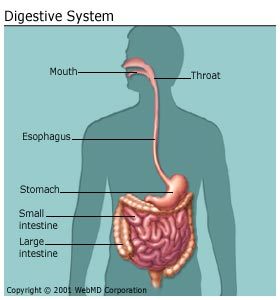
This is a example of........ 
a)
organ system
b)
cells
c)
organ
d)
tissue
22.
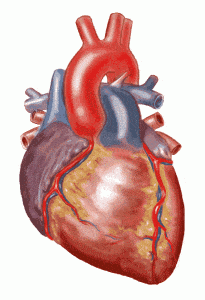
This is a example of ........
a)
cell
b)
organ system
c)
organ
d)
tissue
23.
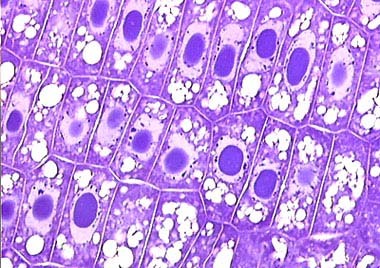
This is a example of ........
a)
cell
b)
tissue
c)
organ 
d)
organ system
24.
What is the body system that sends and recieves electrical signals from the brain?
a)
Skeletal System
b)
Nervous System
c)
Muscular System
d)
Digestive System
25.
What system allows motion in the body?
a)
Digestive System
b)
Stomach
c)
Musuclar System
d)
Veins 
26.
Which body system transports oxygen and nutrients through out the body?
a)
Muscular System
b)
Nervous System
c)
Digestive System
d)
Circulatory System
27.
What system breaks food down into energy for the body?
a)
Stomach
b)
Digestive System
c)
Respiratory system
d)
Lungs
28.
How does the digestive system work with all other systems?
a)
The digestvie system transports blood to all the other systems
b)
The digestive system puts oxygen into the body
c)
The digestive system gives the body energy and nutrients
d)
The digestive system allows the body to move
29.
How does the cardiovascular system and the respiratory system work together?
a)
The cardiovascular system transports oxygen around the body while the repiratory system gives the body oxygen
b)
The cardiovascular system makes cells while the respiratory system moves them where they are suppose to go.
c)
The cardiovascular system allows the body to have energy while the repiratory system makes cells
d)
The cardiovascular system transports nutrients around the body while the respiratory system brings oxygen into the body
30.
Which way will the water molecules move during osmosis?
a)
Out of the cell, so the cell shrinks.
b)
Out of the cell, so the cell swells.
c)
Into the cell, so the cell shrinks.
d)
Into the cell, so the cell swells.
31.
All the activities that are for life are called:
a)
homeostasis
b)
excretion
c)
metabolism
32.
All living things are made of
a)
cells.
b)
water.
c)
muscle.
d)
organs.
33.
All living things obtain and use
a)
cells.
b)
sunlight.
c)
energy.
d)
territory.
34.
All living things _______ and develop during their lifetime.
a)
eat
b)
run, swim, or fly
c)
hibernate
d)
grow
35.
Living things
a)
reproduce.
b)
divide.
c)
mutate.
d)
move from place to place.
36.
Living things sense and ___________ to their environment.
a)
grow
b)
reproduce
c)
respond
d)
move
37.
Living things need _________ for chemical reactions and cellular hydration.
a)
food
b)
sunlight
c)
water
d)
energy
38.
Living things need __________ for growth and activities.
a)
energy
b)
food
c)
water
d)
living space
39.
Living things need _________ to obtain needed resources and to reproduce.
a)
food
b)
water
c)
oxygen
d)
living space
40.

Which best describes all unicellular organisms?

a)

Every cell is round

b)

Every cell can make food.

c)

Every cell can move on its own.

d)

Every cell performs all life functions.

41.

Why do humans require many different types of cells to survive?

a)

Human cells are identical and work together to perform the same function.

b)

Human cells are specialized and work together to perform the same function.

c)

Human cells are identical and work independently to perform different functions.

d)

Human cells are specialized and work independently to perform different functions.

42.

How are single-celled organisms and multi-celled organisms similar?

a)

Both need food for energy and growth.

b)

Both have a skeletal system for support.

c)

Both require the interaction of many cells to survive.

d)

Both are able to carry out all life functions in only one cell.

43.

How are multi-celled and single-celled organisms different?

a)

Multi-celled organisms need energy to survive, while single-celled organisms need no energy to survive.

b)

Single-celled organisms can be seen without using a microscope, while multi-celled organisms are microscopic.

c)

Multi-celled organisms have large numbers of specialized cells to perform a variety of life functions, while single-celled organisms complete life functions with one cell.

d)

Single-celled organisms have large numbers of identical cells that all perform the same function, while multi-celled organisms have cells that are all different and perform different life functions.

44.
This type of cell needs a cell wall and chloroplasts
a)
Plant cell
b)
Animal Cell
c)
Bacteria
45.
Which organelle is in a plant cell but not in an animal cell?
a)
cytoplasm 
b)
chloroplast 
c)
mitochondrion
d)
cell membrane
46.
What type of cell has a defined nucleus and membrane bound organelles.
a)
Bacteria
b)
Prokaryote
c)
Eukaryote
d)
Archaeabacteria
47.

What type of cell(s) are eukaryotic?

a)

Plant Cell Only

b)

Plant and Animal Cells

c)

Animal Cells

48.
Which of the following helps plant cells remain rigid?
a)
nucleus
b)
chloroplasts
c)
central vacuole
d)
cell membrane
49.
What type of cell has a "small" vacuole?
a)
Plant Cell Only
b)
Both Plant and Animal Cells
c)
Animal Cells Only
50.
What type of cell(s) produce glucose/food?
a)
Plant Cells Only
b)
Both Plant and Animal Cells
c)
Animal Cells Only