
 Worksheets
Macromolecules
Total questions: 35
Worksheet time: 41mins
Name
Class
Date
1.
Lipids are made up of which of the following?
a)
glycerol and fatty acids
b)
glycerol and monolipids
c)
fatty acids and phosolipids
d)
amino acids and nucleotides
2.
Phospholipids are used in what biological structure?
a)
RNA
b)
DNA
c)
Cell membrane
d)
Cell wall
3.
What is the monomer of nucleic acids?
a)
Glycerol
b)
Monosaccharides
c)
Amino Acids
d)
Nucleotides
4.
What is the function of a carbohydrate?
a)
Stores energy
b)
Movement
c)
Stores genetic information
d)
Speeds up reactions
5.
This is one job proteins do NOT have in the body
a)
insulation
b)
structure for tissues and organs
c)
speed up chemical reactions
d)
transport things through cell membrane
6.
DNA and RNA are examples of...
a)
proteins
b)
nucleic acids
c)
carbohydrates
d)
lipids
7.
What is the function of nucleic acids?
a)
Stores energy
b)
Stores genetic information
c)
Movement
d)
Physical structure
8.
What is the monomer of nucleic acids?
a)
Glycerol
b)
Monosaccharides
c)
Amino Acids
d)
Nucleotides
9.
Most enzymes:
a)
speed up the chemical reaction
b)
have no effect on the rate of the chemical reaction
c)
slow the rate of the chemical reaction
d)
keep the rate of the chemical reaction the same
10.
What suffix (word ending) is used in the names of most carbohydrates?
a)
-ase
b)
-nic
c)
-ose
d)
-yme
11.
All organic compounds contain the element
a)
carbon
b)
nitrogen
c)
phosphorus
d)
sulfur
12.
Carbohydrates are made of...
a)
C H O
b)
C H O N
c)
C H O N P
d)
C H O N S
13.

Which macromolecule is shown?
a)
lipid
b)
protein
c)
nucleic acid
d)
carbohydrate
14.

Which macromolecule is shown?
a)
lipid
b)
protein
c)
nucleic acid
d)
carbohydrate
15.

Which macromolecule is shown?
a)
lipid
b)
protein
c)
nucleic acid
d)
carbohydrate
16.
Why are lipids insoluble in water?
a)
lipids are polar
b)
lipids are non-polar
c)
lipids have a negative charge
d)
lipids are building blocks of protiens
17.

Which major macromolecule is being represented in this image?
a)
carbohydrate
b)
lipid
c)
protein
d)
nucleic acid
18.
cellulose, glycogen, starch, or chitin
a)
carbohydrates
b)
lipids
c)
proteins
d)
nucleic acid
19.
Nucleic Acids contain which elements?
a)
Hydrogen, Oxygen, Carbon, Nitrogen and Phosphorous
b)
Hydrogen, Oxygen and Carbon
c)
Hydrogen, Carbon and Nitrogen
d)
Hydrogen, Oxygen, Carbon and Nitrogen
20.

What is structure A?
a)
Substrate
b)
Active site
c)
Enzyme
d)
Products
21.

What is structure C?
a)
Substrate
b)
Active site
c)
Enzyme
d)
Products
22.
What is structure C?
a)
Substrate
b)
Active site
c)
Enzyme
d)
Products
23.

What is structure E, F, G?
a)
Substrate
b)
Active site
c)
Enzyme
d)
Products
24.

The graph shows how enzymes affect reactions in cells. Which statement best summarizes the information shown in the graph?
a)
Enzymes increase the energy of the reactants.
b)
Enzymes decrease the energy level of the products.
c)
Enzyme decrease the activation energy of the reaction.
d)
Enzymes reverse the direction of the reaction.
25.
Which chemical is classified as an enzyme?
a)
Galactose
b)
Lipid
c)
Protease
d)
Manganese dioxide
26.
What is another name for enzymes?
a)
chemical catalyst
b)
microorganism
c)
biological catalyst
d)
catalyst
27.
If you are testing for the effect of enzyme concentration on rate of reaction, what IS NOT a control variable?
a)
type of enzyme
b)
enzyme concentration
c)
concentration of substrate
d)
Type of substrate
28.
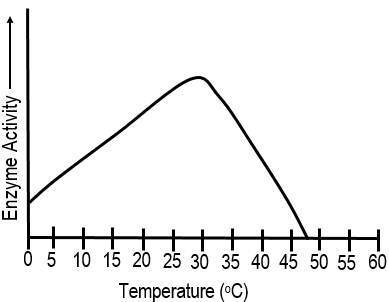
Based on the graph, what temperature does this enzyme work best?
a)
15 C
b)
40 C
c)
30 C
29.

Most enzymes have the ending:
a)
-ase
b)
-ose
c)
-ic acid
d)
-ate
30.
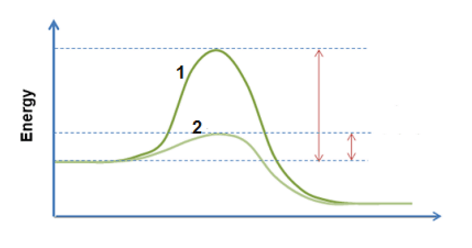
Which line represents an enzyme-catalyzed reaction?
a)
Line 1
b)
Line 2
31.
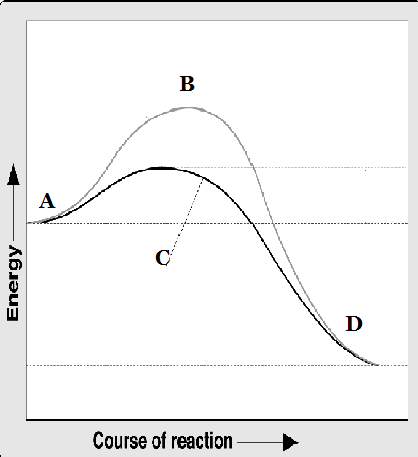
The portion labeled "B" represents the
a)
reaction with enzyme
b)
reaction without enzyme
c)
reactants
d)
products
32.
The 3 categories of carbohydrates are:
a)
Monosaccharide, disaccharide, polysaccharide
b)
glucose, fructose, galatose
c)
starch, cellulose, chitin
d)
There are no categories of carbohydrates
33.

What type of carbohydrate is this?
a)
polysaccharide
b)
disaccharide
c)
monosaccharide
d)
it isn't a carbohydrate
34.
The digestion of sucrose (table sugar) results in what two monosaccharides?
a)
Fructose and glucose
b)
Maltose and glucose
c)
Glucose and galactose
d)
Galactose and fructose
35.

Which of the following elements does a Nucleic Acid have that a Carbohydrate and Lipid do not?
a)
Carbon
b)
Oxygen
c)
Hydrogen
d)
Nitrogen
100 %

