
 Worksheets
Chapter 12 Molecular Genetics Comprehensive Review
Total questions: 50
Worksheet time: 56mins
Name
Class
Date
1.

Which of the following best describes a DNA molecule?
a)
double helix
b)
contains ribose
c)
made of amino acids
d)
contains Uracil
2.
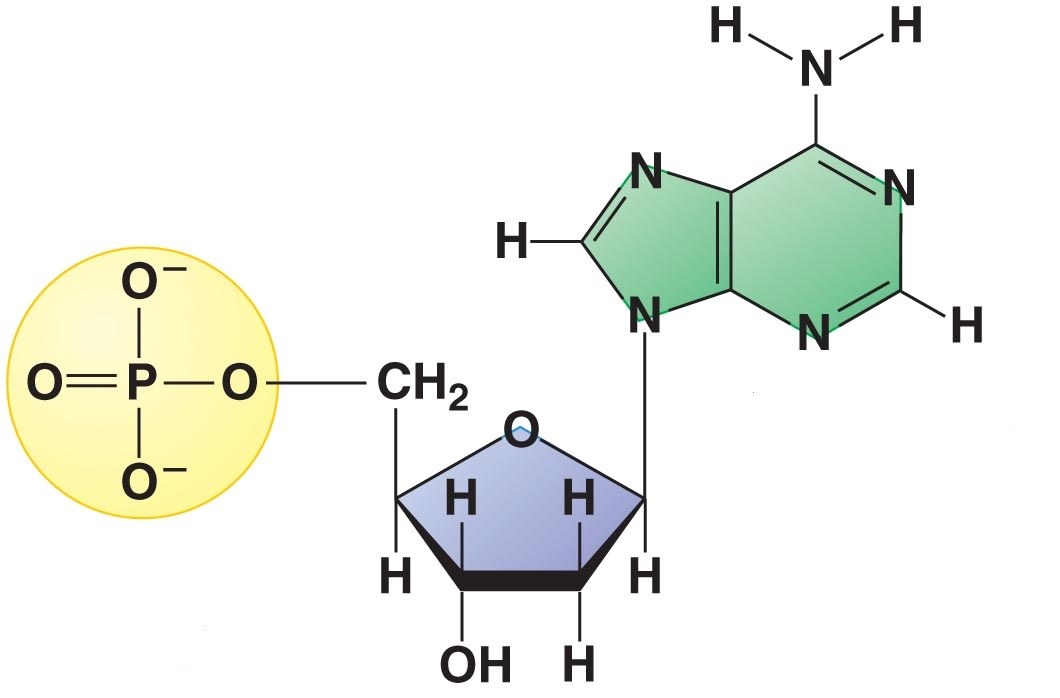
Name this structure
a)
double helix
b)
nucelotide
c)
twisted ladder
d)
hydrogen bond
3.
Which shows the correct complementary base pairing for DNA?
a)
C-A, T-G
b)
A-G, C-T
c)
C-G, U-A
d)
T-A, G-C
4.

In a molecule of double-stranded DNA, the amount of Adenine present is always equal to the amount of
a)
cytosine
b)
guanine
c)
thymine
d)
uracil
5.
DNA polymerase is a(n)
a)
lipid
b)
enzyme
c)
sugar
d)
starch
6.
What does DNA stand for?
a)
Deoxyribonucleic acid
b)
Denitrogenous acid
c)
Deribonucleic acid
d)
Diribonucleic acid
7.

What determines the code, or information, of a DNA molecule?
a)
the shape (structure) of the nitrogen bases
b)
the order (sequence) of the nitrogen bases
c)
the color of the nitrogen bases
d)
the frequency (number) of nitrogen bases
8.
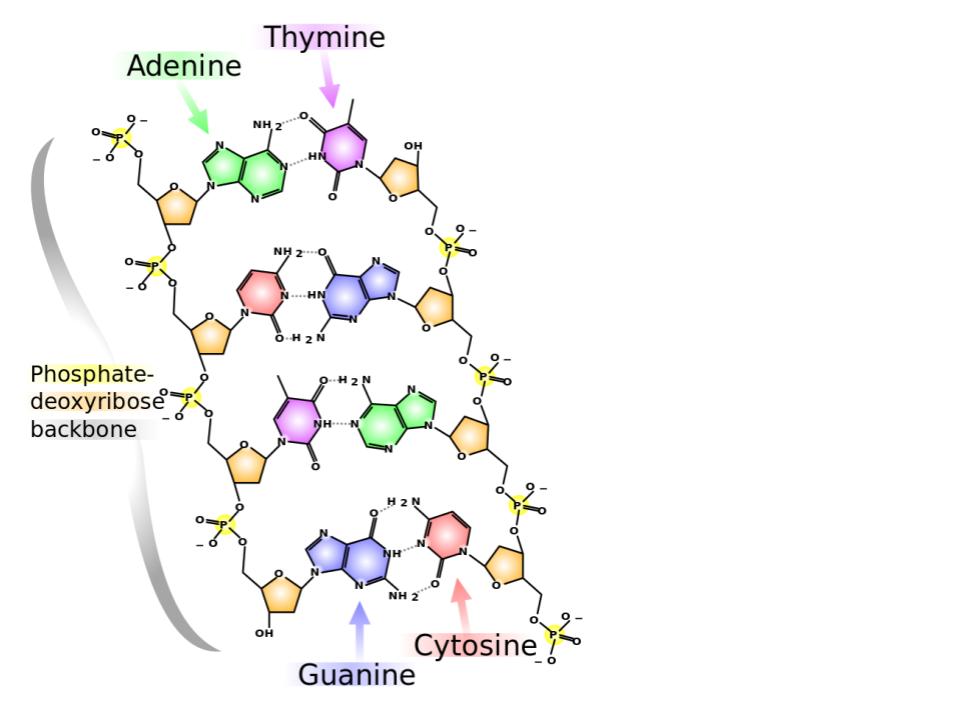
The two strands of DNA are held together by:
a)
Hydrogen Bonds
b)
Phosphodiester Bonds
c)
Glycolsyl Bonds
d)
Glycosidic Linkages
9.

The term used to describe DNA Replication is:
a)
Semi-Conservative
b)
Conservative
c)
AntiParallel
d)
Dispersive
10.
What is the complement to the DNA strand below:
5'-ATGCCAT-3'
5'-ATGCCAT-3'
a)
5'-TACGGTA-3'
b)
3'-TACGGTA-5'
c)
3'-ATGGCAT-5'
d)
5'-ATGGCAT-3'
11.
Which 2 molecules form the sides (backbone) of the DNA ladder?
a)
deoxyribose sugar and adenine
b)
deoxyribose sugar and a hydrogen bond
c)
deoxyribose sugar and the nucleus
d)
deoxyribose sugar and phosphate
12.

In Erwin Chargaff's lab we were counting the different types of molecules that made up DNA. Which is true?
a)
The number of S's = the number of P's
b)
The number of A's = the number of G's
c)
The number of G's = the number of P's
d)
The number of S's = the number of T's
13.

For what reason does DNA copy itself?
a)
to replace worn out DNA
b)
so cells can divide
c)
to export DNA to other parts of the body
d)
more DNA is better
14.
In what phase of the cell cycle does DNA replication take place?
a)
G1
b)
S
c)
G2
d)
M
15.

This image shows that DNA Replication is _______.
a)
Conservative
b)
Semiconservative
c)
Dispersive
d)
Spontaneous
16.
Seals the Okazaki fragments together
a)
DNA Polymerase
b)
ligase
c)
helicase
d)
primase
17.
what does tRNA do?
a)
carry info from genes to ribosomes
b)
carry amino acids to ribosomes
c)
help with RNA splicing
d)
make up ribosomes
18.
what does rRNA do?
a)
carry info from genes to ribosomes
b)
carry amino acids to ribosomes
c)
help with RNA splicing
d)
make up ribosomes
19.
Which process is used to make mRNA from the DNA in the nucleus?
a)
transcription
b)
translation
c)
replication
20.
In DNA replication, which enzyme is responsible for adding an RNA primer, telling DNA polymerase where to go?
a)
helicase
b)
primase
c)
ligase
d)
polymerase
21.

What process does this picture show?
a)
Translation
b)
Replication
c)
Transcription
22.

Which phase of which process does this picture show?
a)
Transcription
b)
Translation
c)
Replication
23.
A segments of DNA that seem to be 'junk' DNA and must be removed from genetic code before being used to make protein.
a)
Exon
b)
Intron
c)
q-arm
d)
Gene
24.
Segments of DNA that DO NOT contain any 'junk regions'. These segments will be used to code for proteins.
a)
Exon
b)
Intron
c)
q-arm
d)
Gene
25.
Every three bases on tRNA are called...
a)
genes
b)
codons
c)
anti-codons
d)
base pairs
26.
Codons are found on...
a)
mRNA
b)
tRNA
c)
rRNA
d)
DNA
27.
Any change in the sequence of DNA is...
a)
transgenic shift
b)
Single Genotype
c)
Monohybrid Trait
d)
Mutation
28.

Transcription is a process that in eukaryotic cells takes place in the:
a)
Nucleus
b)
Cytoplasm
c)
Golgi Apparatus
d)
Rough E.R.
29.

What is the RNA synthesized from a section of DNA with the code: GATTACA ?
a)
CUAAUGU
b)
GATTACA
c)
GAUUCA
d)
CTAATGA
30.

The enzyme that produces RNA in Transcription is called
a)
RNA Polymerase
b)
DNA Polymerase
c)
Transcriptase
d)
RNA Intrase
31.

When the Ribosome reaches ________________ the process of translation stops
a)
Stop Codon
b)
Okazaki Fragment
c)
Terminator
d)
taq Polymerase
32.
Which of these is the Central Dogma of Biology in the correct order?
a)
DNA --> mRNA --> polypeptide chain
b)
DNA --> polypeptide chain --> mRNA
c)
mRNA --> DNA --> polypeptide chain
d)
polypeptide chain --> DNA --> mRNA
33.
Are all mutations bad?
a)
Yes
b)
No
34.
Original: ATC CAT
Mutation: ATC GCAT
What mutation occurred?
Mutation: ATC GCAT
What mutation occurred?
a)
deletion
b)
insertion
c)
silent
d)
transverse
35.
What happens in Inversion?
a)
Its repeated
b)
They all get deleted
c)
A section of the chromosome gets flipped
d)
they start to cross-over
36.
What causes mutations?
a)
Mistakes in replication or environmental substances
b)
The amino acids
c)
Passed down by genetics
d)
It's how your born
37.
Where do mutations occur?
a)
DNA and RNA
b)
DNA
c)
RNA
d)
mRNA and tRNA
38.
What happens in Translocation?
a)
They all live normaly
b)
They all repeat each other
c)
Different chromosomes cross-over with each other
d)
Something happens
39.
Why is the order of amino acids so important?
a)
The order of amino acids dictates what shape the protein will fold into.
b)
It is not important. The protein folding chamber will force the protein to fold into the correct shape.
40.
ATTTGAGCC- Original
ATTGAGCC - Mutated
The example above is an example of a
ATTGAGCC - Mutated
The example above is an example of a
a)
Insertion- Frameshift
b)
Deletion- Substitution
c)
Deletion -Frameshift
d)
All of the above
41.

This diagram can be used to specify amino acid sequences in polypeptides. Which sequence of the genetic code would produce a polypeptide with the amino acid sequence Ala-Arg-Pro?
a)
GCAAGACCU
b)
GACCUGCUC
c)
GCCAGUCCG
d)
ACGGCGUCC
42.

Which change below would result in a different Amino Acid?
3'-GCT-5'
3'-GCT-5'
a)
GTT
b)
TCT
c)
TCC
d)
GCA
43.

What is a Gene?
a)
A segment of RNA that encodes for a protein
b)
A chromosome
c)
A segment of DNA that encodes for a protein
d)
Your genome
44.
Identify the DELETION mutation from the following DNA sequence:
ATG CCA AAT
ATG CCA AAT
a)
ATG TCA AAT
b)
ATG CCT AAA T
c)
ATC CA AT
d)
ATG CCA AAT
45.
If Chargaff found that a sample of DNA has 20% ADENINE, how much GUANINE would he have determined to be there?
a)
30%
b)
20%
c)
80%
d)
60%
46.
Rosalind Franklin's "Photo 51" allowed Watson and Crick to determine the ___ of DNA.
a)
Shape
b)
Backbone
c)
Nitrogen bases
d)
Hydrogen bonds
47.
Griffith discovered that
a)
DNA is different than RNA.
b)
adenine = thymine.
c)
bacteria can transfer DNA.
d)
DNA is the genetic molecule.
48.

Who was responsible for the experiment depicted by the image/data table?
a)
Oswald Avery, et. al.
b)
Watson and Crick
c)
Erwin Chargaff
d)
Frederick Griffith
49.

Who was responsible for the model shown?
a)
Oswald Avery, et. al.
b)
Watson and Crick
c)
Erwin Chargaff
d)
Linus Pauling
50.

Who was responsible for the experiment depicted by the image/data table?
a)
Oswald Avery, et. al.
b)
Watson and Crick
c)
Erwin Chargaff
d)
Rosalind Franklin
100 %

